Best Of
Re: Size Transfer Pump to Flush a Small Hydronic Loop
a small 1/2 hr transfer even a small sump pump will flow that
If it is just an ocassional use get a small plastic sump pump pump.
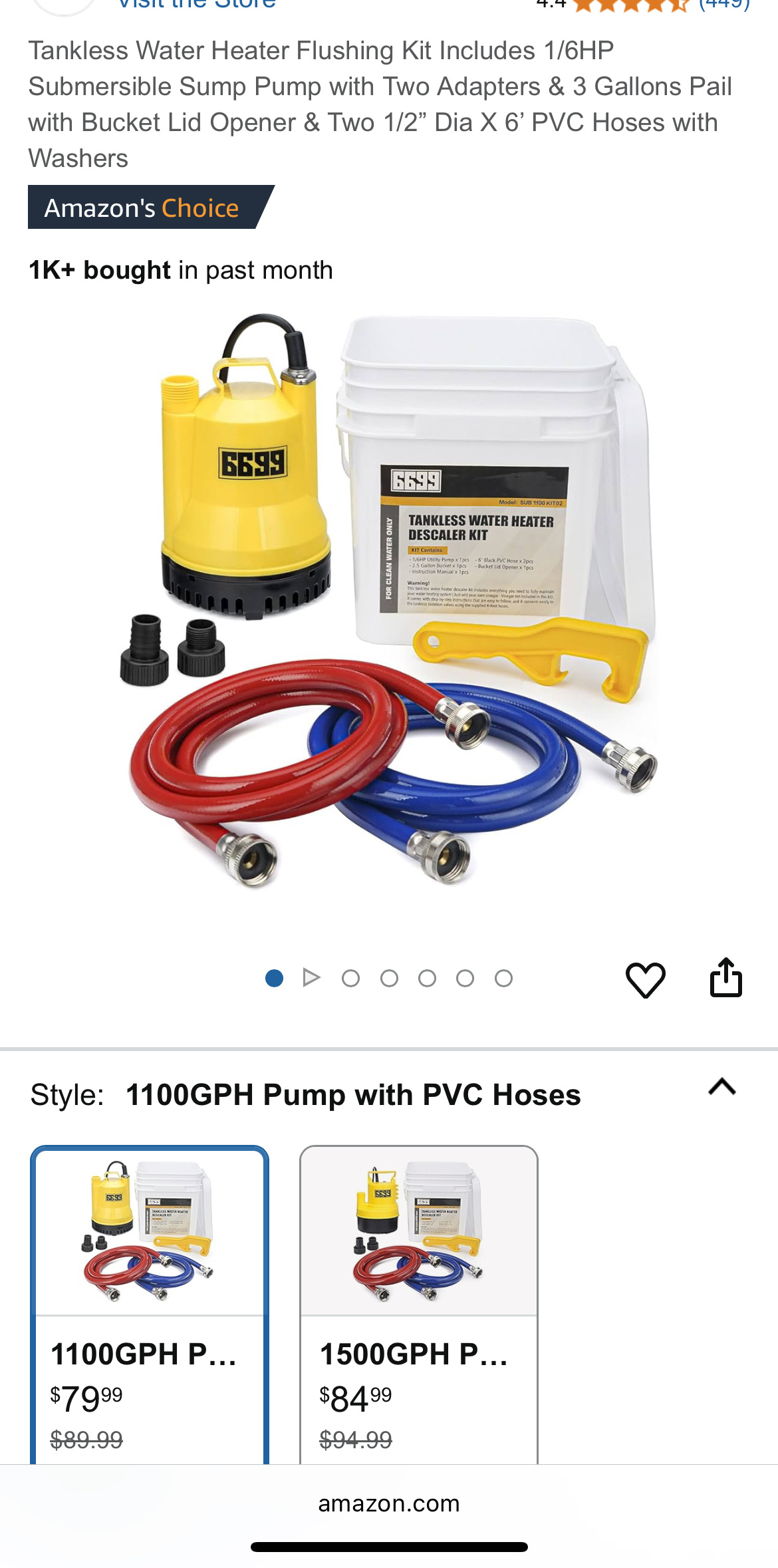
If you have a scaling concern get a tankless water heater kit, pump, cleaner, hoses, and bucket, around 80 bucks online
 hot_rod
Re: Material price increases due to govermental tarrifs
I'll believe that when I see it. A few of the Caleffi products bear a striking resemblance to others coming from Asia, but it's hard to say. Then there are other items like Rifeng and Bluefin that we all know come from China, without a significant price hike. Webstone is simply greed in my opinion as they've got the market cornered with certain valves and can charge whatever they want, but the others I think for the most part are simply catching up to the 15+% inflation we had not so long ago. It looks bad now but I can see quite a few items that I paid the same for a month ago as I did 3 years ago. For example we have Taco, an "American" company, charging 35% more for zone controls than they did a year ago but that price was stagnant for 2-3 years prior.
 GroundUp
Re: Single Pipe Steam Boiler Replacement & Piping (Unusual header?) Advice for Amateur
The near boiler piping is very wrong. it might happen to work ok now but it should be done correctly with the new boiler.
The header should be in the order of:
risers from boiler
risers from header to mains
equalizer
The header and risers from boiler size should be at minimum the size specified in the manual
Each main should connect separately to the header. If a main is counterflow it needs a drip down to below the water line before it connects to the header. each drip needs to have its own return connection below the water line.
The header shouldn't reduce in size on the horizontal so it doesn't trap water.
Run away from anyone that says to put in a boiler bigger than the connected edr. The nameplate edr has an extra 30% pickup factor subtracted from it so it is probably oversized a bit even if it matches the nameplate. Do not use anyone that suggests you should go bigger than the connected edr beyond what is the closest size.
If you have a main that is filling from a return, you have to figure out why that is possible, most likely returns from different mains that are connected above the water line. The returns from different mains must connect together below the water line. The most common reason for this is that a connection that was below the water line became above the water line when a boiler with a lower water line was installed. Also possible that whoever installed that boiler didn't understand why returns at the boiler needed to drop below the water line before connecting. The steam from the other main will come in to the main at the vent and close it, preventing the main from venting properly. It will eventually vent through the radiators but it will be slow to heat.
Your near boiler piping looks like they just hooked up whatever was closest wherever they could and didn't know what they are doing.
 mattmia2
Re: An off-topic waste of your time (but amusing)....
I logged over a thousand miles in the last ten days & am so tied of sitting that I'm going to have the kids doing lawn work all day. Also, DC traffic sucks.
Protip: if you're driving with two different GPSes, make sure they have the same destination…
 ratio
ratio
Re: Single Pipe Steam Boiler Replacement & Piping (Unusual header?) Advice for Amateur
Suggest you get @Mad Dog_2 to consult. PM him

Re: Which indirect water heater to buy or not?
Replace it with a standalone water heater and let your boiler rest (and not heat your building) during the summer.

Re: What was the best MacGuyver moment you actually saw on a job site?
Yeah a fuse is less costly except when you don't have one.
The utility wires coming into your house overhead have fuses at the transformers. Underground utility wires have no fuses. The wire is the fuse let it Burn!!
@PC7060 It didn't leak so we never went back. This was a 26 story high rise and we were not on the top floor (i think we were on floor 12 or 14 so there was a ton of pressure on the system. They wouldn't allow another shut down to drain and drill or anything.
We installed the biggest plate and frame HX I ever saw. It was too heavy for the elevator so we had to purchase it knocked down and pay Alfa Laval to send someone up to supervise the assembly
Re: Boiler Header Manifold
i'd be more concerned about the pipe and the threads which aren't mutually exclusive
mattmia2
Re: Confused by basement runs in school 2 pipe system
I have a few copies of these booklets left. The pages are composed of reduced copies of the pages Nash last published in their heating pump engineering data book in 1966. We printed a run of these booklets back in 1992 to help promote our Type CLS vacuum heating pumps which we introduced at that time.
We still offer these latest design Type CLS vacuum units.
The pages I post here from time to time are full size copies of these pages.
In this particular case, I don't believe the problem of the induced vacuum caused by condensing steam in the boiler resulting in the boiler being flooded by atmospheric pressure pushing feed water from the vented boiler feed tank is covered in these pages.
The solution to this problem is to remove the swing check valve on the discharge of the boiler feed pump(s) and substitute a motorized or other type of normally closed positive closing valve.
This positive closing discharge valve needs to be controlled by the boiler water level controls. When the boiler needs to take on feed water, the boiler feed pump is energized and the valve should open. When the boiler water level is satisfied, the boiler feed pump is de-energized and the motorized valve should close.
When the motorized boiler feed valve is closed, atmospheric pressure can't push feed water from the vented boiler feed tank into the boiler even if the boiler is at a vacuum, i.e. a pressure lower than atmospheric.
A simple swing check valve won't work since it only stops flow in one direction, away from the boiler. In this case we need to control flow in both directions, toward and away from the boiler.
 Pumpguy