Best Of
Re: near toilet floor constantly wet
a bell hanger's bit is just a long twist drill, it is maybe 18" long or so. the hook is just a big pick or hook with a screwdriver handle on it. they sell them for releasing radiator hoses but there probably are other ones out there too.
 mattmia2
Re: The 20 second challenge: What's wrong with the boiler?
Hi @RayWohlfarth , I'm just a water heater guy and know next to nothing about boilers. However, what you said about safety and letting the owner know should you see something unsafe is so important. I couldn't sleep if I didn't alert people to the dangers. For fun, here's a water heater I came across. No, it's not AI! 🤪
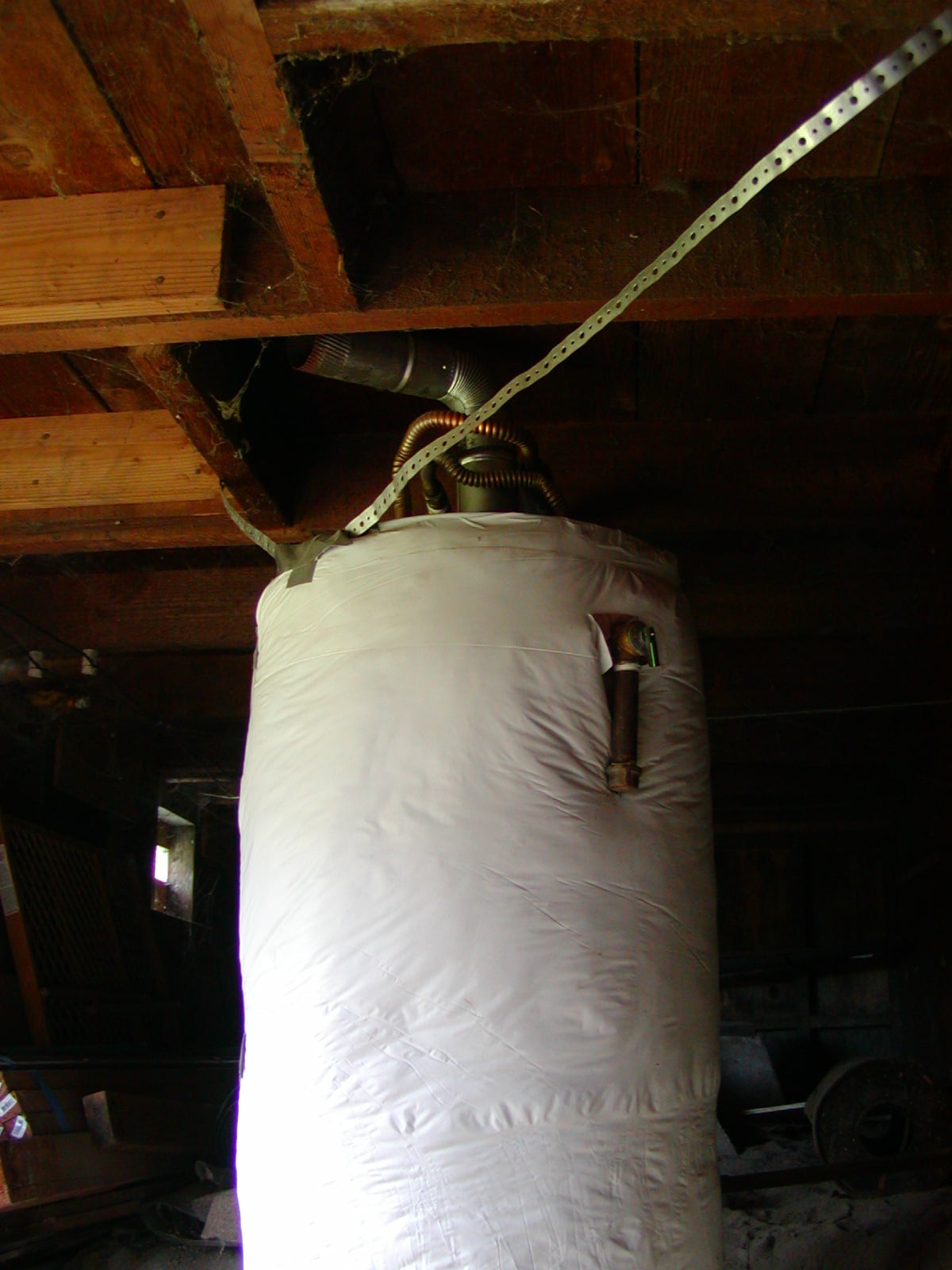
Yours, Larry

Re: Dryer vent duct
You seriously need a professional level II inspection. So much going on I can see from here. The terra cotta flue tile is severely eroded and does not extend the requisite 2-4" above the crown. The crown appears to be either a mastic gobbed over the crown or rich Ordinary Portland Cement (OPC) mortar crown wash instead of a cast concrete crown with a 2" overhand that has a reglet but into the overhang forming a drip edge 1.5" from the face of the chimney. The flue has to be accessible- this is entombed by the OPC mortar/ mastic crown mess.
The cleanout is for a masonry chimney. If you install a listed liner, the listing applies. I'm not aware of any mfr. that requires a tee with a cleanout for liquid or gaseous fuels. Wood/ pellet/ coal solid fuels typically DO require a cleanout 6-12" below the breaching or thimble. This provides a convenient point of inspection, a cleanout port, and a trash can to collect solid flue deposits and previous clay flue liner and mortar. Since metallic liners do not slough off and burning liquid or gaseous fuels does not result in significant flue gas deposits requiring intermediate sweeping to keep the flue open, they don't need a cleanout. The IRC Ch. 24 discussing sizing liners by NOT requiring the single broad radius bend at the base of the liner (meaning no tee or cleanout).
I quote the IRC and NFPA 211. If your local code is more restrictive, you follow it.

Re: My SteamPunk boiler
My point is: let’s not lose sight of the forest because of the trees
that boilers shot!
 pecmsg
Re: Suck start my boiler
thats not a quirk. those units are made to drain condensate, if its not draining condensate you need to service it, if its leaking from the water side to fire side its shot. you should be able to take a hose to the fire side after cleaning and it should drain free and clear out the condensate drain, if it starts backing up then its not yet clean,
 GGross
Re: Suck start my boiler
That's not a fix. There should never be water in the burner, ever, for any reason. Either the HX is leaking and spraying the burner, or the HX is plugged up so badly that the condensate can't drain (very common with the UFT's Kiturami HX running low temp radiant); maybe even both.
 GroundUp
Re: Buderus G125 Blue Flame Oil Boiler Need Help in Western Ma ASAP
The best response may be to ditch the blue flame and put 'regular (spec'd by Buderus) burner that mostly anyone can work on it.
But where you are there are still plenty of competent techs up there that can work on them.
When someone tells you "they are booked out for months", they don't want your business, nor should they get it.

Re: Draining residential boiler in spring
I doubt that you'll find much agreement on a "best" method. I prefer to leave it alone — most of the oxygen is boiled out of the water, and the interior of the piping and radiators will be at or close to 100% relative humidity. Some people like to fill the boiler higher, on the theory that that moves any corrosion which might happen at the water level to another area of the boiler. In that case, though, it is essential that the boiler be brought to full steam and the system filled with steam and then shut down — again to drive as much oxygen off as possible.
I personally don't see much point in draining the boiler it introduces air to do that, and the boiler will be wet anyway.

Re: Taco needs to create an animation of how the 570 series zone valve works.
They are a bit confusing at first — I certainly was anyway! But the secret is that the three terminals are really two completely different circuits. One (1 and 2) powers the zone valve to open when it gets power — from somewhere. The other 2 and 3 — is a simple limit switch which closes when the valve is open. Apply power to 1 and 2, and the valve motor is energized and the valve opens. When it is opened, the limit switch closes between 2 and 3 and you can use that closure for whatever.
Now there is a ringer in the deck: terminal 2 is common to two circuits. Whatever is sending the signal to open the valve is one circuit. Whatever the valve is telling to operate is the other.
Those circuits must be independent. In theory, under certain miswiring conditions, it is possible to set them up so that they can short out, but if both the independent 24 VAC circuits are intact and NOT GROUNDED this won't happen.