Best Of
Re: Transformer/Thermostat
Ah… if you are checking at the service entrance panel…. more than a volt or two difference between the two legs and the neutral is a problem. Ditto for the busses in the switchgear. But if you have a heavy load on one leg but not the other, you might see as much as a five volt difference out in the far reaches at a remote panel, such as a barn a couple of hundred feet away…
A heavy load on one side may drop the voltage at the load a few volts, as well — but it shouldn't change the voltage balance at the panel.

Re: Transformer/Thermostat
I believe that @pecmsg wants to be sure you are measuring the 18 VAC. at the proper terminals. LIKE THIS:
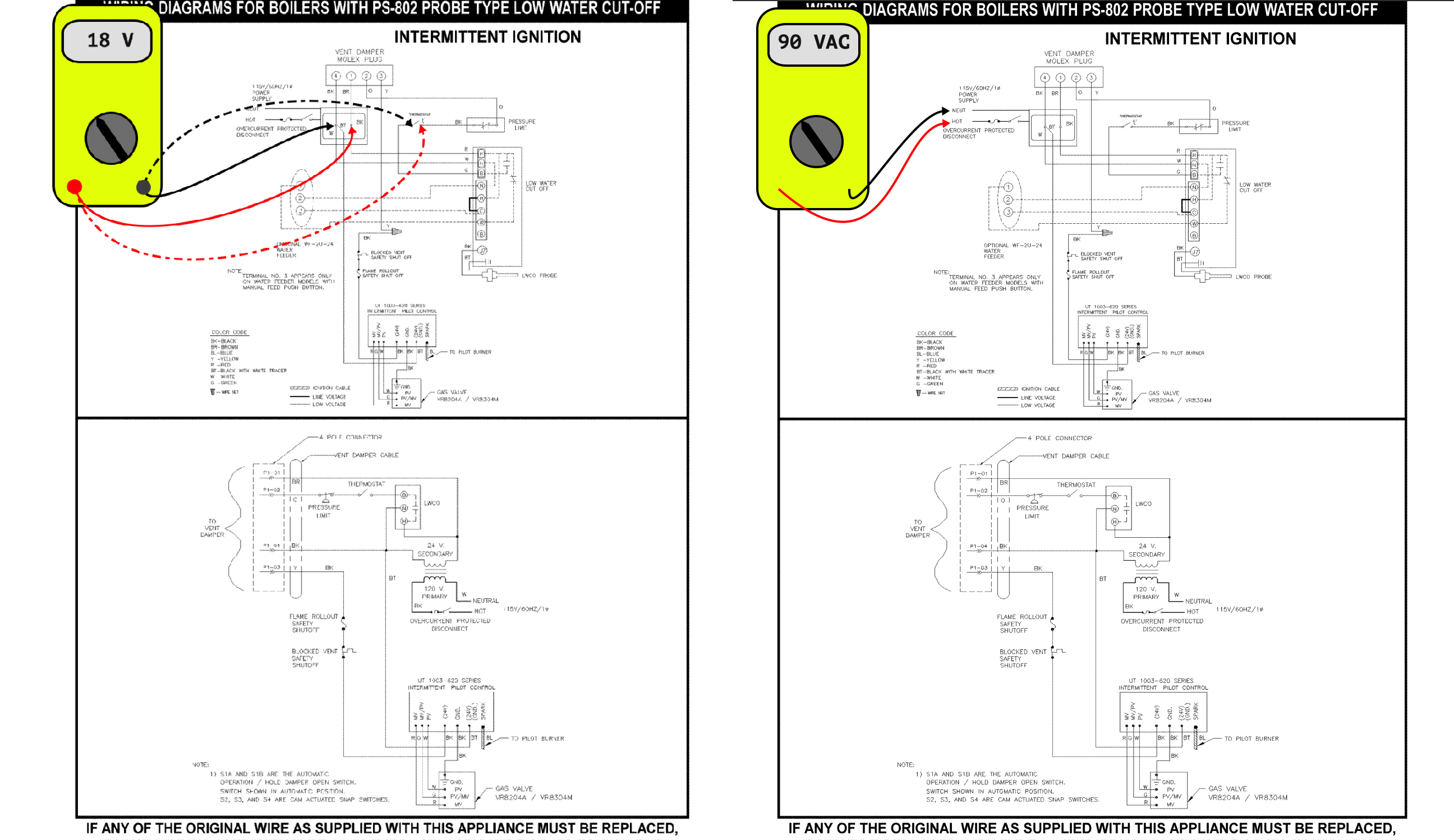
On the left diagram you should be checking the transformer R and C terminals, with the thermostat calling for heat (solid leads) The thermostat should be checked at the thermostat location with the thermostat not calling for heat to get the voltage reading using the R and W terminals at the thermostat.
Some transformers on some steam boilers have up to 5 terminals. You always want to check at R and C
Also did you check the incoming voltage to the transformer? Right diagram if that transformer gets less than 120 VAC coming in then it will hhave less than 24 VAC coming out.


Re: Preferred gauge glass cutter
Yes you can get HP gauge glass, and it is much thicker

Re: Is this at risk of freezing?

Re: Boiler plumbing questions
Typical residential water heaters are in the 30- 40,000 input btu/hr range. So not much horsepower from one of those. It could be enough to keep pipes from freezing, but not much heating on a cold day.
High output tanks run up around 75,000, commercial tanks 500.000 or more.
The only ways to know for sure would be a heat load number for the space, or trial and error.
 hot_rod

Re: Stupid Little Bracket
This comment's insinuation was disrespectful and not helpful. I've removed it. Please follow site rules and remember that we are all here to learn and not to fight with one another.
-Andrew
