Best Of
Re: Baffled: Weil-Mclain startup and delay on break relay
Although I did see it in that YouTube video that the person in the video complained the timer was hooked up backwards (with no real demonstration and resolution in the video, I think there was other issues), I would say in this case it does not matter. IMO it does not matter which way terminals 1 and 3 are connected, for two reasons, first it is a series circuit (it's only a two wire device), also it is an AC series circuit. Secondly (at least with the ICM203F) the terminals 1 and 3 immediately goes through a bridge rectifier circuit inside the timer and it does not care either way about terminals 1 and 3.
Your connection details may be helpful to others if they have never worked with relays and/or this type of timer before.
Thanks.
 109A_5
Re: Main vent making loud noises
I would say that is not normal, my Big Mouth is petty quiet last I checked it. Maybe the 'O' ring needs replacing.
109A_5
Re: troubleshooting milwaukee press tool 2763-20
@HydronicMike a little of all the above. low cycles, been rained on lightly occasionally. really seems like a physical and not electrical issue. haven't dropped it from height. its tipped over once or twice but not off a bench onto the floor. case is in decent shape. not cracked.
interesting that you find ridgid has better response on service. i got this one because i liked the form factor. i think ridgid has a straight one now. i can't say i'm unsatisfied . this is prob. going on 10 years old, but low cycles. maybe the only thing i'm unsatisfied about is I don't like being sidelined from working on my own tools. if i were able to query for faults and it was unsure on calibration or I could check and find it out of calibration then i could probably get a quote out of milwaukee and send it in. but they give a range $700 to 1400. that's a wide range. i could see at the low end, forget it at the high end.

Re: T87F anticipator appears faulty
Does he mean the coil that holds the mercury switch?

Re: A2W heat pump as primer for 4 bank hydrothermo ( 864,000 btu )
Assumption is that COP of 4 would mean 50% cost of the BTU from heat pump.
Swapping 864,000 BTUs over to an a2w heat pump would require more land space, more money and more electricity than the building currently has available. Ideally we'd start with something and see how it goes before 100% committing. Too often projects are contemplated in an all or nothing scenario resulting in nothing.
We have our domestic preheating with 3 HPWTs before final heating with a gas hot water tank. The proterra units are each 4200 BTU. The gas hwt is 385,000 BTU. While the HPWTs aren't providing a huge portion of the hot water it did enable us to reduce from 2x 385,000 BTU tanks to one and leave the redundant one as backup. The setup likely was overkill to start with but the hybrid solution has saved ~10% off the overall gas bill with minimal impact on the electric side.
In order to justify the project I'd want to see making the money for the installation back in 10-15 years (ignoring interest). I can't see a full swap ever paying back so a full swap point could only happen once the current hydrotherm hits end of life. 1985 cast iron - it might be around for another 25 years? The heat pump tech is still in flux so it is nice to start small and realize the improvements in the technology rather than bleed out on the cutting edge.
The HPWTs are an easy win as they are used year round whereas the boiler is only used Oct-April and I think the heat pumps will generally have a hard time heating water at 127F a lot higher before the boiler while maintaining a high COP.
My sense is that given the project requirements a heat pump can't work for this application but I thought I'd post and get a sense from the experts. Can assume 46F+ as air temperature during the majority of the heating season.
 walnut

Re: Radiator vents sucking in air at end of cycle
I didn't come up with that one. Someone else did but I have remembered that for so long I can't remember where it came from.
But you can tell someone (1700 x) but you can visualize that as well as the "28" Think it was in a book somewhere

Re: DIY Boiler Monitor Project -- Useful?
Here is the link to Zoning Made Easy. I believe I have sent it to you before. After reading this book a few times, you can try to answer these questions from the Zoning Made Easy Workbook. This reinforces what you have learned by reading this book.
I used it as the textbook for the one day seminar I used to teach for the Eastern Heating Cooling Council.

Re: Radiator vents sucking in air at end of cycle
@ethicalpaul thanks very much for linking that!
 abea17
Re: Cross over heat transfer
Air comes out of solution best at the hottest point, so as a general recommendation air purgers go at the supply. But that is not what is causing your issues.
Looks like some work was done here? A check added to the bypass?? Someone shooting the parts cannon at it?
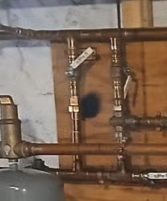
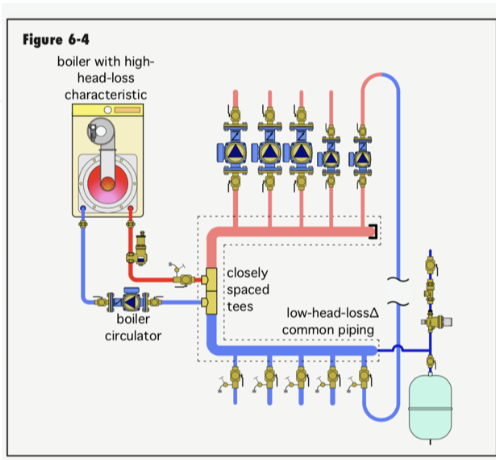
Think of a primary loop as a conveyer belt on your system.
The boiler loads heat into that conveyer. To take a portion of heat out you tap into the conveyer belt.
By using two tees close together you create a hydraulic separation between the conveyer and the zone. So the individual zones just pull off the conveyer what they need. And yes, in your example each set of tees down the line receives lower water temperature.
With low temperature zones that is not a concern. You have mixing valves to adjust the temperature you need.
I don't know how deep you want to dive into theory?
This issue 19 we took the most common mistakes made in piping and tried to explain and show the fix. Many are missed attempts at primary secondary. I think you will find your exact piping in here, sorry.
Another good read by our host
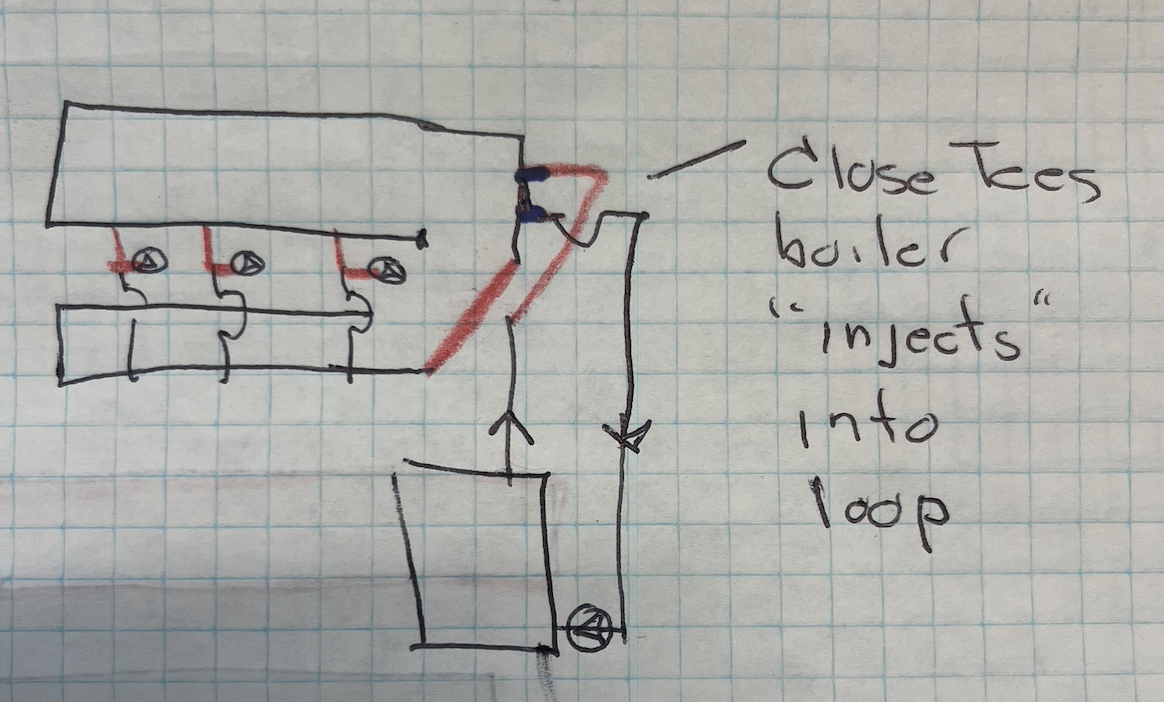
Here is a way. hand sketch, I think you could correct this with the least amount of repiping.
Connect the upper red line with the lower blue line, red line shown. Now you have you zone loop.
Next the boiler needs to feed a supply of hot into that loop, but also a return back. Closely spaced tees MAKE a primary secondary piping system.
Now system and pumps are isolated from one another. Boiler pump no longer interferes with the zone flow, they are isolated, hydraulically speaking.
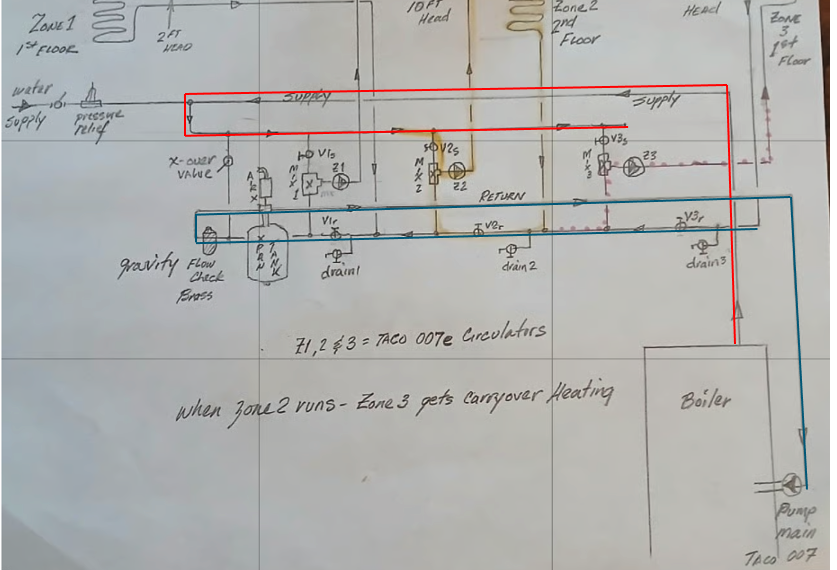
It will be a messy version of this "horseshoe" piping method.
 hot_rod