Best Of
Re: Williamson GSA-100 Steam Boiler Tappings
so i just put in a GSA 125 and it had left and right return (2.5" on the 125) but only left steam outlet (3" on the 125). IIRC the WM is tapped for a right steam outlet as well and that is another point of differentiation.

Re: Heating and Cooling Options for 1850s Greek Revival New York
From a relatively educated homeowner's point of view, I would do the following:
- Definitely convert to natural gas if you can, as you have stated is your plan. This is for me a no-brainer regardless of the boiler or furnace technology you choose. Yank out those oil tanks before they fail and cause an environmental disaster in your basement.
- Keep the hot water radiators. Hot water radiant is a great heating technology. You will be able to re-use the existing piping to the radiators, or if any needs to be replaced, it can be done cheaply and simply with oxygen-barrier pex piping
- Avoid a "high efficiency" boiler. The higher up-front cost, greatly increased maintenance requirements, and shorter lifetime do not make up for the slightly higher efficiency
- Install a cast-iron atmospheric gas boiler. It is dead simple, everyone knows how to keep it running, it requires nearly no maintenance, and it will last for 30 years
- Get a new standalone water heater. Do not fall for suggestions that would use the boiler to heat your domestic hot water. These are complex and require a lot of up-front material and labor cost for no measurable gain, and they "tie" your hot water to your boiler so that if the boiler fails you also lose hot water. You can choose a natural gas one, or my advice is to strongly consider a heat pump water heater which will likely come with attractive incentives from the state and/or utility company
- Check your chimney, you may need a stainless steel liner but it should be an easy install for a chimney professional
Additional edit: You can make your AC unit be a heat pump for marginally more $$ and then you can use it for cost-efficient heating in the autumn and switch over to hot water boiler when it gets cold. This will give you a great backup as well.
Re: Heating and Cooling Options for 1850s Greek Revival New York
I wouldn't rule out Viessman, or any reputable, Gas fired, Wall-Hung Condensing boilers just yet. If you get the right installer/s, that has experience, and will be the ones servicing it, that option should be fully explored. We have excellent State-of-the-art Oil-fired equipment out there too. You need apples to apples comparisons to make such a decision.
Last, it can often be a rookie mistake to fall prey to the thinking that "one contractor can do it all" for you....that's its "just easier" to have one company handle the plumbing, heating and AC. Mad Dog

Re: Heating and Cooling Options for 1850s Greek Revival New York
If the house will be used as a single home rather than a duplex with two units occupied separately, you might consider one larger boiler rather than two smaller ones. There could be significant savings in installation costs.
 bburd
bburd
Re: Heating and Cooling Options for 1850s Greek Revival New York
Every house I've ever seen that was converted to forced air was a train wreck. Furthermore, why would you want to remove a radiant heating system? The radiant is a premium system. Forced air is for the peasants. Radiators are works of art. Registers are holes in the ground for vermin to crawl in.
The heating system is part of the house. One does not swap an arm or a foot like they are articles of clothing. In the same way, the mechanicals are just as essential to a structure as any architectural detail might be.
I like the advice of your father's friend. That's probably what I would do without knowing all the details. Regarding boilers: there's merit in keeping it simple. But I do like the modulation that comes with the fancier "mod-con" equipment. The modulation makes zoning more practical. The modulation allows the burner to ramp up and down, instead of being just full on or off. I like that because the boiler runs closer to a state of equilibrium with the heat loss of the home.
 Eastman
Re: Heating and Cooling Options for 1850s Greek Revival New York
Actually, you don't need conventional ducting if you use a high-velocity A/C system. These are great for A/C since they move the air more quickly which makes you feel cooler. But they don't do well for heating since they move the air more quickly which makes you feel cooler.
Radiators heat by radiation as well as convection. Think of the sun- when you're outside and a cloud blocks the sun, you feel cooler- that's radiation. No forced-air system can ever equal this. The increased comfort from radiators means you don't have to turn the thermostat up so far, which saves fuel. I don't know where @Kaos is located, but he must be in an area with a lot of salesmen who want to pad the bill by pulling radiators out, then cash in when they are scrapped.
@lchamb, the rads in my house will only be removed over my dead body. Keep yours.

Re: Heating and Cooling Options for 1850s Greek Revival New York
And regarding boilers, the Burnham (not Buderus) MPO you have is a first-class unit. Burnham throws a temper tantrum when we talk about putting gas conversion burners in these, but it can be done with the right burner. I know of several that run well using the Carlin EZ-Gas Pro.
The Smith is older- I think it's a BB14 series- and though it's built like a tank, if you're looking for efficiency I'd replace it.
Re: Heating and Cooling Options for 1850s Greek Revival New York
@lchamb An important thing to add. When you do make your choice on what to do, choose the installer as well as the product. A good relationship with a reputable company cannot be understated. Look again at the above @ethicalpaul and @Jamie Hall posts.
 Intplm.
Re: Complex System Needs a Simple Solution
You are not crazy. Nor, however, will what you want to do be obvious at first…
However, it is an engineering problem, and as such it can — and should — be approached that way.
First. Define, quite exactly, just what you want the system to be able to do. Not how. Not with what. Not referencing anything that's there at the moment. Just what it is that you want the system to be able to do.
Second, identify what basic conditions you have and, to a basic extent, what equipment you have.
Next identify ways in which the basic equipment — in this case your boilers and piping and radiation or air handlers might be used to accomplish the objectives (e.g. I want the west end of the second floor to be controlled at a constant temperature) and, taking that, assessing whether what basic stuff you have is possibly fit for the purpose.
Now you can begin to figure out how to connect the basic equipment bits together, possibly in groups — or identify places where what you have isn't going to do the job.
Note that I haven't said anything about controls or pumps or valves or manifolds of that sort of thing at this point!
Now you need to figure out how to hook the various equipment you have together to accomplish the goal — or to assess what you need to add.
Now, and only now, can you begin to decide just what controls, such as valve or pumps, you need to make it behave.
And, last of all, you can figure out what electrical controls — most likely thermostats and a few pump control boards at most and how to hook them together.
Take it step by step.
And don't be shy about coming back here with questions!

Re: I'm getting solar panels. I'll let you know how it goes in this discussion thread.
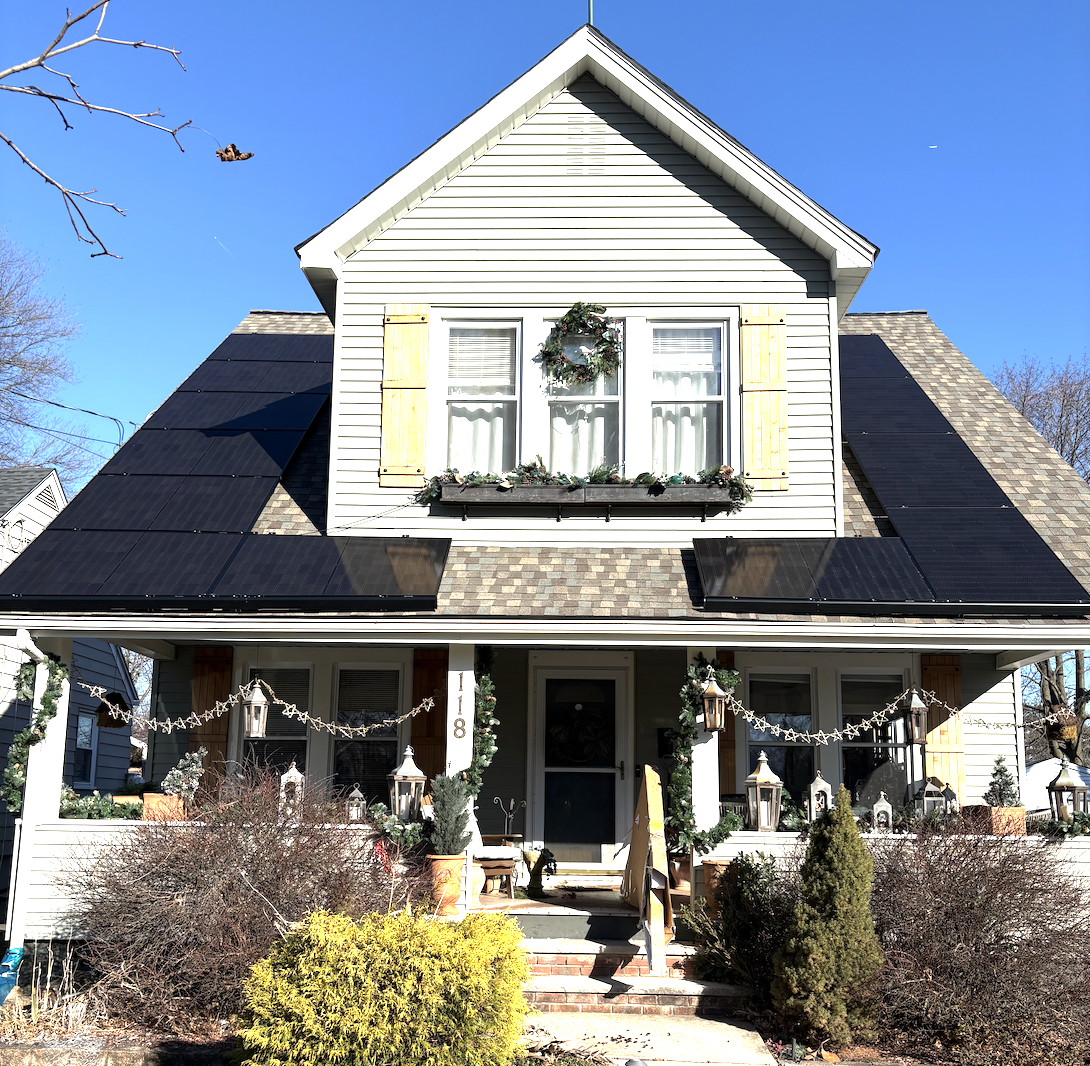
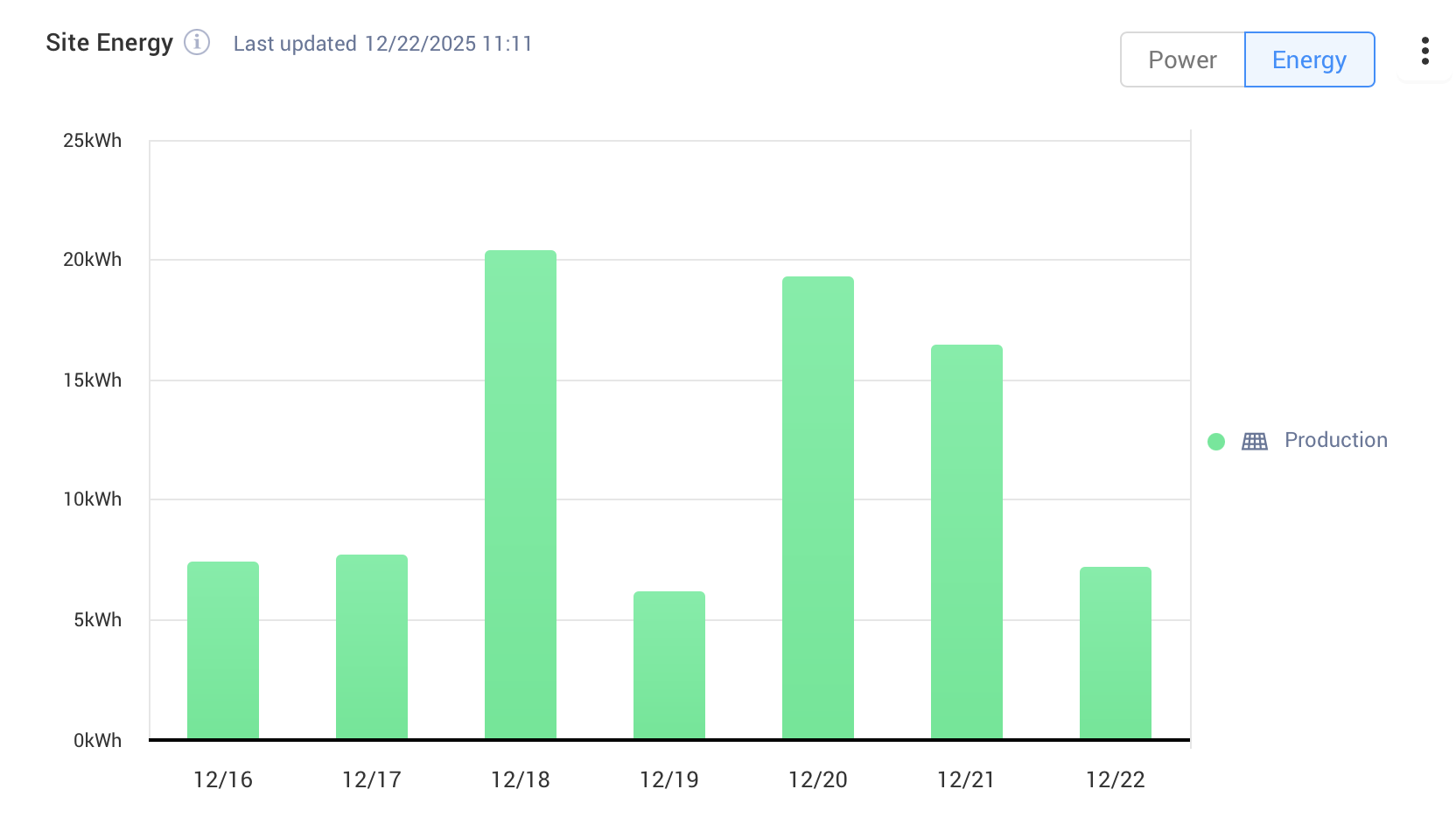
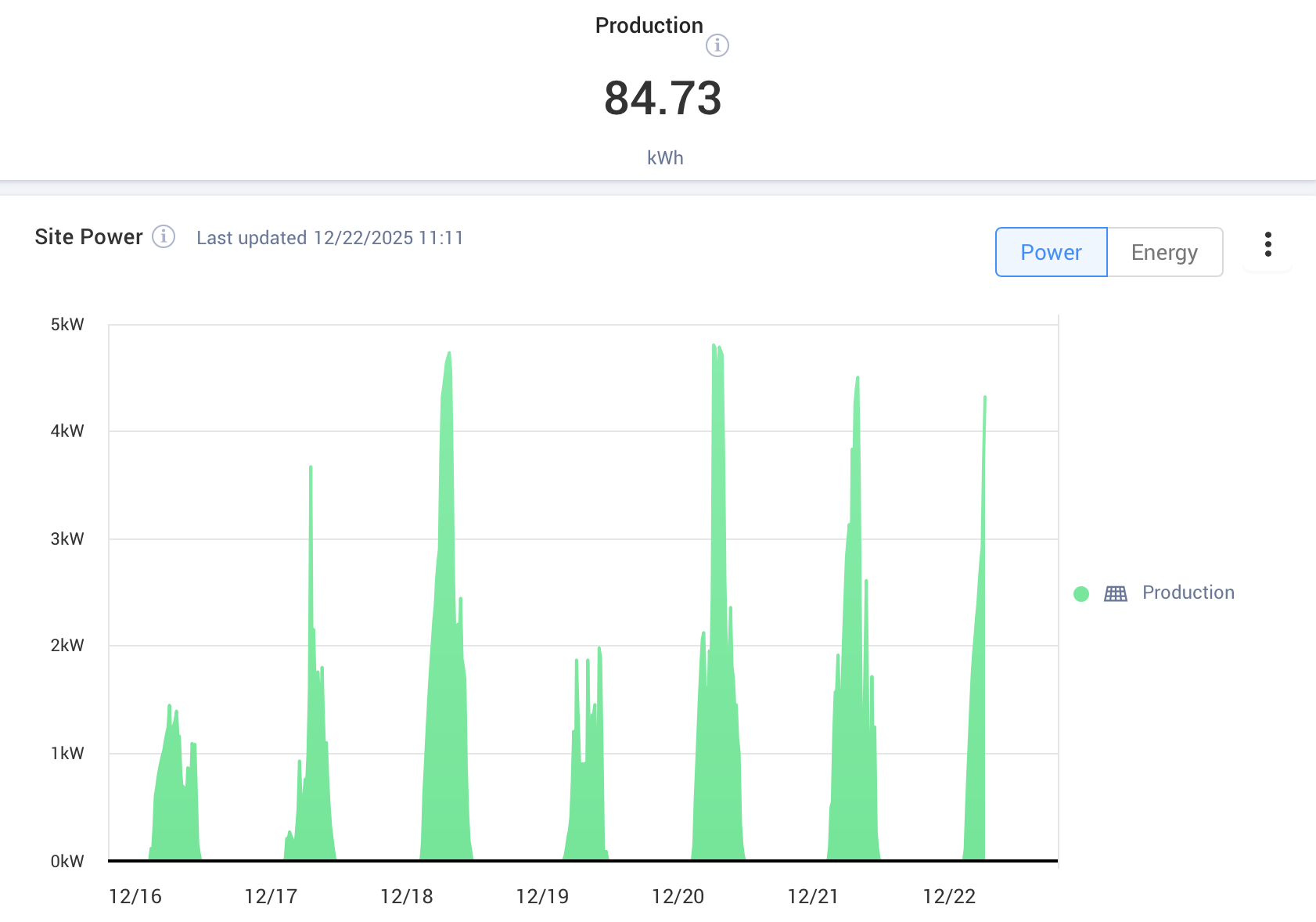
Today is a nice sunny day on the day after the shortest day of the year. I should have really good production as the days get longer
Here's energy, showing daily kWh (12/22 is full sun, but it's still morning):
Here's Power, showing kW over time:
In my first full month of November 2025, I had 438 kWh produced (reported from the solar provider).
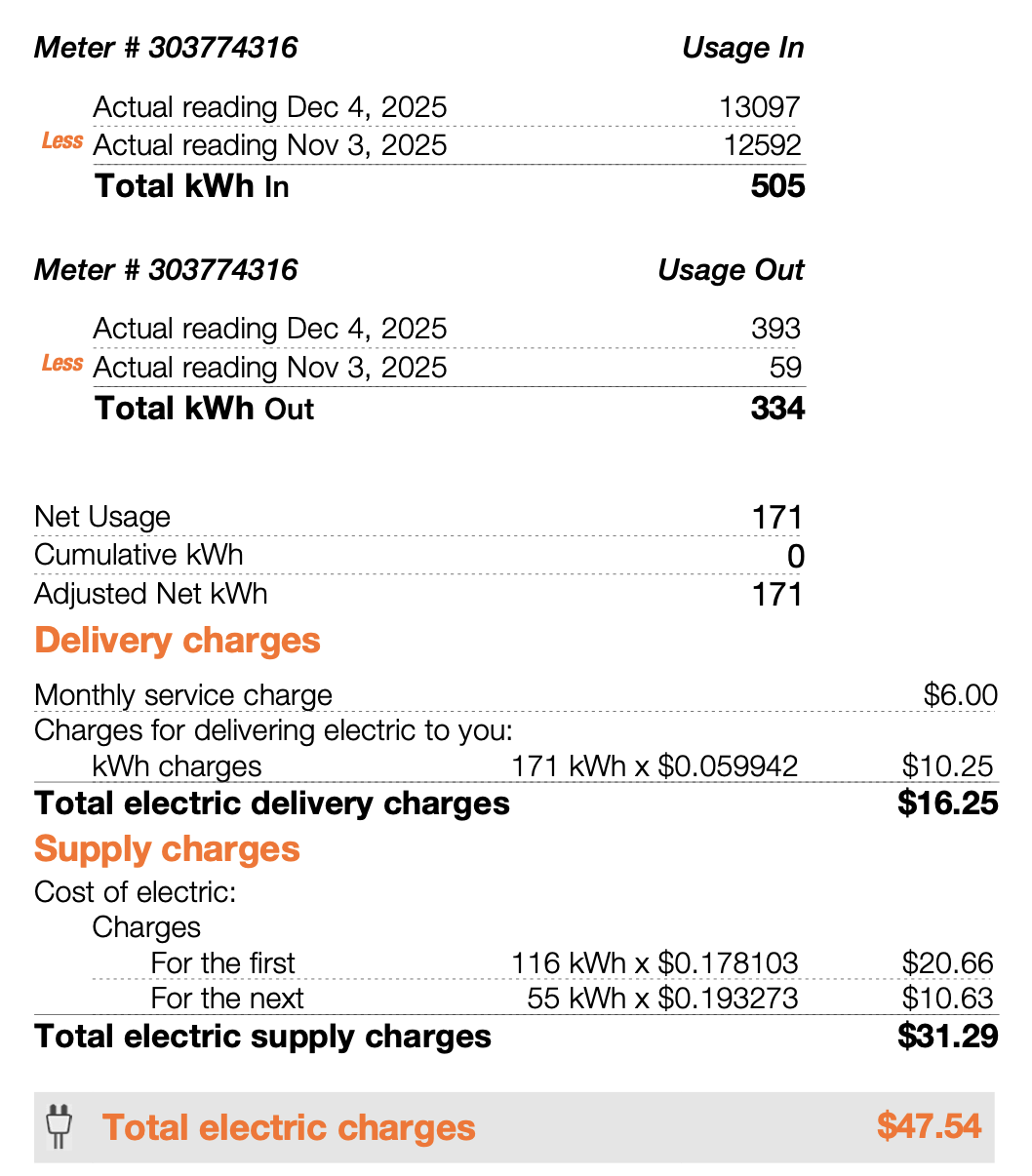
In the utility bill below, though, you'll see the numbers don't match up. This is because there is a number missing I think, and that is the number of kWh of my own production that I used (and so never got sent out to the grid, nor came in from the grid). So I think that number is 438 kWh produced minus 334 kWh sent out to the grid, which equals 104 kWh.
But regardless for now I'm super happy to have output 334 kWh to the grid against 505 kWh incoming from the grid in miserable, cloudy, short-days November. It will be interesting to see which month I first break even, and then of course, the surplus starts piling up.
One more note that I see solar naysayers talk about is the charges that remain on the bill regardless of solar generation, or "Delivery Charges". I will have the $6 service charge regardless, but look at the rest of the Delivery Charges. It is billed at $0.059942 per kWh. But it's only charged against the net incoming kWh which is just 171. That amount will soon be zero and should remain zero as I expect to be at Net Zero electric usage year over year. We'll see!