Welcome! Here are the website rules, as well as some tips for using this forum.
Need to contact us? Visit https://heatinghelp.com/contact-us/.
Click here to Find a Contractor in your area.
If our community has helped you, please consider making a contribution to support this website. Thanks!
Best Of
Re: Buderus 2107 Intermittent Failure
Ironman, I have had a few experiences with companies that are absolutely piss-poor, but where I realize that all the competitors would likely also be piss-poor, I can think of a rental car issue I had with Avis that was atrocious, but where I suspect Hertz or Enterprise would have been just as bad.
Unfortunately, I suspect that may be the case here. That doesn't change the fact that this is piss-poor customer service on Bosch's part, and would be on any other manufacturer's part.
Unfortunately, I suspect that may be the case here. That doesn't change the fact that this is piss-poor customer service on Bosch's part, and would be on any other manufacturer's part.
 AJinCT
0
Re: Buderus 2107 Intermittent Failure
Did you even read my post coherently?Sorry, but you are not their customer; the contractor who sells their equipment is. And you're the customer of your contractor.They should still be able to provide technical support to the customer who paid for the product. That is just piss poor customer service to refuse to even talk to the end user.
Also, a lot of people do their own work, what about them? Just just get no support? We don't do our own boiler work, but I know several people who do, and while they don't have Buderus/Bosch equipment, it's the same idea.
I know of NO manufacturer that will give direct tech support to the end user in this industry for the reasons stated. Your recourse is your contractor, not the manufacturer.
Just because you wanna operate outside of the system, doesn't mean that everyone in it is gonna suddenly bow to your demands.
It's the same way when you buy a vehicle: you may choose to work on it yourself, but you won't get tech support from the manufacturer. The dealer gets that, not the end user.
 Ironman
0
Re: Buderus 2107 Intermittent Failure
Sorry, but you are not their customer; the contractor who sells their equipment is. And you're the customer of your contractor.They should still be able to provide technical support to the customer who paid for the product. That is just piss poor customer service to refuse to even talk to the end user.
Also, a lot of people do their own work, what about them? Just just get no support? We don't do our own boiler work, but I know several people who do, and while they don't have Buderus/Bosch equipment, it's the same idea.
If the 2107 is toast, it's most likely getting replaced with whatever the new contractor uses the most, which is some sort of Honeywell ODR controller I believe. The 2107 does some interesting things, and it works very well with the DHW in the summer, but it also is confusing as heck to program, and not very flexible in terms of options of how it operates. It seems like it's really intended for use with panel rads in a constant circulation or near-constant circulation system, like they use in Germany, and not so much for hydro air, or even fin-tube. Good to know there are other options out there too if they want to use one of those. Does the Beckett product work with non-Beckett burners?
I'm don't know about the Honeywell aquastat, but the Beckett Aquasmart and Hydrolevel Hydrostat both offer domestic high temp and the option of priority.
The indirect get wired into the aquastat and then configure it for domestic.
You will need the Phase sensor and thermostat though and remove the Buderus sensor.
You'll have to change the boiler well also.
The 2107 is an awesome control. It'll be a shame to get rid of it.
AJinCT
0
Re: Buderus 2107 Intermittent Failure
Sorry, but you are not their customer; the contractor who sells their equipment is. And you're the customer of your contractor.
We're not talking a tv or an Xbox; we're talking about equipment that requires technical expertise, a license(s), insurance,etc,etc,etc.
They have an ethical and legal obligation to only give technical advice to contractors. What if they gave you advice and your boiler burned the house down or someone died. You or your family would get a lawyer and sue them. A contractor can't do that because his license makes him responsible for his work.
You can't bypass the contractor and then expect the manufacturer to deal directly with you.
We're not talking a tv or an Xbox; we're talking about equipment that requires technical expertise, a license(s), insurance,etc,etc,etc.
They have an ethical and legal obligation to only give technical advice to contractors. What if they gave you advice and your boiler burned the house down or someone died. You or your family would get a lawyer and sue them. A contractor can't do that because his license makes him responsible for his work.
You can't bypass the contractor and then expect the manufacturer to deal directly with you.
Ironman
0
Re: Well? Will the new tax overhaul
I understand and feel your pain. I have family in the NYC as well but one argument I have heard is, why should poor communities subsidize wealthier communities? Deductions are subsidies.
We have relatives paying $18K property taxes, and their neighbors paying $22K property taxes. The same people also pay NY State income taxes. Combined, that's a huge deduction to lose.
 SlamDunk
1
Re: Copper or Steel Pipe for a buried steam pipe
If I understand correctly the old steel steam pipe lasted over eighty years. I would use steel again, schedule 80 would be best, but I think schedule 40 will be fine. I'd also make sure to use cast iron fittings.

Re: HTP UFT Tankless boiler
Here's the relief valve, it came packaged along with the boiler, the cast iron elbow and tee were also packaged with the boiler... it is not optional.That is the procedure for the DHW side HX, I don't think he has the Combi version? Doesn't look like it from his pic.
HX = Heat Exchanger
The Descaling setup and procedure are described on page 69 of the I&O manual dated 7.21.2017...


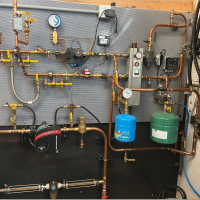 hot_rod
0
Re: Pressure Optimization
Well, vapourstats could be regarded as more fine tunable pressuretrols, although it might be more accurate to say they are more sensitive. They come in two ranges -- 0 to 16 ounces and 0 to 4 psi. One would use one of the other, depending on one's application.
Now that you have a nice 0 to 3 psi gauge, though, the first thing (before you change anything!) to do is to watch it as you go through a heating cycle. What you should see (I hope) is that the gauge will register very little pressure -- say less than half a pound (lower is better! for quite some time after the boiler fires up. Indeed, if you have a collaborator, you could have them keep an eye on the slowest radiator, and let you know when that radiator starts to heat up. Ideally, when that radiator starts to heat up you should still be at the low pressure reading -- it shouldn't have changed much. What you should see then is the pressure should start to rise. That is the pressure -- for your system -- at which you want the pressuretrol or vapourstat to shut the burner off, to let the system catch up to the boiler.
If it's less than about 1.6 or 1.7 psi -- which is about as low as a pressuretrol can reliably operate -- you should have a vapourstat. But before you rush out and get one (yeah, I know, it's Christmas and a shiny new vapourstat under the tree would be nice!) there is at least one thing to think about.
Specifically, what was the more or less stable pressure which the system ran at, before it started to rise? If it was more than half a pound or so, how is your main venting? That more or less stable pressure is a direct reflection of your main venting and piping, since that is the pressure it takes to get the air out of the mains. It really shouldn't be over that half a pound or so; in fact, ideally it should be around 0.2 psi for a more or less typical residential system -- even a fairly big one.
Would the reduced fuel burn from not raising the pressure beyond what is needed to get that last radiator going save enough to pay for the vapourstat? Hard to say. It certainly isn't even close to proportional to the pressure setting, but it will save some fuel.
You mention a concern about interrupting the heating cycle. It will interrupt the burner running, if the heating cycle is long enough (on the main system I care for, it sometimes interrupts on very long recoveries). But this doesn't hurt the heating cycle -- those radiators will keep on delivering heat quite happily while the burner is off, working on the excess steam which was produced before the burner shut down. Most important, though, this causes at most a minor reduction of efficiency. Consider. While the burner is off, waiting for the system to catch up, it isn't burning any fuel. When the system catches up, it will fire up again. True, there is a small loss in there -- if there is a post purge and a pre purge, the gasses left in the fire chamber will have cooled off -- but the boiler itself will not have cooled significantly (which you can verify by noting that steam is produced almost immediately when the boiler fires up again)(I have, parenthetically, a disagreement with my delayed restart using a timer friends on this one -- you want as short an off period as is reasonable, so the boiler doesn't cool off).
Some would say that the additional wear on the burner from stopping and starting is a consideration. However, with any kind of luck at all (unless you got the system at midnight plumbing supply, off the back of an unmarked box truck) all the components should have a service life of many tens to hundreds of thousands of starts. Even if you ran 24 heating calls every day all winter, and each call involved the burner cycling on pressure four times (in which case your boiler is wildly ovesized, and you have other problems) that's only about ten thousand starts per winter. If the boiler is reasonably matched to the system, so that you have only perhaps three or four pressure cycles per start, and only on recovering from a setback on a cold morning, the difference is even less. So yes, it is a consideration, but in my view a minor one.
There is a consideration in the opposite direction, too, however: neither vents nor traps are really happy at higher pressures. Yes, they are rated for it (typically up to 3 psi working pressure), but they will last longer at lower pressures. Again, to cite the system in the main building I care for, all the traps are original to the system -- 80 years old -- as is one of the two main vents (I added one a few years back; don't really need it) -- since the system has never subjected them to a pressure differential greater than 12 ounces per square inch; I have heard others quoting a ten year life for traps.
I'm rambling -- but I hope my thoughts help!
Now that you have a nice 0 to 3 psi gauge, though, the first thing (before you change anything!) to do is to watch it as you go through a heating cycle. What you should see (I hope) is that the gauge will register very little pressure -- say less than half a pound (lower is better! for quite some time after the boiler fires up. Indeed, if you have a collaborator, you could have them keep an eye on the slowest radiator, and let you know when that radiator starts to heat up. Ideally, when that radiator starts to heat up you should still be at the low pressure reading -- it shouldn't have changed much. What you should see then is the pressure should start to rise. That is the pressure -- for your system -- at which you want the pressuretrol or vapourstat to shut the burner off, to let the system catch up to the boiler.
If it's less than about 1.6 or 1.7 psi -- which is about as low as a pressuretrol can reliably operate -- you should have a vapourstat. But before you rush out and get one (yeah, I know, it's Christmas and a shiny new vapourstat under the tree would be nice!) there is at least one thing to think about.
Specifically, what was the more or less stable pressure which the system ran at, before it started to rise? If it was more than half a pound or so, how is your main venting? That more or less stable pressure is a direct reflection of your main venting and piping, since that is the pressure it takes to get the air out of the mains. It really shouldn't be over that half a pound or so; in fact, ideally it should be around 0.2 psi for a more or less typical residential system -- even a fairly big one.
Would the reduced fuel burn from not raising the pressure beyond what is needed to get that last radiator going save enough to pay for the vapourstat? Hard to say. It certainly isn't even close to proportional to the pressure setting, but it will save some fuel.
You mention a concern about interrupting the heating cycle. It will interrupt the burner running, if the heating cycle is long enough (on the main system I care for, it sometimes interrupts on very long recoveries). But this doesn't hurt the heating cycle -- those radiators will keep on delivering heat quite happily while the burner is off, working on the excess steam which was produced before the burner shut down. Most important, though, this causes at most a minor reduction of efficiency. Consider. While the burner is off, waiting for the system to catch up, it isn't burning any fuel. When the system catches up, it will fire up again. True, there is a small loss in there -- if there is a post purge and a pre purge, the gasses left in the fire chamber will have cooled off -- but the boiler itself will not have cooled significantly (which you can verify by noting that steam is produced almost immediately when the boiler fires up again)(I have, parenthetically, a disagreement with my delayed restart using a timer friends on this one -- you want as short an off period as is reasonable, so the boiler doesn't cool off).
Some would say that the additional wear on the burner from stopping and starting is a consideration. However, with any kind of luck at all (unless you got the system at midnight plumbing supply, off the back of an unmarked box truck) all the components should have a service life of many tens to hundreds of thousands of starts. Even if you ran 24 heating calls every day all winter, and each call involved the burner cycling on pressure four times (in which case your boiler is wildly ovesized, and you have other problems) that's only about ten thousand starts per winter. If the boiler is reasonably matched to the system, so that you have only perhaps three or four pressure cycles per start, and only on recovering from a setback on a cold morning, the difference is even less. So yes, it is a consideration, but in my view a minor one.
There is a consideration in the opposite direction, too, however: neither vents nor traps are really happy at higher pressures. Yes, they are rated for it (typically up to 3 psi working pressure), but they will last longer at lower pressures. Again, to cite the system in the main building I care for, all the traps are original to the system -- 80 years old -- as is one of the two main vents (I added one a few years back; don't really need it) -- since the system has never subjected them to a pressure differential greater than 12 ounces per square inch; I have heard others quoting a ten year life for traps.
I'm rambling -- but I hope my thoughts help!


Re: Taco Viridian vr15-1
Everything was brand new the boilers, (3 Buderus G315/8) piping, one very large spirovent and indirects. We had to build a whole new system while the other one was running because shutting down the DHW system for more than a couple of hours was not a option.Then I doubt you have an issue with magnetite seizing the motor, certainly not multiple circs in a short time period. Your pics confirm that. Sounds like a microprocessor or programming glitch.
hot_rod
0