Best Of
Re: One-inch magnetic filter on 1-1/4 boiler return?
Just so you know @seized123 there are some folks that have their boiler installed incorrectly with the pump on the return and the expansion tank on the supply, the auto water feed on the suction side of the pump and all other types of stuff that you haver already corrected. Those system can work for years and years without ever having to replace a circulator pump or move an expansion tank. It seems that you like to read about what is the best practice and do that to your system, even if you don't get any benefit from it. Your constant draining and adding water to make another minor correction every year until you have the best design ever, might actually cause more problems that you are correcting.
When I do a maintenance on a boiler that is poorly designed, I don't recommend to my customer that we make a minor change here and another minor change in the design next year, and continue to redesign everything with every new article I read in the trade journals. Those 80 year old systems worked fine for 80 years. Those 50 year old systems worked fine for years and those 20 year old systems worked fine for years. I might add that until you actually experience a problem with your system, just do the maintenance and leave the system just work as it is. You already did all you need to do last year. Let it work for a couple of years before you start changing stuff around. You may find that nothing fails to operate and there is no need for change.
If I have a problem with constantly draining an expansion tank two times a year, or constant air problem with one loop of baseboard in a home, then I would recommend a major redesign to solve a problem. But if the system is operating satisfactory, then I go with the old saying… "IF IT AIN'T BROKE…" you know the rest.

Re: A/C Capacitor Voltage
Just to recap (sorry). You can safely use a capacitor with a higher VOLTAGE rating than required. No problem. You can NOT use a capacitor with a capacitance much more than 10 percent higher or lower than required.

Re: Your thoughts and opinions please
“The customer was thinking of a quick thing about what to look for on each type system.”
Herein lies the problem: They want you to give them in less than 4 hours what you’ve spent a lifetime learning.
It takes 12 years to get a high school diploma, another 4 to get a bachelor’s degree;, 3 more to get a master’s, and 1-2 more to earn a doctorate. But somehow, they expect you to be able to condense what you’ve learned through decades into 3-1/2 hours. It’s just part of the instant gratification culture in which we live.
I would suggest that you reduce it down to maybe one two sub points from each main topic that you feel are most needed and spend a little time emphasizing that it takes a lot more time and effort to get a working understanding of hydronics and then promote you books and videos along with this site. Those that really want to learn will take your advice.
 Ironman
Re: A/C Capacitor Voltage
The life of an electrolytic cap is a function of voltage and temp. It will work a bit above its rated voltage for quite a while but won't get its rated life. You can get more life by using a cap with a significantly higher voltage rating than the working voltage.
 mattmia2
Re: A/C Capacitor Voltage
When it comes to Capacitors for HVAC repair I stopped stocking 20 different dual and 15 different single caps in favor of the Turbo 200. Three of those per truck and one of the larger Turbo caps greatly reduced truck inventory costs and space. I can also offer a 3 year warranty on them because Turbo offers a 5 year warranty. I just need to cover the labor portion. That Turbos are all rated at 440 and you can build the exact uf you need. I know that they are more expensive that the ones made of chinesuim but the warranty suggests that they will last longer. A better deal for the customer that is paying retail for repairs.
Re: A/C Capacitor Voltage
The voltage rating refers to what voltage the capacitor is rated to withstand, not to what voltage that will be measured at its terminals. If the actual measured voltage is in excess of its RATED voltage, then a higher rated capacitor should be used.
It never hurts to go up in rated voltage. In fact, it’s a good practice.
Ironman
Re: A/C Capacitor Voltage
If you need a 370 V capacitor you can use a 440 v capacitor. If you need a 440 V capacitor you can not use a 370 V capacitor. So if you don't know if you need a 370 or 440 then you should use the 440. If you can find the original specification in the equipment docs, and it specifies a 370, the you are good to go.
Re: tiny droplet leak from the oil tank firomatic shut off valve.
I know it was asked a few times but How old is the tank? This can be a simple repair for an experienced oil technician. It can also turn to crap pretty quick.
Before I thought about this job I would let an experienced set of eyes take a look at the whole tank. Better safe than sorry.
 CTETeach
Re: Strange situation of Utica MACF 150
Regardless of who put what where I would restore it to the manufacture's intended electrode placement. Looks to me like there is an intentional bend with both electrodes to get the electrodes near where the flame is expected to be. Since the electrode gaps are almost the same, 4mm & 5mm I could see it working if the wires were swapped. However it appears the Ignition Electrode has its own dedicated ground wire. The ignition spark should jump across the ignition electrodes gap. If the flame sensor is used for the ignition spark it would arc to the burner which may cause damage.
If either or both electrodes are dilapidated they should be replaced.
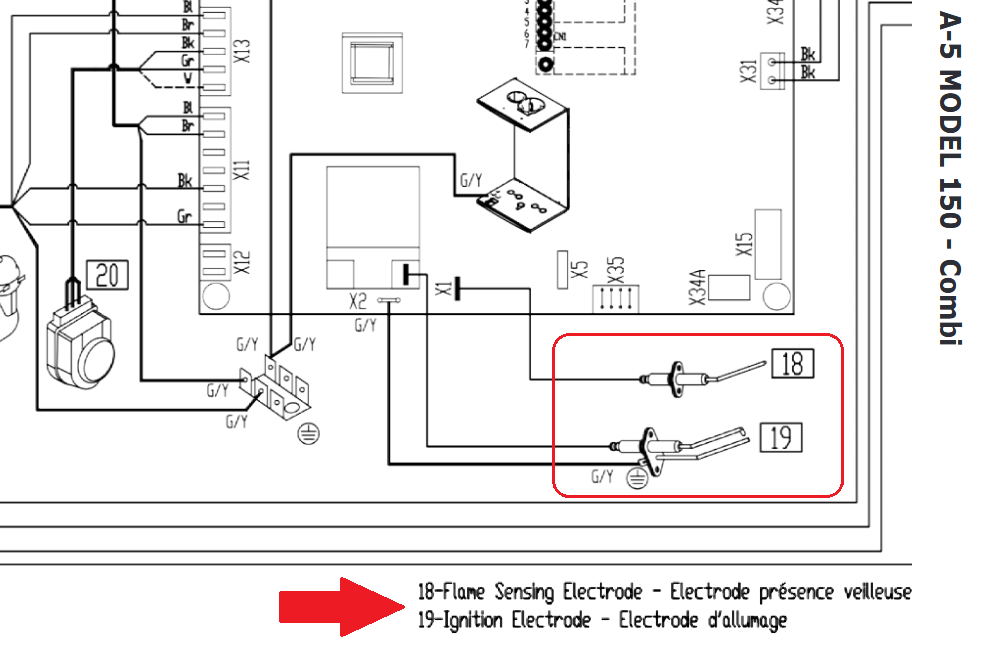
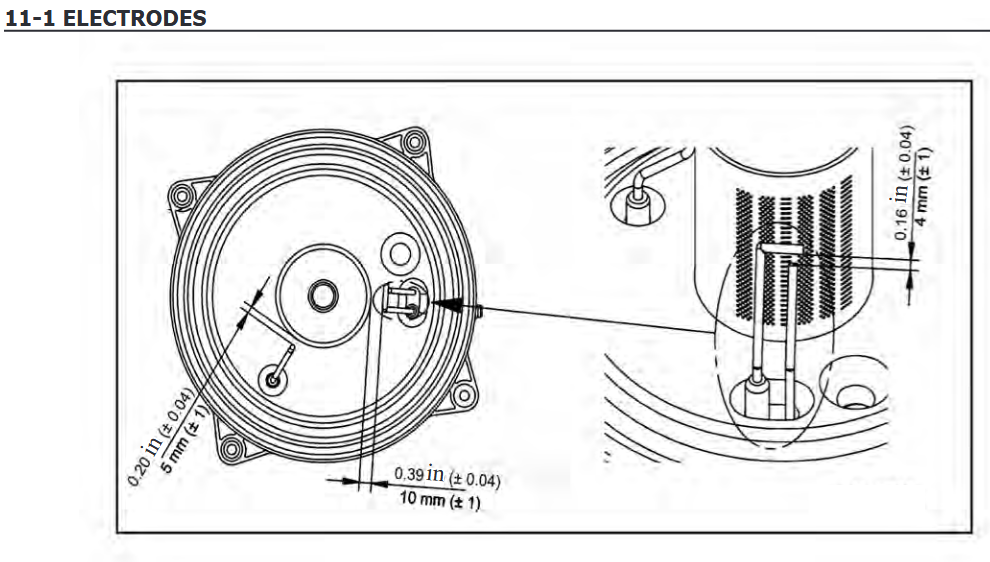
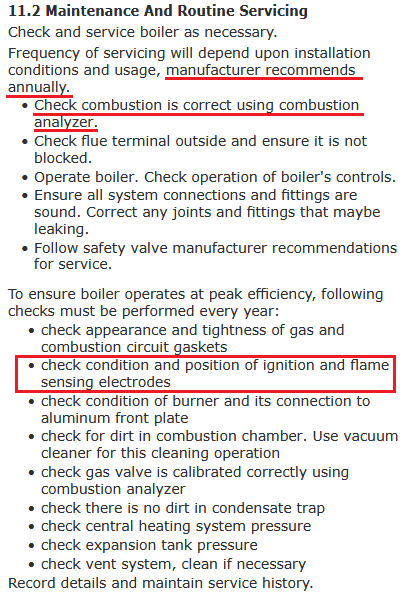
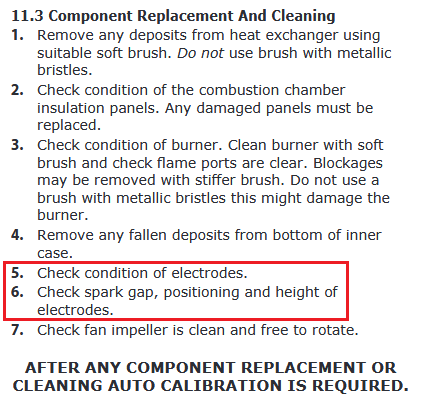
https://uticaboilers.com/wp-content/uploads/2022/09/MACF-MAHF-75-205-FLOOR-CONDENSING-BOILER-MANUALS-MGC-1225-REV-A.pdf
 109A_5
Re: Air Vent Requirement
On a one pipe steam system, vets on the main or the risers will determine how fast steam reaches a given radiator. The vent on the radiator will determine how long after steam gets there before the radiator is filled. Two different functions — but on most one pipe systems the runouts and risers do not have vents, and the radiator vent handles both functions, and that is perfectly fine if the radiator heats adequately along with the rest of the system. If a specific radiator gets steam much more slowly than desired, then a vent on the runout or riser can help