Best Of
Re: Need help with new install of radiant with Buderus cast iron boiler
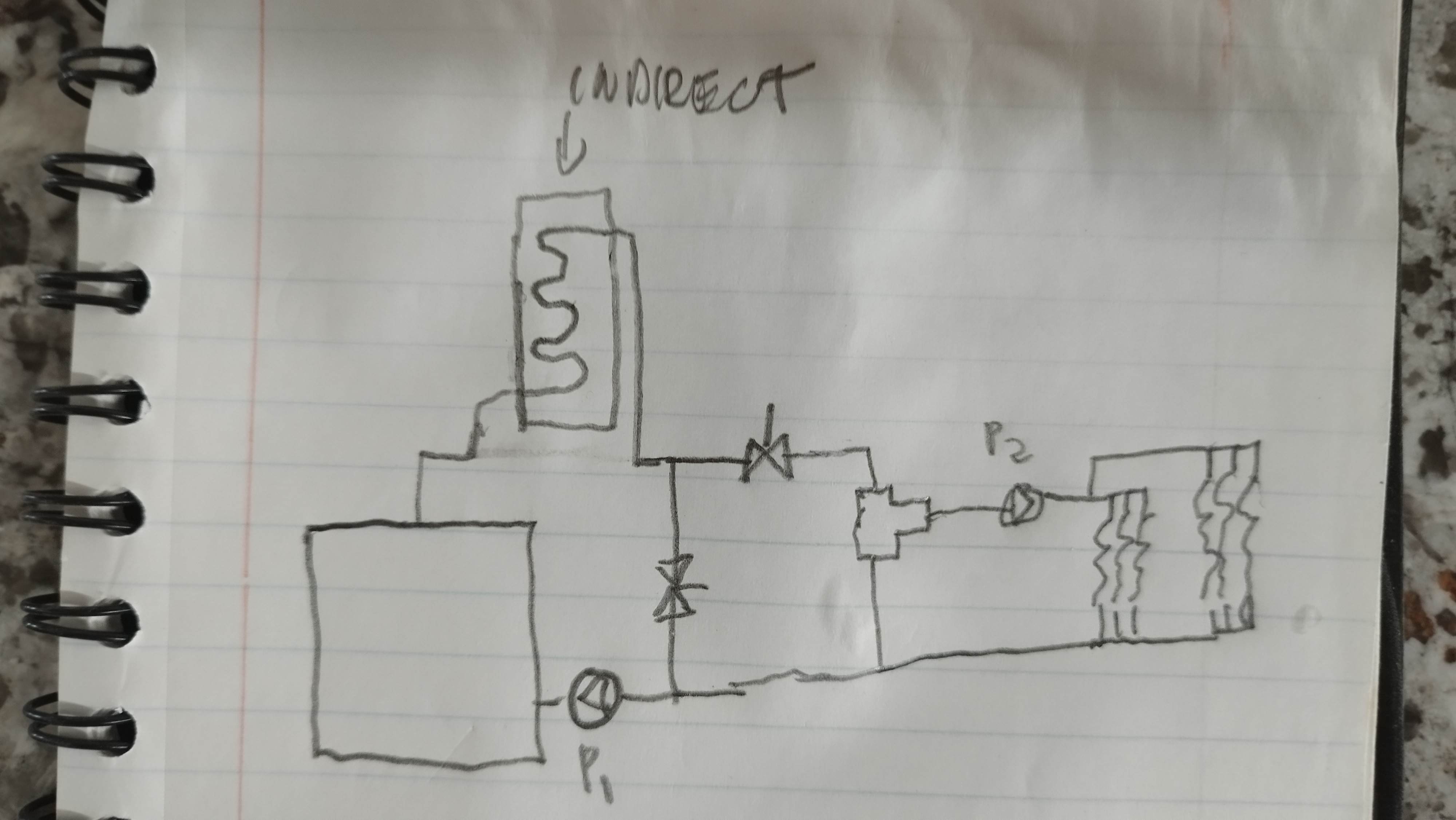
How about this as a cost optimized setup.
Fixed bypass and hold off on P1 for boiler temperature protection. Thermostatic mix valve for floor heat. No zoning to limit short cycling.
The indirect is always on the heat loop, when the boiler runs, indirect is always heated. When only indirect needs to run, only P1 is turned. Will need a valve before P2 that can be closed in the summer to stop flow through the floor heat.
The indirect does double duty as a buffer to reduce cycling.
 Kaos
Kaos
Re: Loop PEX *under* joist instead of through? Reasons it won’t work?
Appreciate all comments and challenges. The perspectives are very informative.
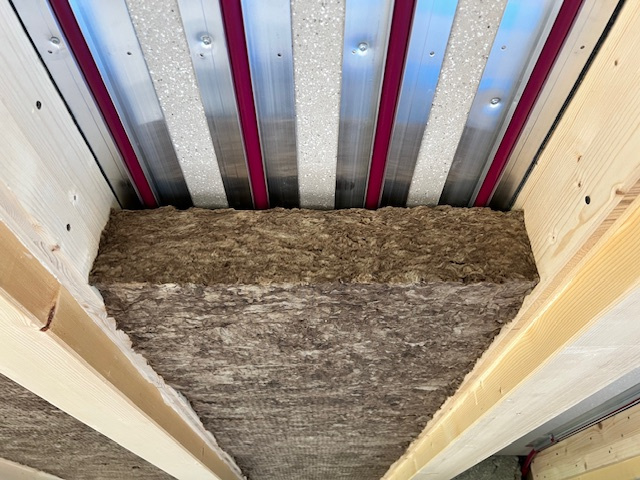
Always part of plan but not mentioned detailed: Presence of ~4in of mineral wool (brand FlumRoc) with R value ~16 with snug fit between joists (see photo). That is to help send the heat „up“ into the subfloor and not down to ceiling.
So, from top ("0" layer) to bottom ("-5" layer):
0) Floor finish: 0.6 in wood parquet, but ceramic tiles in wet areas. (est. R value of wood: ~0.6)
-1) Subfloor: 1.1 inches Gypsum fiber board (28mm Knauf GIFAfloor, R value: ~0.4)
-2) Heat transfer plates: 1/2“ Alu c-clamp plates (Uponor)
-3) Pipe: 16mm, O2-barrier (Rehau RauTherm NEO-X5, 0.63 inches OD)
-4) Insulation: 4 in Mineral wool batts (10cm FlumRoc with R value of ~16 h•ft2•F/BTU)
-5) Sheetrock: 5/8“ sheet rock for 21“ span between joists (R value: ~0.6)
(Note: You may notice I didn't use screws to fasten plates to the gypsum fiber board. The screws simply twist off when driving them in. Pre-drilling would take forever. Opted for concrete nails instead. Hilti BX-3 battery-powered nail gun with 2/3 in (17mm) nails on a magazine. Incredibly easy and fast. Incredibly strong fastening. Would recommend that system if fastening to thick gypsum fiber board. Battery-powered roofing nail gun (DeWalt) might be option if OSB subfloor?…)
 Brian_W
Re: Need help with new install of radiant with Buderus cast iron boiler
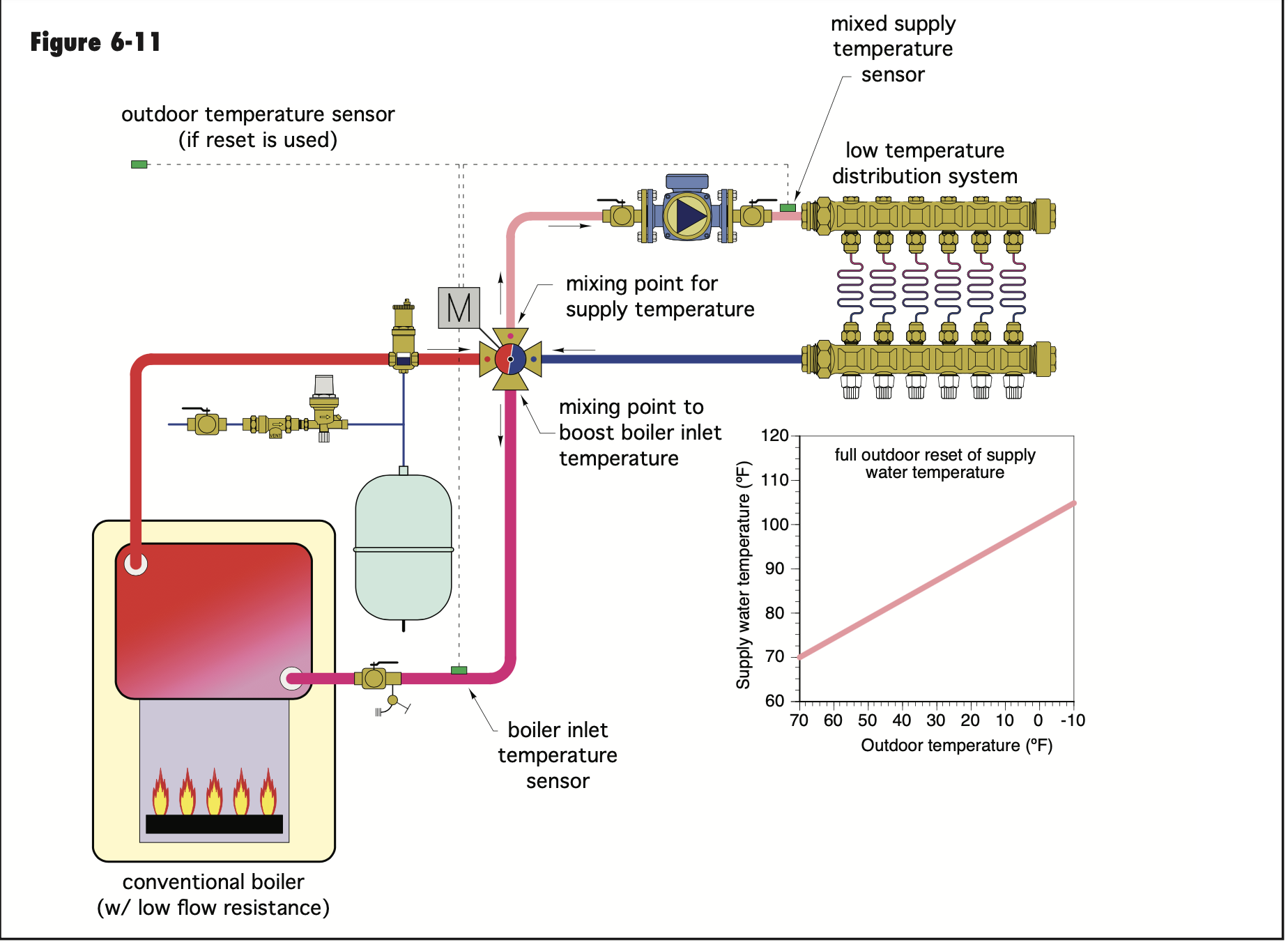
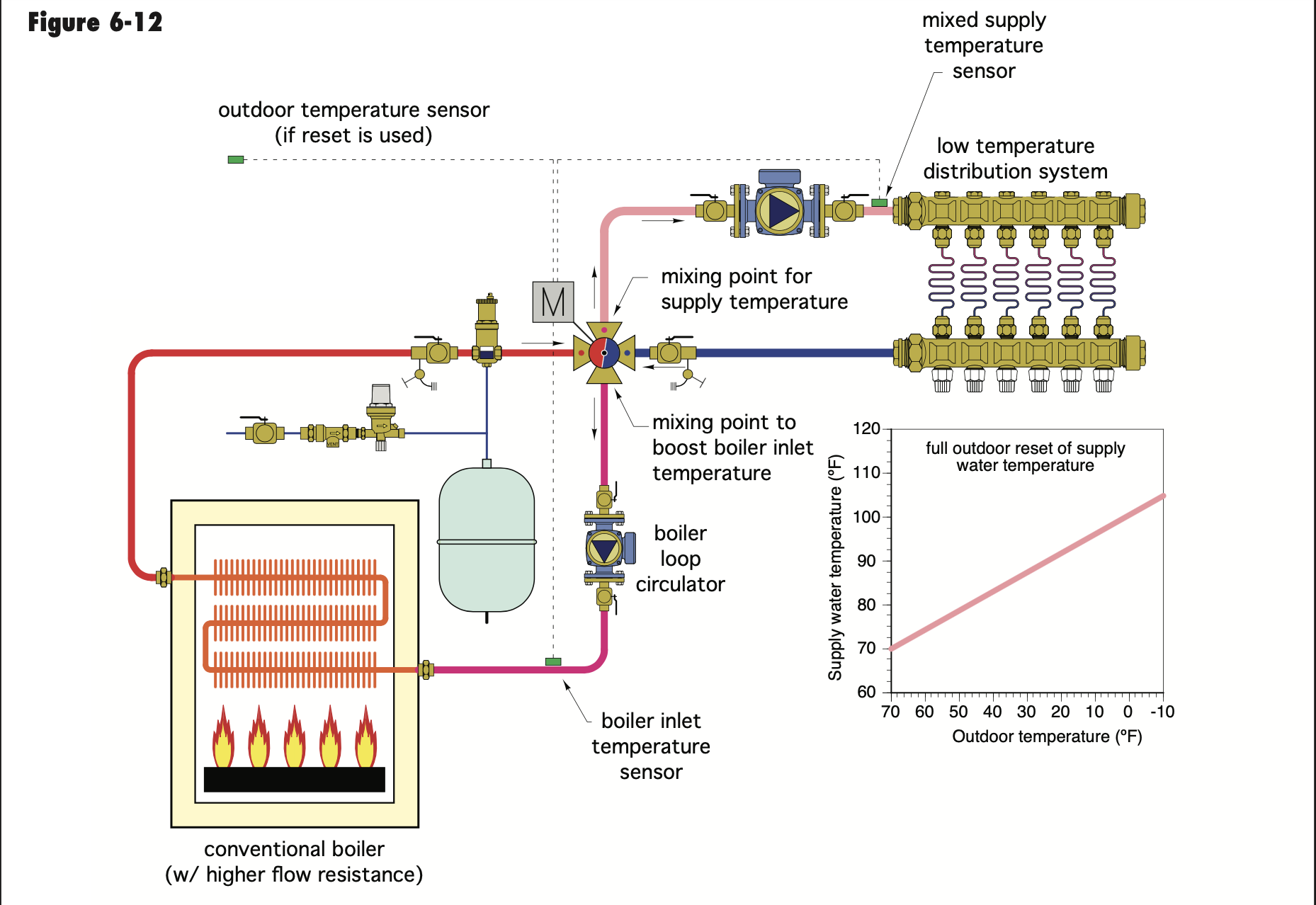
Back in the day, before mod cons, CI boilers were commonly piped with 4 way motorized mix valves.
This valve both protects the boiler from low return, and provides the mix down temperature. Many of the Euro boilers offered this assembly. Tekmar, HBX are a few that still offer the valve, actuator, and controller.
\If return drops below acceptable temperature the valve modulates to protect it as priority.
Possibly a single circ will; work, depending on the loop requirements, gpm and head.
If not a two pump system was used with either a high pressure drop boiler, or high pressure drop radiant.
Buderus used to promote that "flexible cast iron" as being able to accept low return without damage? But flue gas condensation needs to be considered.
Price it with the components to use that boiler, or a combi.
Many here rave about simplicity and long life, inexpensive maintenance and parts of CI boilers.
The 4 way also provides outdoor reset.
Caleffi Idronics #7 talks about numerous mixing options for projects like yours. Hard to beat a 4 way.
 hot_rod
Hodge Boiler Plant Photo (1890s)
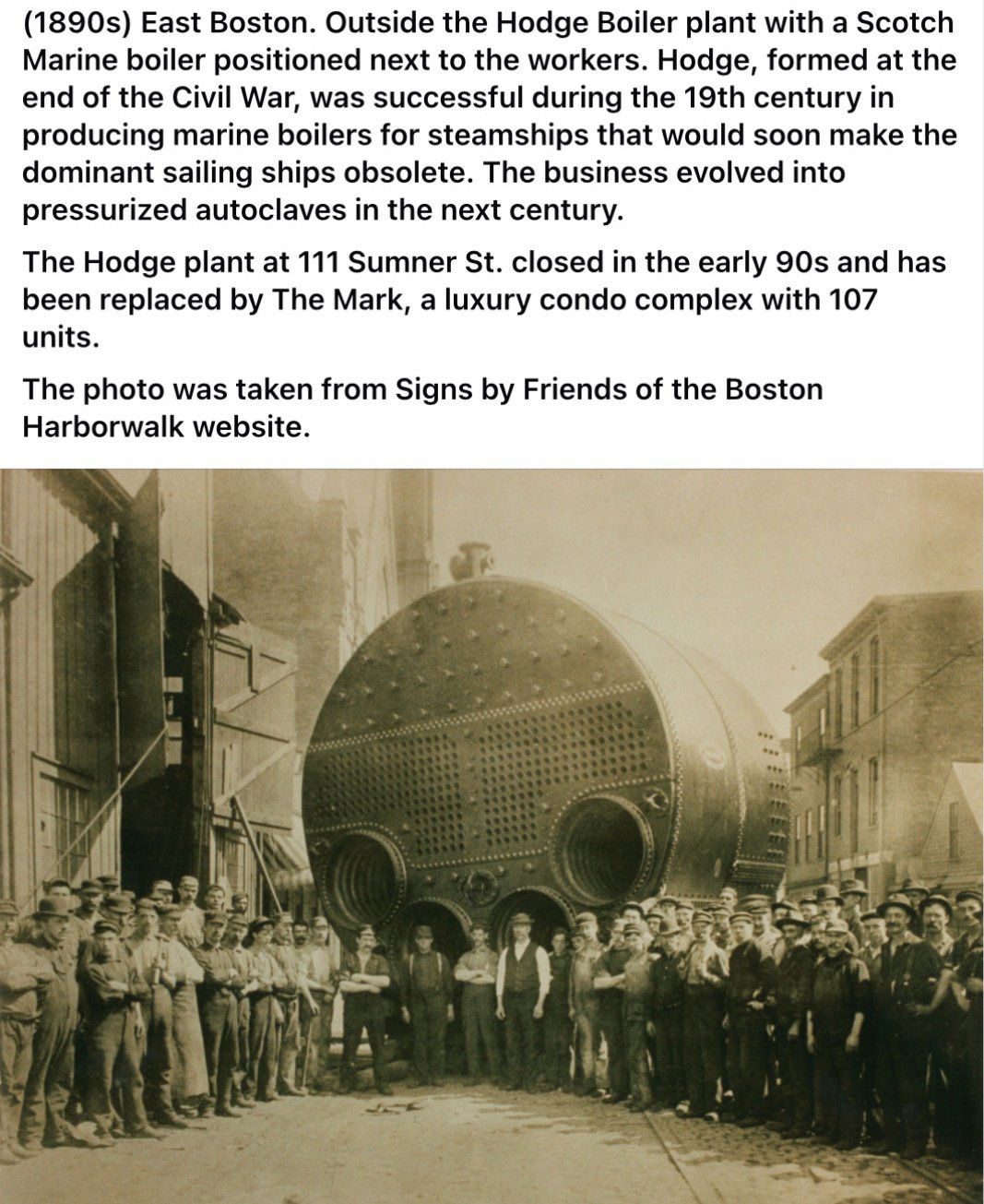
Thanks to our friend Steve for sharing this piece of history with us!


Re: Interchanging Warm Morning Heater Parts
That would be difficult to do. Maybe you would be better off replacing the entire unit

Re: Hodge Boiler Plant Photo (1890s)
Impressive!
Can you imagine the noise created from doing up all those rivets?
 Pumpguy
Re: Hodge Boiler Plant Photo (1890s)
@mattmia2 I did not know that. I always assumed the steel bridges they built in the 1800's and early 1900's used the "hot rivet method" that I saw in the cartoons as a kid some fifty years ago. I think it was Bugs Bunny or perhaps it was Wile E Coyote?

Re: Loop PEX *under* joist instead of through? Reasons it won’t work?
@ethicalpaul : "How much will it lose to convection? It's not in free air, it's screwed to the floor."
Despite their name, "radiant" systems heat mostly with convection. So they do heat more readily up than down, because air rises.
The rule of thumb is that a floor will deliver 2 BTU/hr/sf for every degree difference between the surface and the room, and a ceiling will deliver 0.7 BTU/hr/sf. So about three to one.
In this installation, though, there's nothing between the plate and the space below, and a subfloor and a floor between the plate and the space above. Let's say the room is at 72F and the heating load is 20 BTU/sf/hr. The surface of the floor would have to be 82F. Let's say the floor and subfloor together are R1.5, the plate would have to be at 97F to deliver 20 BTU/sf/hr. If the room below is also at 72F that's 25F colder than the plate, which means 17.5 BTU/hr/sf going down. So you get 47% of the heat going down and 53% going up.
If the room below is a cold basement it could be even worse.
OP has clarified that there will be insulation below the plates, and drywall, which helps limit airflow.

Re: Need help with new install of radiant with Buderus cast iron boiler
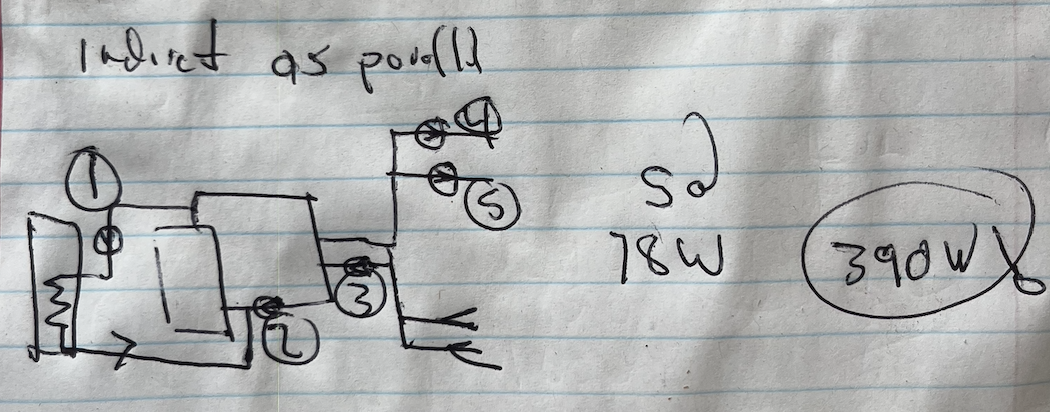
The loops I see indicate you need about 4.5 gpm at design? So to do that with 4- 78W circs will be 300W. Lots of electricity to move a very small heat load :)
One pump and two zone valves less that 100W.
Pumps with flanges, iso valves, relays X 5 is what you need to VBS injection.
 hot_rod