Best Of
Re: Gorton vents is there a way to test them?
I've seen vents work after taking them off and dumping out the water and maybe boiling in vinegar, but not always. You need to find out how water is getting to the vents first. With a new boiler installed there are lots of possibilities although insufficient skimming is the most common. Don't worry about adding an additive (8-way) until skimming brings satisfactory performance. I look at additives as just optizing pH to minimize corrosion more than anything else.

Re: Buderus G115 Strangeness
What type of tubing is in floor?
Are you sure its O2 barrier? Is it Onex epdm tubing?
Are you sure the circulator(s) is running? Any chance to shoot the floor out for temp? Flir camera?
 kcopp
kcopp
Re: Navien NFB-200h combi temps for space heating and domestic hot water?
the bottom of the finish flooring will see the surface temperature of the subfloor material. So right over a transfer plate would be the highest expected temperature
Yes any floor covering adds some r-value and so the floor “panel” output needs to account for that.
Bottom line without the original design, or a reverse engineering, I would maybe start at 110 SWT, the coldest days is when you will make the fine tuning. There are cases where the radiant floor alone cannot cover the heat load of the room or space, and supplemental heat is needed.
Running the boiler on an outdoor reset curve will adjust and vary the supply temperature. This adds comfort and can reduce operating cost. On mild days maybe 100 covers the load, in the coldest days maybe it needs to ramp to 130?
82 surface temperature of the final flooring is a common limitation number you see in design manuals from various radiant manufacturers . Above that it becomes uncomfortably warm to bare feet. The sweaty foot syndrome 🤔
There are various opinions on how hot the bottom of the subfloor where the plates touch should be allowed to run. The plywood manufacturers have opinions on that number
It will be a fun learning experience to get it dialed in to your liking.
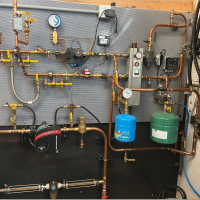 hot_rod
Re: How to bleed the Radiant Floor Heating System
The pic of your gauge shows the pressure high for the temperature reading. These gauges do go bad so you should probably verify the accuracy with another screw on gauge on the boiler drain as stated. 12PSI for one story house and 15PSI for two story house when the boiler is cold. That's what I do.
If the technician bled the air out of the sys and that solved the problem, why would you need to do it again? Where is the new air getting into the sys? That's the question. I have never had to extract air repeatedly.
I can think of 3 ways that air is getting into the sys. 1) fresh city water entering the sys, 2) a failure of the Expansion tank, 3) air being sucked into the sys thru the air vent because of improper piping and pump placement.
1 & 2 would be most probable, I would think. You could shut off the fresh water supply to the boiler and see if the pressure gauge falls to zero, indicating a leak somewhere in the sys. You can shake the E-Tank and see if it is sluggish, indicating that water has leaked into the air side of the bladder. You can push the tire valve on the bottom of the E-Tank, quickly, and see if water comes out.

Re: copper pipe feedback
Yeah, i'll reiterate the 2 or more mains thing. If the mains go off in several directions from the boiler, they should not be teed together at that ceiling but should individually come down to individual tees in the header. There will be some additional fittings and nipples beyond what comes in the kit required to do that.
 mattmia2
Re: copper pipe feedback
Also, this won't come as any surprise to anyone monitoring this conversation but I reached out to Crown Tech Support and they confirmed in writing that the installation was totally botched. They thought the current piping could be removed without damage to the unit. They also thought the proper installation would help resolve some of the hammering throughout the house. Obviously the way it is currently piped also voids any warranty on the unit. This will be very valuable information when I reach out to the contractor who did the installation. Guess the next step is to confirm whether or not the boiler is an appropriate size and, if not, determine how to deal with that added complication.
 nycbones
Re: Replacing fin tube radiation with cast iron
the cast iron has vastly more thermal mass and heats the space far longer in between heating cycles than fin tube
 Waher
Waher
Re: copper pipe feedback
Keep in mind the piping kit isn't 100% full proof, even though it should be if the contractor reads the directions (which they already didn't do). They still need to tie the piping kit into your system correctly, seems easy, but pics we see on here all the time prove that wrong.
For example the piping kit comes with a single tee to go the the system. That doesn't mean you only make one connection to the system, that is if you have 1 main. If you have 2 mains, then the contractor needs to add another tee and bring that main into the header individually.
Not trying to scare you, just advising you stay on your toes with this stuff.
 KC_Jones
Re: Oil guy couldn't fill my tank today
From the comfort of my easy chair, i wouldnt write off those tanks yet based on that photo. Maybe if there was a strong diesel smell….I'm with @bburd onsticking with oil.
You know, a modern oil furnace, properly sized and tuned would pay for itself in fuel savings. My parents had an ancient oil furnace that burned three thousand gallons of oil per winter. We replaced it with a better sized furnace, 80% efficiency, and now burn between 400&500 gallons per year, depending on the winter.
 SlamDunk
Re: Oil guy couldn't fill my tank today
I am not a fan of the 2" crossover design, although that is a recommended piping design in the NFPA 31 code book. I have delivered to many fuel oil customers that have 2 tanks in the basement. I like the two separate fill pipe design myself.