Navien NFB-200h combi temps for space heating and domestic hot water?

Hey folks. New construction… 2300 ranch style with crawlspace in Colorado mountains and staple-up hydronic radiant floor heating throughout. What temperature would you recommend for the Navien NFB-200h for the floor heating? The flooring is 5/8" engineered hardwood.
Also, separate question, there are 2 settings for temp for domestic hot water. 1) "DHW Tank Set Temp" and 2) "DHW Boiler Set Temp". I can't find anything in ANY of the manuals/literature/youtube which says what the difference is between these two DHW settings. Any insight? Should they both be at 120ish degrees?
I also want to say that you folks on here who chime in with your professional insight are doing a tremendous service to those of us who aren't professionals, yet want to clearly understand the inner workings of our systems. Thank you thank you thank you! You are appreciated!!!!
Comments
-
I don’t thing that model is a combi boiler, is there a tank next to it?
Does the radiant have metal transfer plates? Or is it bare tube stapled up?
One temperature setting is for how hot the boiler operates, the other is the actual tank temperature
Do you have a manual, they generally show the factory default settings, and explain the setting adjustments
Staple up could run as low as 110, or as high as 140 It depends on how it was installed and the heat load of the various rooms
Maybe there was some info on the system from the installer, a radiant design, ideally
Bob "hot rod" Rohr
trainer for Caleffi NA
Living the hydronic dream1 -
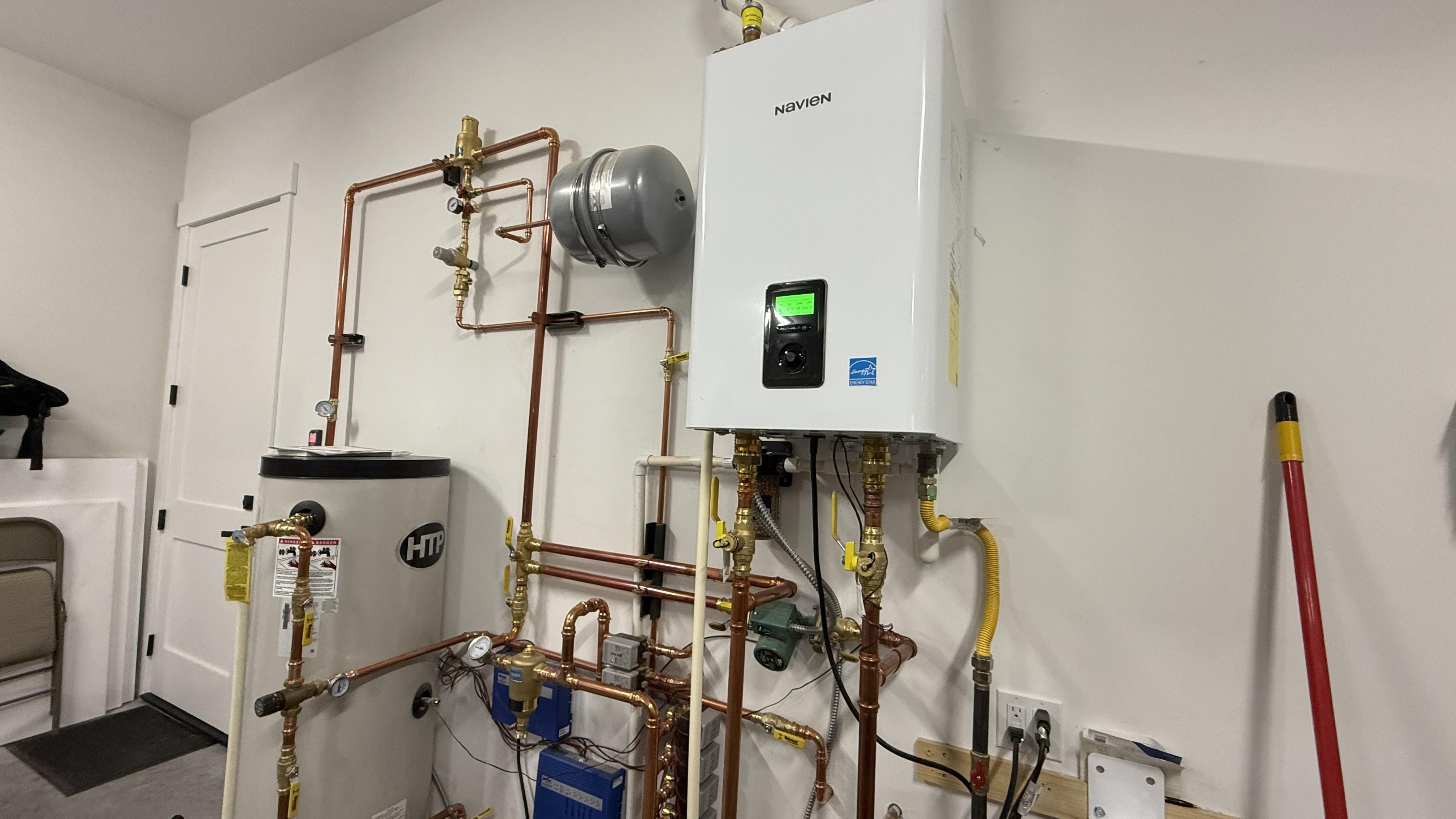
Yes, it does have the long metal transfer plates. There is an HTP SuperStore Ultra next to it. Here is a picture. I wil look for the factory default settings. The flooring that I purchased just lists the max surface floor temp, but doesn't say anything about the radiant water temp. Other flooring manufactures appear to say 110 degree max. The house is super insulated, but does have quite a bit of glass.
 0
0 -
 0
0 -
the bottom of the finish flooring will see the surface temperature of the subfloor material. So right over a transfer plate would be the highest expected temperature
Yes any floor covering adds some r-value and so the floor “panel” output needs to account for that.
Bottom line without the original design, or a reverse engineering, I would maybe start at 110 SWT, the coldest days is when you will make the fine tuning. There are cases where the radiant floor alone cannot cover the heat load of the room or space, and supplemental heat is needed.
Running the boiler on an outdoor reset curve will adjust and vary the supply temperature. This adds comfort and can reduce operating cost. On mild days maybe 100 covers the load, in the coldest days maybe it needs to ramp to 130?
82 surface temperature of the final flooring is a common limitation number you see in design manuals from various radiant manufacturers . Above that it becomes uncomfortably warm to bare feet. The sweaty foot syndrome 🤔
There are various opinions on how hot the bottom of the subfloor where the plates touch should be allowed to run. The plywood manufacturers have opinions on that number
It will be a fun learning experience to get it dialed in to your liking.
Bob "hot rod" Rohr
trainer for Caleffi NA
Living the hydronic dream1 -
Thanks so much!!!
0 -
Try to get the ODR sensor installed if you don't have it yet. It can take weeks or months to find tune the ODR curve.
Your boiler is not a Combi.
"DHW Tank Set Temp" this is the temperature target for the tank. Looks like you have a mixing valve in place. You can set this 120F to 150F or so. Lower numbers are more efficient but you'll be more likely to run out of hot water. Some city codes require higher numbers 140F.
"DHW Boiler Set Temp", this is the temp of water the boiler will send through indirect coil of the tank until the target temp is achieved. This is usually 140F to 180F. Lower numbers tend to be more efficient.
1 -
Also the green taco circulator under the boiler is not installed correctly. The axis of the motor needs to be horizontal with earth. It can wear out faster if not.
1


Categories
- All Categories
- 87.6K THE MAIN WALL
- 3.3K A-C, Heat Pumps & Refrigeration
- 59 Biomass
- 429 Carbon Monoxide Awareness
- 124 Chimneys & Flues
- 2.2K Domestic Hot Water
- 5.9K Gas Heating
- 119 Geothermal
- 168 Indoor-Air Quality
- 3.8K Oil Heating
- 78 Pipe Deterioration
- 1K Plumbing
- 6.6K Radiant Heating
- 394 Solar
- 16K Strictly Steam
- 3.5K Thermostats and Controls
- 56 Water Quality
- 51 Industry Classes
- 50 Job Opportunities
- 18 Recall Announcements