Best Of
Re: Old copper pipe smaller than todays 1/2"
Possibly 3/8 OD that expanded when it froze. That is common with hard drawn 1/2" in homes when they freeze.
I've used a flaring bar to size it back down to put a fitting on.
 hot_rod
Re: Need advice: What type of HVAC system & capacity to install, 3-bedroom house
@ethicalpaul indicates "For your domestic hot water, do not install an indirect." and I will disagree with this every time he says it. Sorry Paul
There are conventional water heaters that are connected to chimney vents to exhaust the unwanted fumes and byproducts of combustion. This is where I will start because this is a very common gas water heater and is usually the least expensive water heater to install.
- Water tank is usually insulated with 1" of fiberglass between the tank and the outer metal jacket
- There is a BIG air hole in the bottom of the tank to let air in to the combustion chamber so the gas can mix with air and burn
- There is a hole in the center of the tank to let the fumes and byproducts of combustion travel thru the tank in order to exchange heat from the flame thru the metal hole in the middle to the water inside the tank.
- There is a pipe that connects the hole in the center of the tank to the chimney. That connector pipe takes the byproducts of combustion and lets them exit the home to the outdoors so you don't get sick or die from breathing those fumes.
Now that is all well and good but that particular design of heating water is not very efficient while it is burning (about 68 to 72% combustion efficiency) but there is another bigger loss of energy with that tank system. You see, that burner is not operating 24 hours a day. It may only operate about 2 hours a day when the home is occupied and the residneeta are taking showers and washing dishes and the like. If you are out of town for several days, the tank will operate the burner up to 30 minutes a day just to keep the water in the tank hot enough to take a shower whenever you happen to come home.
The other 22 hours of each day, all those holes in the tank are still connected to the chimney, even when the burner is not operating. And when the tank contains 120° to 130° water, and all those air holes are connected to that chimney, that hot water will exchange in the opposite directions as cool basement air gets sucked into the BIG hole in the bottom and leaves a little warmer by the time it reaches the chimney. Stand by loss is greatest in that type of water heater, and causes the water temperature to drop so the burner must run for 5 to 10 minutes every 4 to 6 hours each day just to make sure the tank has that 130° water in case you decide the you want a shower at 3:00 AM or at 12:45 PM or you want to do a load ow hot water laundry on any given tuesday.
So lowest cost water heater = highest waste of fuel.
So pay a little more for less waste, Right?
Now there are tanks that use electricity that do not connect to a vent pipe so they have lower standby loss. The problem is that in most places, Electric rates are so much higher than gas, that it is less expensive to buy a cheap gas automatic water heater and waste fuel. There are other electric water heaters that do not vent. The heat pump water heaters, still not perfected in my opinion. There are also on demand water heaters that use an enormous amount of electricity for the time that the water is being used, then turn off as soon as the faucet or tap is closed and the water stops flowing. That means there is no storage tank to have any standby loss. There are also on demand (called tankless) gas water heaters that eliminate the stand by loss problem because there is no water stored in a tank to have that standby loss.
There are other, more efficient tank type water heaters that cost more for all the features that make them more efficient. Just variations on the same vented tank theme.
Now we come to the indirect. If you are purchasing a high efficiency gas boiler that is large enough to heat your home, say 70,000 BTU input, and you connect that super efficient burner to a zone that is connected to a water tank that has no vent (one of the big plus features of electric water heaters) you end up with a very efficient burner (much more efficient that the lower price Gas automatic water tank that operates as low as 68% combustion efficiency and has all that venting for increased stand by loss). Now you are making hot water more efficiently than any other gas water heater, and at a much lower cost than an electric water heater of any type.
After making that hot water faster because the burner is larger than the typical gas automatic water heater, and more efficiently that the inexpensive burner in that vented water heater tank, you get to store that hot water in a tank that has a much longer warranty, much longer life expectancy, much better insulation to keep that heat from escaping, and will stay hot for up to 20 hours before needing the burner to charge that tank with more heat as a result of the standby loss.
Like Paul, I like to prove my point, but I didn't have the luxury of video back in the day. I used electric timers that clocked the time electricity was powering a circulator or a gas valve or an oil burner. These timers indicated that my buderus 30 gallon indirect, When the home was unoccupied, would not call for recovering from stand by loss for as long as 20 hours on some days. So I believe that the indirect is one of the most efficient ways to heat water and store hot water compared to any other tank system, and is better at providing faster recovery when using hot water. And I like it better than instant / tankless water heaters.
I do agree with Paul that it is not a good idea to purchase an indirect water heater in some cases. Let's say you have an old coal converted boiler with an inefficient conversion burner. A Gas automatic 40 gallon tank water heater would be the better choice. You don't want to crank up that dinosaur in the middle of the summer with its total combustion efficiency of less that 50%, just to heat up 30 gallons of hot water. That would be a bad idea.
So all in all, Paul is pretty smart. I just disagree about indirect water tanks. They are IMHO a great source of domestic hot water.

Re: Need advice: What type of HVAC system & capacity to install, 3-bedroom house
Yes electric resistance is 100% efficient but usually (maybe not now) costs more to run than gas.
As far as new technology water heaters (tankless and HP):
We don't see many posts with problems with standard gas and electric tanks
We see quite a few posts on tankless and HP problems (mostly tankless)
Tankless needs a big gas pipe and its almost always a water flow issue of some type or a scaled HX. A lot of this probably has to do with water quality
HP water heaters:
Right now the ac & refrigeration stuff is fraught with problems. Changing to newer refrigerants that are not readily available or the price is so high you choke on it. I don't know what refrigerant is in HPWH.
With AC everything is changing to R-454B which many have posted is in short supply and if you find it may cost $1000 for 20 lbs. Some units use R-32 which is less $ maybe $250 for 20 lbs. We have had several post about 'HPWH running on resistance" weather its a control issue or something in the programming or the HP can't keep up it doesn't much matter its a service call to fix it and who do you call?
The quality of the equipment:
I bought 2 new through the wall AC within the last 5 years. Both failed. 1 was a GE with a bad compressor that ran 4 years then failed and is out of warranty. The other was a Friedrich that failed after 1 year (leak) and I just got a warranty replacement.
Friedrich says "we don't fix anything 1 ton and under" throw it out.
So a HPWH is treated like a window unit. Its an expensive throw away appliance. Like a MOD CON that 8 years old and you can.t get parts for it, or if you can it needs a $1000 blower assembly. How much fuel savings do you need to offset the cost of the parts?
Maybe you and I can fix things most HO can't. Furnace blower motors are all ECM and cost $100s of dollars.
But back to the HPWH and we are talking about the average HO here.
He has a plumber install it and it works ok.
After a year he has an issue. lets say it lost its charge and is under warranty so the MFG says replace it with a new one. Now he gets a labor bill. Whatever fuel savings he had is gone. So it a crap shoot. Its like a window unit. No one is going to fix a refrigeration problem because someone shows up with there tools and it already exceeds the price of a HPWH and the plumber that installed it probably doesn't do refrigeration
We had a guy in town who ran the local HVAC supply house and he used to say "why buy high efficiency for AC. in the northeast they don't run enough to be cost effective"
If you watch you tube videos on AC service calls its a common call to have a bad capacitor. Why? They used to last 20 years hardley ever had to change them. Now its about the most commo service call there is. They are junk. Motors are another issue although they seem to last the price for ECM motors is high. Evaporator leaks are common now and they never used to be, microchannel condenser failures
I can't see putting more $$$ into high efficiency until it becomes more reliable. Its getting so all the equipment is junk.

Re: Radiators make my apartment unbearable during winter
And just to reiterate, even though you are experiencing the symptoms of a messed up heating system in your particular apartment, there is a pretty good likelihood that the cause of the problem is located elsewhere. And always passable that there are a combination of factors.

Re: Radiators make my apartment unbearable during winter
Having the thermostat, in an unheated hallway, is quiet silly. Let's just envision the following scenario. The building is 60 degrees. Someone turns on the thermostat and sets it to 70 degrees. Let's say in 20 minutes, the radiators start heating up a bit. In 30-40 minutes, the apartment room temperature has climbed a degree or two. In one hour, the apartment room temp has climbed a few more degrees. Meanwhile, the hallway, is as cold as ever. Because it is unheated. Maybe the hallway will get a bit of heat, from the surrounding apartments. Maybe for every 5-7 degrees of temperature rise in the apartments, the hallway will increase 1-2 degrees. As you can readily see, this setup is a guarantee to have overheated apartments. And it is obviously extraordinarily inefficient. Boiler will need to run how much longer than it should have to.
There is a relatively easy solution to this problem. Put in a thermostat with locking features. That only the landlord can control. Install remote sensors in one or more apartments. Landlord will have control but the actual temperature that controls the thermostat will be in the apartments.
Re: Radiators make my apartment unbearable during winter
Jamie Hall, please refer to my comment at 4:08 pm.
To all of you saying stop complaining, I realize others have it worse. Asking to have a dwelling in reasonable temperature parameters is not out of line. It’s a matter of ethics and general respect for the living conditions of human beings. If living in 80 degree temperatures is acceptable to you, then you’re welcome to adjust your own thermostat. Or, put your money where your mouth is and let’s trade houses.
I clearly asked for help with understanding the mechanisms of a boiler system with radiators and when repair is necessary. I did not ask for your opinion on what I should find acceptable.
I have everything documented from the last two years. Thought I’d save myself some research time by consulting experts. Didn’t realize this was The View for some people.
And, yes, both Eds seem to be redundant.
Thank you mattmia2 for the relevant commentary.
It’s not section 8 housing, but thank you for revealing your bias.
It’s amazing how I came here for advice relevant to a heating system and got the clicky preteen treatment for free from some of you.
This must be the highlight of your week. Inviting others to ask questions about heating and putting them down because you can’t help but assert your opinions outside of the subject. I’ve never known people worth while that practice behavior like that. You must feel so big.
Cheers
 wisco
wisco
Re: Radiators make my apartment unbearable during winter
Let me just give my two cents. You should not need to live under such conditions. Doesn't matter if you are paying a million a month or ten dollars a month. Or anything in between. The landlords who are subjecting you to inhumane living conditions, to save a few bucks, have a special place in "not paradise" (see site rules).
That said, you need to be realistic. There is no way to get the underlying problem fixed, if the landlord is not on board. That is the unfortunate reality.
You can try to take the legal route, to force the landlord's hand. That can be long and aggravating and might not work.
You can try the heavy blanket route and see if that helps.
Maybe one screen, combined with occasionally leaving the front door open, to encourage air movement. Maybe leaving a few windows open a crack. Maybe fill the tub and a few buckets with cold water. Will absorb some of the heat.
Just to reiterate, you should not need to do these things. But the reality is what it is. I wish that there was more that I could do to help.
Re: A/C Heat Pump Design Question
No
Nothing wrong with 3 systems as long as there properly sized and the ducts can handle the required air flow!
 pecmsg
Re: Trying to decide on a system...
You can also ask your local hydronics supplier(s) for references. I'm sure they would give you some names of contractors that buy from them. And then check references on those contractors.

Re: Adding Hydronic run to existing system
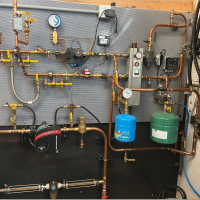
II've done all my own Pex systems in previous house but never had a boiler system just regular DTWT. But yes if it's something I can do then 100% will do just don't know where to tie in and what would need. I've installed all my own Heat Pump minisplits and pretty much nothing would seem to overwhelm me so once I take some full wall pics someone can hopefully tell me where to tie in the new manifold and whatever else needed.
Also would I need another small pressure tank or would the one there supply it as well?