Best Of
Re: Steam Near Boiler Piping
" My plan would be to combine both return lines (both 1 ½”) at the ceiling and drop them down to the Hartford Loop. Would there be any issues combining both of the returns to one at that point in the system? "
NO !! If this is a 'One Pipe' system the returns should be connected way below the water line at the wet return level. You need steam isolation at the end of the returns.
Youtube, the "Silent Steam Team" videos, many example installs. Looks like you are trying to build it like the manual shows, Good !!!
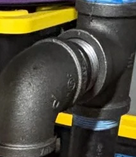
Is this a 'Close' nipple ?
 109A_5
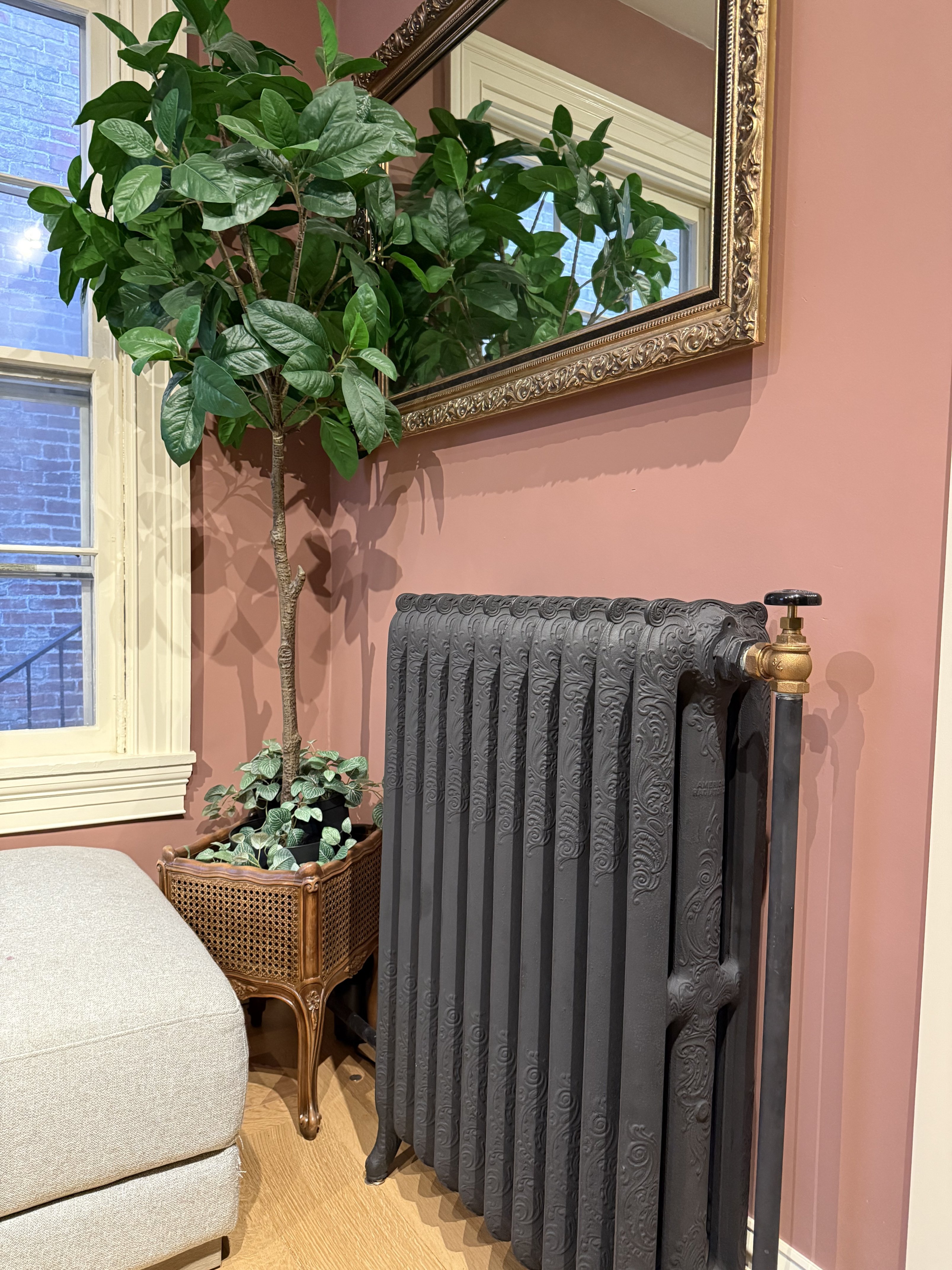
Beautiful cleaned up American Radiator
Been a while since I posted, but mostly as it’s been a while since I needed to (or unnecessarily chose to) work on our system… but as I’ve fired things up for the first time this year, felt like a good time to get a picture of the beautiful American Radiator beast I bought, cleaned up, and installed last year.
 JShep
JShep
Re: Steam Training in New England
That's who I worked for but I worked for a smaller branch in MA. 1992-2001

Re: DIY boiler supply leak woes
I didn't let myself believe it wasn't going to leak for at least two weeks. @Intplm. your realistic and clear-eyed description of just what I might be facing (and, I think, accurate guess about what the plumber might have been thinking) helped a lot. And thanks everyone else too.

Re: New press
The larger tongs (1-1/2 - 2”) are heavy and make the tool front heavy when used. The pistol grip is better in that scenario. But the barrel grip is better for tight spaces. You decide.
 Ironman
Re: Hot Water Recirculating system?
Hi, The gold standard in my opinion is the ACT Metlund demand system. It does what @tim smith did and has remote push buttons and temp sensor to tell the pump when to turn off. It saves around 90% of thermal losses. At the other end of thngs, a well insulated gravity system can work, but some old timers taught me to drill a small hole in the swing check, as gravity might not open it.
Yours, Larry

Re: Outdoor reset
More and more manufacturers are outsourcing their tech support. Retired hydronic contractors or reps are often who is on the other end of the line
You’d rather have an experienced hand on person on the line than someone reading from the same manual that you have.
There are no exact setting numbers for ODR, it needs to be configured to your system, heat emitters, and expected outdoor temperatures the manuals give you starting point examples
If you don’t have some accurate load and swt data, it will be trial and error
 hot_rod
Re: Gas valve/solenoid stuck open on old Janitrol boiler
Short answer YES
If you are getting the standard atmospheric boiler that does not have a combustion air fan, every one of the new ones for residential use are equipped with vent dampers. That is one of those little savings that add up to get the basic entry level boiler to meet the minimum efficiency. The flue passages may be a little tighter design, the electronic ignition and adding baffles to the old original boiler that they all made for over 50 years can be made to reach 80% in the AFUE laboratory.
If your fuel usage is over $4000.00 per winter month and you save 2% that is about $400 per year so the answer will be yes. If you have a very tall chimney and that sucks a lot of heat out of the home and your savings is greater than 2% and more like 5%, then a bigger YES.
In this case @guitbox fuel bill seems to be less than $1500.00 Per year, then the answer would be a big NO
It is all relative to the actual job. Keep the old boiler until it cracks and starts to leak.
When calculating your actual gas usage I always say take the meter reading and divide it by the check you write. That is your cost per cubic foot. When you are on the budget it becomes a little harder but if you look close the information is there. To help my customers determine if a new job is worth the price, I would take the highest bill from the winter and subtract it from the lowest summer bill. That is the difference between the water heater, cooking and laundry. That number might be $300.00 on a $400.00 winter bill. In southern NJ I would use an average of 5 months for the winter season so that annual bill would be $1500.00 in the example I just used. That would account for 3 months of pre season mild weather and three months of cold winter days and three months of post season mild weather.
Then I would determine what the expected saving percentage might be. Back in the early days a new boiler or furnace usually paid for itself in savings within 7 years and that was a go for something that was going to last for 20 to 25 years. Today the cost of stuff is so high that it is rarely a reason to purchase a new boiler or furnace without some other rebate or incentive from the utility company.

Re: New NYC steam radiator inspection law - what does it mean?
Read the law. It's onerous. The legislation will have one certain result. It will make it still harder and more expensive for families with kids to find landlords who will rent to them.
The landlord must include in every lease that he must inspect radiators annually. He then has a 15 day window each year to request in writing in English and Spanish from the tenant a written statement of whom under six years old lives in the unit. If the tenant doesn't reply, in writing, he must report this to the City by a certain date. If he misses any of this, he pays $500.
Each year, the landlord must hire an licensed master plumber to conduct a
" visual inspection for indicators of possible defects or damage of the steam radiator, including, but not limited to, leaking water, browning floors or walls, signs of corrosion on the steam radiator or its surrounding surfaces, any other evidence of water damage, and looseness of the steam radiator valves."
… in each unit where the under 6 year old lives and all common areas. The plumber must then rat out to the City any deficiencies he finds.
Then, of course if those stains aren't removed from the wood, there are fines and more fines…
If lead paint laws haven't ruled out renting to folks with kids, steam radiators will.
With the obscene costs of doing business in NYC, at least the real plumbers who haven't left for Florida and maintain the license and pay the parking tickets can make a few dollars inspecting iron. You see, none of the legion of foreign handymen who install gas boilers with garden hose will ever be able to call himself a "Radiator Inspector"

Re: Steam sight glass
The nature of corrosion gets rather complex, and I'm not about to run a course on it. However, pure distilled water — while corrosive — has a limitation as a corrosive agent: the only available anion is the hydroxyl ion. The only cation is hydronium. in the context of a more or less sealed pipe, there is very little oxygen. Iron, under those conditions, tends to form a nearly insoluble layer (very thin) of Iron (II) hydroxide, which actually protects the underlying metal up to a point. Similar reactions occur with other metals. Now in a boiler the water — almost inevitably — contains other anions, in particular chloride and the carbonates. Unfortunately, the iron compounds formed in the presence of these anions are soluble, and thus the underlying metal is not protected There is also usually some dissolved oxygen present, which will accelerate the conversion of iron metal to the iron II ion.
But there's no need to go into the details. The bottom line is this: the interior of a steam main will indeed corrode, but very very slowly — unless there are areas of standing water such as sags and incorrectly pitched pipes. The interior of true dry returns also will corrode, but again very very slowly. The interior of wet returns, however, can and does corrode rather quickly.
There is a slight tendency for there to be additional corrosion in both steam mains and dry returns at threaded fittings. This is not due to dissimilar metals, but simply because the fitting may have made up in such a way as to leave a small pocket for standing water. This is not usually a problem — at least over reasonable time spans (say a century or two) but is why if one is looking for leaks in steam lines and dry returns fittings are one place to go looking.
