Best Of
Re: Heating and Cooling Options for 1850s Greek Revival New York
@lchamb An important thing to add. When you do make your choice on what to do, choose the installer as well as the product. A good relationship with a reputable company cannot be understated. Look again at the above @ethicalpaul and @Jamie Hall posts.
 Intplm.
Re: Complex System Needs a Simple Solution
You are not crazy. Nor, however, will what you want to do be obvious at first…
However, it is an engineering problem, and as such it can — and should — be approached that way.
First. Define, quite exactly, just what you want the system to be able to do. Not how. Not with what. Not referencing anything that's there at the moment. Just what it is that you want the system to be able to do.
Second, identify what basic conditions you have and, to a basic extent, what equipment you have.
Next identify ways in which the basic equipment — in this case your boilers and piping and radiation or air handlers might be used to accomplish the objectives (e.g. I want the west end of the second floor to be controlled at a constant temperature) and, taking that, assessing whether what basic stuff you have is possibly fit for the purpose.
Now you can begin to figure out how to connect the basic equipment bits together, possibly in groups — or identify places where what you have isn't going to do the job.
Note that I haven't said anything about controls or pumps or valves or manifolds of that sort of thing at this point!
Now you need to figure out how to hook the various equipment you have together to accomplish the goal — or to assess what you need to add.
Now, and only now, can you begin to decide just what controls, such as valve or pumps, you need to make it behave.
And, last of all, you can figure out what electrical controls — most likely thermostats and a few pump control boards at most and how to hook them together.
Take it step by step.
And don't be shy about coming back here with questions!

Re: I'm getting solar panels. I'll let you know how it goes in this discussion thread.
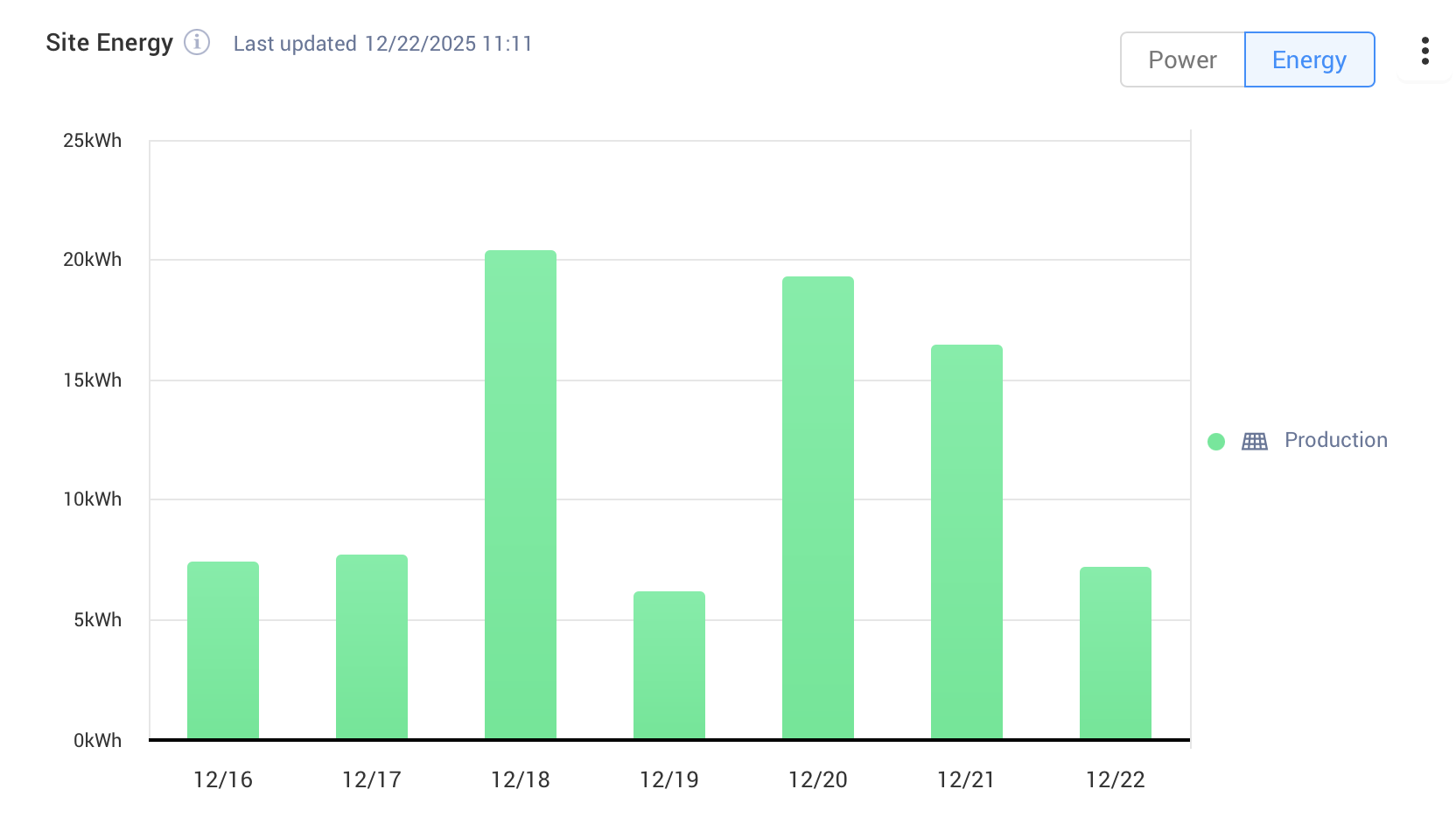
Today is a nice sunny day on the day after the shortest day of the year. I should have really good production as the days get longer
Here's energy, showing daily kWh (12/22 is full sun, but it's still morning):
Here's Power, showing kW over time:
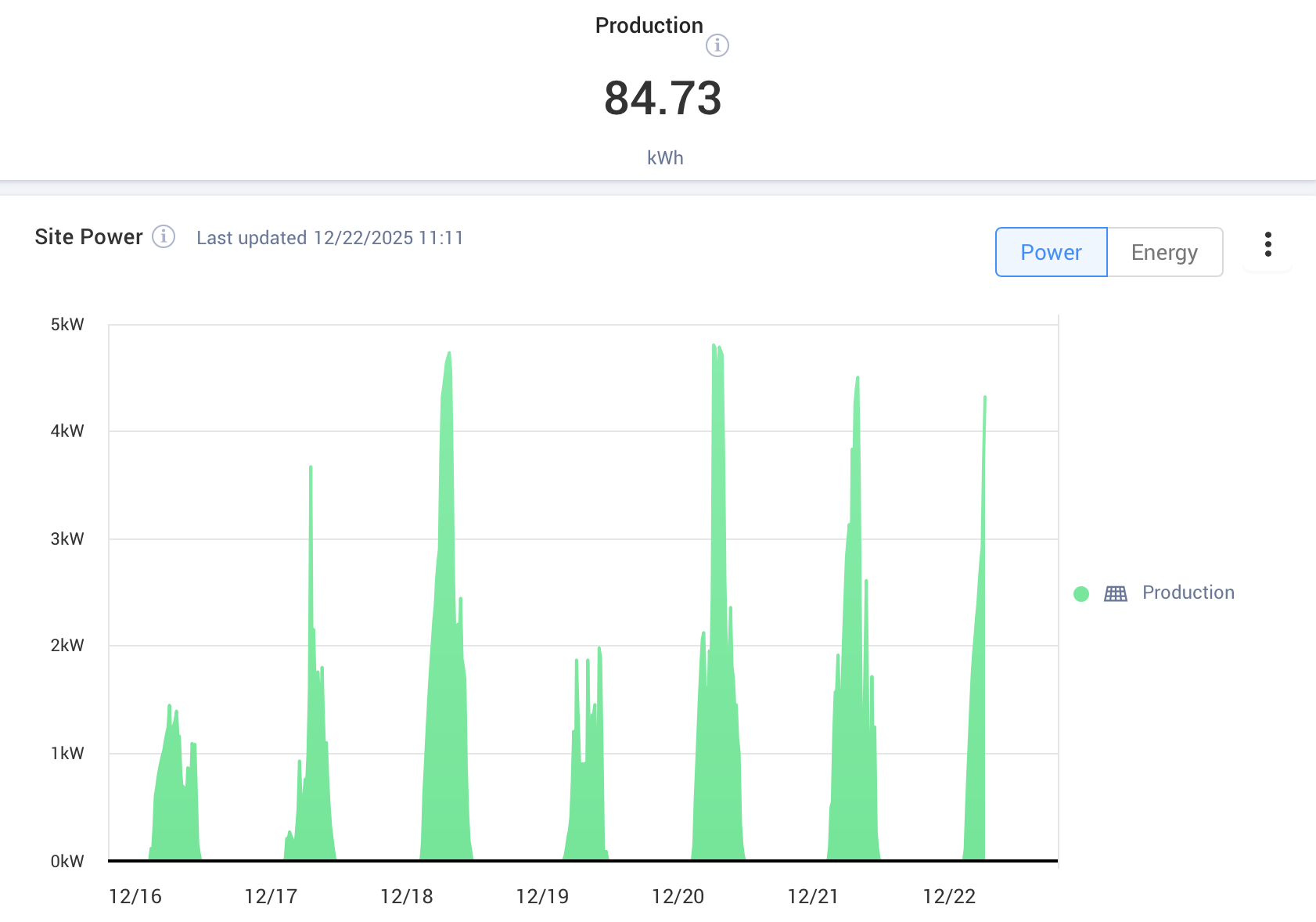
In my first full month of November 2025, I had 438 kWh produced (reported from the solar provider).
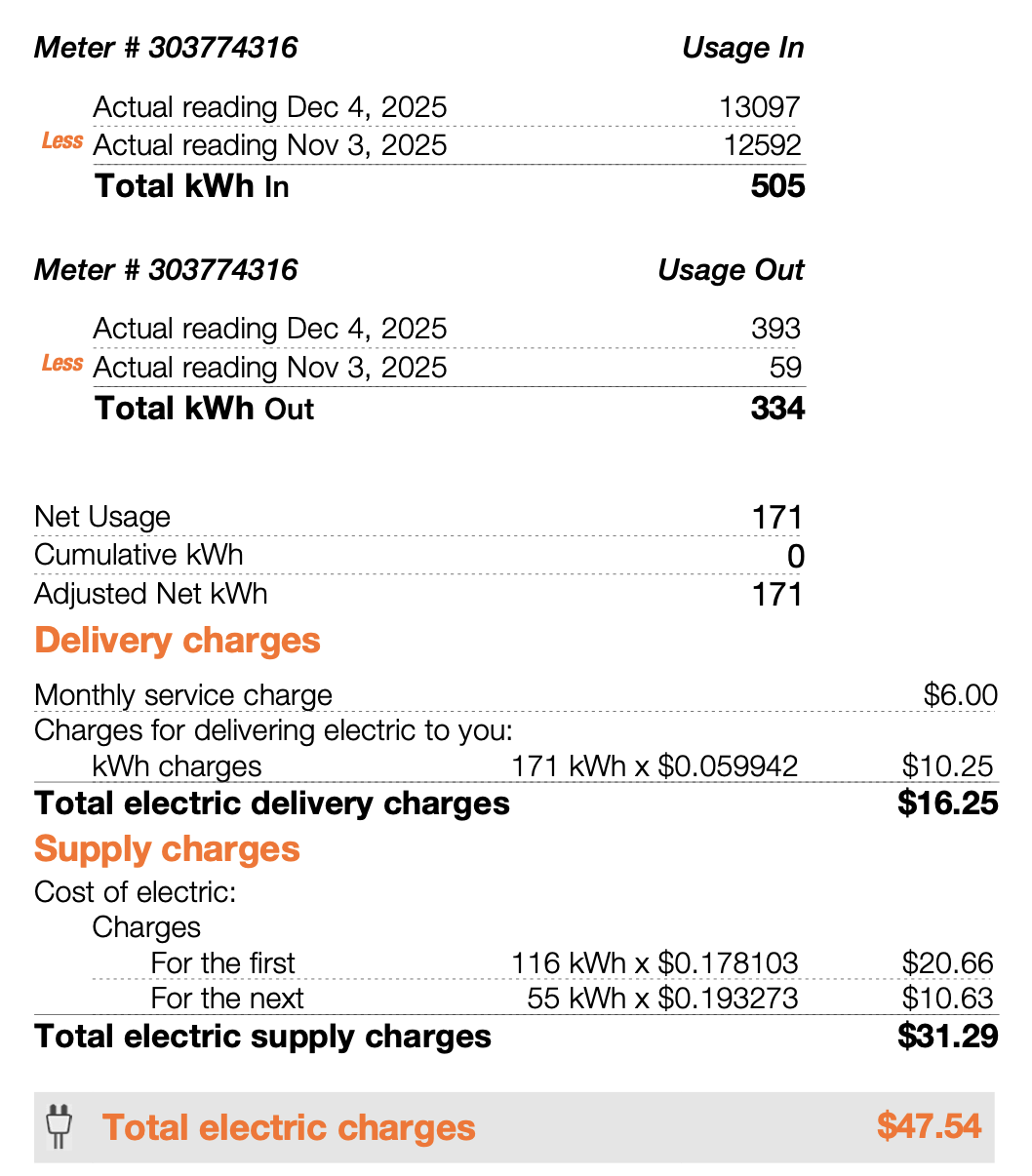
In the utility bill below, though, you'll see the numbers don't match up. This is because there is a number missing I think, and that is the number of kWh of my own production that I used (and so never got sent out to the grid, nor came in from the grid). So I think that number is 438 kWh produced minus 334 kWh sent out to the grid, which equals 104 kWh.
But regardless for now I'm super happy to have output 334 kWh to the grid against 505 kWh incoming from the grid in miserable, cloudy, short-days November. It will be interesting to see which month I first break even, and then of course, the surplus starts piling up.
One more note that I see solar naysayers talk about is the charges that remain on the bill regardless of solar generation, or "Delivery Charges". I will have the $6 service charge regardless, but look at the rest of the Delivery Charges. It is billed at $0.059942 per kWh. But it's only charged against the net incoming kWh which is just 171. That amount will soon be zero and should remain zero as I expect to be at Net Zero electric usage year over year. We'll see!

Re: boiler can't reach the temperature
I saw the tech took apart the aquastat and did some soldering. there were some loose connections
 rlxyz0
Re: Rinnai shuts off during use
Takeaways for those experiencing similar problems is to monitor the HEX temp to determine if the unit is turning off because of over heating. Rinnai should have the unit produce some sort of code for this.
Replacing they bypass valve was very simple, took 15 mins. 4 out of 10 difficulty on this unit, was able to access and remove part without removing anything else. Replaced all O-rings also would recommend if changing any part.
Replacing the Servo was a 6.5 out of 10 difficulty, required really getting into the unit.
Another thing to mention is my unit used to produce a truly annoying air horn sound when cold starting. Here is a clip.
https://www.youtube.com/shorts/vgzstxI2pbQ
Replacing the servo solved the issue, so an unexpected win there after dealing with it for 2 years.
I saw multiple post regarding the same issue, but none really nailed down a solutions. I hope my experience will help someone in the future and I am able to contribute something to this great community.

Re: Let me try this again, this time with a 1" supply pipe. Surely that will cause trouble!
Thanks for the video .. Thinking the increase of system pressure caused by the smaller supply condensed the steam .
 Big Ed_4
Re: Triple Aquastat
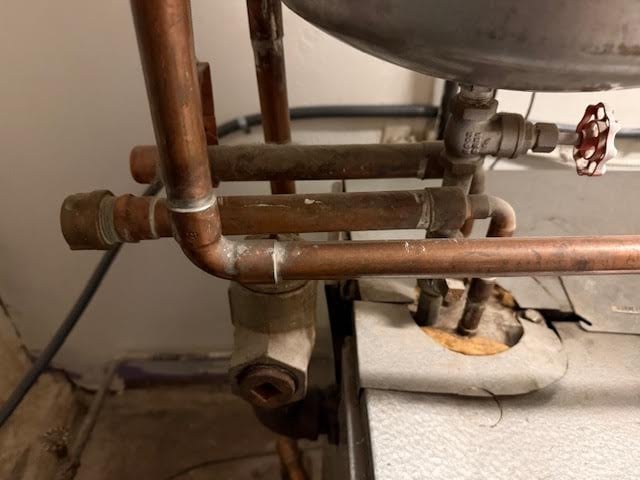
I got so focused on the wiring, that I missed the capped tankless coil and the reason why there was a triple aquastat. They should have changed out the control when they capped the HX and saved a lot of fuel.
I installed the 2-pump control and a simple L6006 aquastat this morning and all is good.

Re: Undersized steam supply causes carryover, right? Right??
IMHO you have to keep in mind the load connected to the boiler as well.
I know for a fact that one job we did in a school that we had issues with. An HB SMITh model 28 boiler brand new 2 of them in fact with 1 5" supply from each boiler piped exactly how the MFG shows in their manual.
I know no one will believe this story.
We did not size the boiler. We just installed what the "engineer " picked and he wasn't an engineer.
We removed two old boilers much larger than what was installed.
On a cold start with both boilers beginning to steam you could not keep water in the boiler. The gauge glass went berserk with the water level jumping up and down violently. tripping low water and bringing on the feed pumps.
This is what I think was happening. And yes the boilers had been skimmed several times.
When the boilers fired and began making steam slowly (large elementary school with a mile of 6" main)
steam started making its way into the system. But there was so much cold 6" pipe and the boilers (I believe undersized) the steam condensed putting a vacuum in the main as the steam collapsed. (2 pipe steam with traps). Now in the instance of a cold start all the water in the boiler has to be at 212 before making steam. Pull a vacuum on the boiler and water happens to the water in the boiler?. It starts to flash and the water level goes nuts You actually for a short time condensing the steam as fast or faster than the boiler(s) can produce it.
They had a steam pressure transducer mounted to the main with a pressure read out and it showed a vacuum. As the boilers cycled on low water, they finally started to gain ground. As soon as the pressure transducer went to +.2psi positive everything ran normal.
Another condition a competitor of mine went through was a boiler with unstable water line. He had the boiler mfg look at it. His condensate was too hot due to traps blowing through.
Condensate was like 200 deg. MFG had the boiler rated at 160 condensate so if you fired the boiler at max normal rating for 160 condensate when the condensate was 200 your overfired..
Btus in the boiler was over what it should have been.
Complicated business.
This is why steam trap MFGs say to size traps at 2-3 times the actual condensate load for warm up load.
The steam a boiler produces isn't just the nameplate rating. Its the nameplate rating at certain conditions.
When the conditions change the output can change.
Risers and the header have to be able to take cold start

Re: Heating and Cooling Options for 1850s Greek Revival New York
Educated homeowner here who recently completed a whole house remodel from bare studs.
Please keep the cast iron radiators. The quality of heat and comfort from these is hard to beat (I had them in a previous house, and I now have radiant floor heat with a wood stove - also nice heat - I would never choose forced air).
If you are doing extensive renovations, consider improvements to the building envelope (insulation and air sealing) to reduce heat loss. This can reduce the size heating system you need by a lot (and reduce fuel cost).
Consider a hot water heat pump for domestic heating. Your cast iron radiators are likely 2-3x oversized and can run with significantly lower temperature water (120 degrees F on your coldest day) and that makes either a geothermal heat pump (somewhat expensive) or a air-source hot water heat pump (less expensive) a viable option if you are ditching the oil system (I second the recommendations from others to get rid of the oil system(s)).
Radiant floor heat is really, really nice, BUT is a lot of work to install and it is hard to find a capable designer and installer (I did this work myself). There is a lot of opportunity for a bad install with radiant floor heating. Plus, you already have cast iron radiators - if I had those already in the house I renovated I would have just used them with my geothermal heat pump instead of installing the radiant floor heating.
New York State (I think) still has some good incentives on heat pump hot water heaters and geothermal heating systems (and maybe air-source heat pump heating systems as well).

Let me try this again, this time with a 1" supply pipe. Surely that will cause trouble!
You may find this video to have a clearer message it's communicating than my last one, thank you for the feedback on that one.
In this one I run all my steam through a 1" pipe to feed my system. We'd be concerned if a homeowner came here looking for help and they had a single 1" supply pipe going to their header, right?