Best Of
Re: Outdoor Reset?
Here is a simple outdoor reset, it is the valve and the controller all in one. all that is needed extra is a 24volt transformer to power it up
and here is the instruction guide
 Dave H_2
Re: 1966 heating oil tank
I went through pinhole leak tank failure in our house, and witnessed a few similar failures for friends and relatives. A few useful things I learned:
- If you have a decades old tank, it is not a matter of if, but when.
1) Tank leak patches:
Leaks are most often pinhole leaks. These can be (short term) mitigated by applying a magnetic patch (e.g. Rectorseal Magne-patch ) to the hole. So it maybe a good idea to have one or a few of these patches on hand, esp if your tank is old, so there is no delay slapping one or a few on, if a leak happens. Will not help with a massive leak, but will with a typical dripping pinhole. I see no downside to having them available. If you don't have them available, you have to wait until a tech can come out, who will slap one on, or until you can have such patch(es) shipped to you. BTW A poor man's magnetic patch is a strong neodymium magnetic disk, combined with a layer of bycicle tire rubber patch layer between it and the hole. My mother-in-law's tank sprung 5 pinpoint holes, and we used the improvised style patch on 3 of these, worked as good as the magne-patch. This tied us over until we could line up a tank replacement. I attached a pic of the purpose made magne-patch (expensive) and a neodymium magnet (cheap).
2) Sludge and leftover oil:
We are in southern MA, and here, it is pretty common for a tank installer, often an oil vendor or burner service company, to pump out the leftover oil into a tanker truck of temporary storage tank, and then pump it back into the new tank. The pump line has a filter but it may not be able to get rid of all the existing biologicals (mold, fungus and bacteria) in the old oil. It is easy to say "get rid of the old oil" or "time the replacement when your tank is empty" , but not everybody has the luxury of time and money to do this. When my tank went, it still had 250 gallons of oil, and I was not about just to chuck ~1K in oil. When they pumped the oil out, they used an overhead hose, and managed to leave the sediment at the bottom of the old tank. The usual installer (all of them we have dealt with) was able to dispose of the sediment for a small fee, along with the old tank. So we just added a biocide and a water dispenser additive when we filled the new tank(s).
3) Additives:
Oil additives you can readily buy are either water dispersants, or biocides. It is hard to find one that does both. I am skeptical about any additive that claims to get rid of sludge, (a "maybe"). Getting rid of ( dispersing) the accumulated water works well, and prevents the biologicals from breeding in the tank, which would lead to sludge formation. So IMO that is a good preventative measure.
![PXL_20250730_161408499[1].jpg](https://us.v-cdn.net/5021738/uploads/TWCHBQTTLRHH/pxl-20250730-161408499-5b1-5d.jpg)
 mrcoder
Re: Main vents on Steam system
That "wasted" steam in the dead pipe will help heat your basement if you want.
I have always put the air vents in the boiler room when possible.
The idea is to have all working/moving parts in one place and hopefully near a floor drain.
 JUGHNE
Re: Base Ray Installation
Base Ray is the best. You need special tools to assemble it. Some supply houses rent them. You will have to check around. If you find a supply that sells Burnham Base Ray they can probably help you out.
Look for the install instructions. They want the wall behind the Base Ray insulated and you need the piping instructions. Base Ray is assembled with push nipples.
If you can configure it with standard lengths, then no assembly will be needed

Re: Base Ray Installation
The end sections (left and right) have 3/4” female threads on the outer side; the rest are push nipples as Ed mentioned. We use RTV to lubricate the nipples when assembling and to provide a good seal.
You’ll need the draw tool to assemble them. I also place one end against a wall and tap the other end with a board and maul while tightening the draw tool.
All of the available lengths are basically two foot sections and end pieces assembled to the desired length.
Get the wider end caps: they will give you more adjustment and working room.
The inside corner kit will also make installation easier.
 Ironman
Re: Co-op in Brooklyn looking for steam consultant, 120 unit, single pipe, 1950s building
Fighting anecdote with anecdote, here in North Jersey it's 95F at 2pm and the voltage in my outlets is 121.9
The grid is fine, updated, and constantly being improved.
Re: Mystery domestic water line
Hi, How about hooking up a wire tracing device that sends a signal down the metal pipe? That could let you trace and find the pipe's location. A search for "wire tracing tool" gives some options. 🤔
Yours, Larry

Specifications for 2-pipe system in large house, 1914
In researching my own building (1925) in Toronto City Archives, I came across information on the beautiful duplex house from 1914 that used to stand beside us. In addition to blueprints that showed the location, type, and EDR of every radiator, there was this textual specification. I thought it would be of interest in this forum.

Re: Navien NHB-055 temp too low
 GroundUp
Re: NPE-240 for baseboard heat?
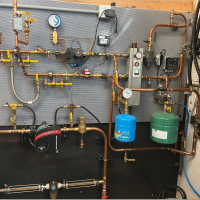
A boiler around 110 - 120k would give you around 2 gpm of dhw. Probably plenty for a small cottage
Thise small combis turn down to around 8k. Much lower than a water heater or a small cast boiler
 hot_rod