Best Of
Re: Beckett furnace keeps tripping
I have no idea what model furnace you have or what the pump pressure is supposed to be. New oil pumps are set for 100 PSI but need to be adjusted to whatever the manufacturer specifications are. That can be anywhere from 100-180 or higher.
The carbon monoxide danger is from the combustion being incorrect and soot forming from incomplete combustion. The heat exchanger will become plugged up with soot and then you can get a puffback into the home. This is what happens when people mess with oil burners without having a combustion analyzer to ensure it's burning correctly! The fact that the burner has been shutting off on safety already leaves me to believe that it was not burning correctly before you started playing with it.
It's your home, your family you can put them at risk if you want to. I have personally seen the aftermath of when homeowners want to play oil burner tech when they don't know what they are doing. The safe and smart decision would be getting a tech who can verify what the pump pressure should be, verify that the correct nozzle is installed and do everything else to ensure safe operation. I'm done with this. I can only say it so many times. Oil burner work is playing with fire. This isn't a DIY project like replacing a toilet.

Re: "Duel fuel" Indirect
You can use a regular electric tank heater and connect a plate HX plus a small recirc pump on an aqua stat for boiler heat. This is what I have and less money than anything indirect. Bonus, unlike a coil tank, you can easily clean the plate HX if you have hard water.
This is how some of the overseas tanks are built:

 Kaos
Kaos
Re: Old high school 2 pipe steam boiler with trane fin blower units.
the vent is to allow water to enter and exit the condensate tank. as @Jamie Hall said, a bad trap somewhere is letting steam in to the returns. that will kill the pump in the condensate tank among other things. obviously each univent and all other emitters have a trap on it and those all need to be good.
the 1960's section with the univents instead of radiators or convectors was the new section of the school…
 mattmia2
Re: Relocating a 1-Pipe Steam Radiator: Cast Iron vs. Brass Fittings?
You are aware that you can't just replace the angle valve with a straight one? That you will also need to replace the spud in the radiator to match?

Re: "Duel fuel" Indirect
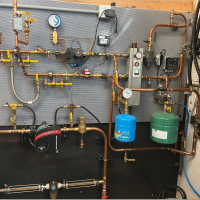
I think Bock still offers them in both single and dual coil with element
Bock manufactured the Caleffi solar tanks, they are a great heavy wall steel, glass lined tank
 hot_rod
Re: Burnham KV 85
Now find the leaks that made the V85 rot out. Bad vents, leaky valve packings, underground return lines.................

Re: Relocating a 1-Pipe Steam Radiator: Cast Iron vs. Brass Fittings?
You can use brass or cast iron or malleable iron. They don't make street elbows in cast iron…never did. They do make them in malleable iron. I would use anything but brass there is no need to use brass as it is more expensive. As @JamieHall said pitch is important. You may have to raise the radiator up on blocks to maintain the pitch.


Re: Relocating a 1-Pipe Steam Radiator: Cast Iron vs. Brass Fittings?
You can mix brass and iron. Not quite sure I'm visualizing how you plan to pipe this so as to use the existing valve and maintain drainage.
Re: A heating challenge!
A roof top packaged heat pump might be the simplest option. It will use a heck of a lot less electricity than a resistance boiler and gets you AC for free. The big names (Daikin, LG, Carrier, York) all make a version in their light commercial product lines, you'll have to see which one is locally available and works better in cold weather. Probably one unit for the shop and one for the office to separate air to keep dust out.
Kaos