Welcome! Here are the website rules, as well as some tips for using this forum.
Need to contact us? Visit https://heatinghelp.com/contact-us/.
Click here to Find a Contractor in your area.
If our community has helped you, please consider making a contribution to support this website. Thanks!
Best Of
Re: Problem with short-cycling, low water, and leaks
This is correct.
The water is almost certainly leaving the boiler as liquid water either through surging or priming throwing it in to the mains.............
I'll say it again, the water is leaving the boiler as liquid not steam, you need to figure out how and why.
Although the boiler is piped per the installation manual with 2" permitted as the riser and header, the steam velocity becomes 45 ft/sec
This boiler should have a minimum of a 2.5" riser (ideally two risers) and preferably a 4" header to slow the steam and allow the water to drop out of suspension.
Notice there is absolutely no time for the water to drop in the very short distance between the top of the riser and the takeoff for the main.
Also, notice that the mains appear to be considerably larger than the riser.
Water is headed up to the radiators in considerable amounts.
 LRCCBJ
1
Re: Reflective Foil Insulation behind radiators
I'm pretty sure this is the only forum where you can get expert advice on troubleshooting a steam boiler AND cooking a turkey without burning the skin. 
 jesmed1
2
Re: replacement for Electrozone relay
If the zone valves are constantly open and the thermostats can handle AC switching, then a Taco SR501 or equivalent will work. TT on boiler is X1,X2.
 HVACNUT
1
Re: Good Ole Mills Steamer
That is a #42 which the "newer" #44 replaced I believe. That I would guess could be 1930s
All those "Mills" boilers with the top and bottom headers were very efficient due to their down draft design. 80% or so would be easy to obtain.
Problem is it is probably massively oversized.
We used to pull the two bottom return headers off clean the muck out and re install them with new nipples. It's quite a job to do that and I did more than I care to admit.
The other problem is the cement and rope between the section would degrade and fall out causing air to leak into the combustion chamber lowering the efficiency.
One advantage they had that Smith used to tout is if one section got cooked or leaked you could cut the supply nipple and two return nipples to the affected section and remove the nipples and put pipe plugs in the headers and continue running the boiler with one less section.
Don't know what size the old steam main coming off the boiler header is but it looks to be 6" screwed i am guessing which also shows the age of the boiler
All those "Mills" boilers with the top and bottom headers were very efficient due to their down draft design. 80% or so would be easy to obtain.
Problem is it is probably massively oversized.
We used to pull the two bottom return headers off clean the muck out and re install them with new nipples. It's quite a job to do that and I did more than I care to admit.
The other problem is the cement and rope between the section would degrade and fall out causing air to leak into the combustion chamber lowering the efficiency.
One advantage they had that Smith used to tout is if one section got cooked or leaked you could cut the supply nipple and two return nipples to the affected section and remove the nipples and put pipe plugs in the headers and continue running the boiler with one less section.
Don't know what size the old steam main coming off the boiler header is but it looks to be 6" screwed i am guessing which also shows the age of the boiler

Re: New boiler surging.
you may need to add a swing elbow to the header as it drops into the tee feeding the existing header to provide the correct pitch. The new header needs to drain into the tee just as the old header is pitched to drain into the current elbow where the new tee should go.  Feeding the steam from above to allow the condensate to drain below with minimal colliding is key in a counterflow system that doesn't have individual drip return lines on each main. That's why Pg. 28 of the boiler manual shows it that way.
Ideally you'd do what @New England SteamWorks shows on one of their diagrams and get a dripped return line for each direction of the main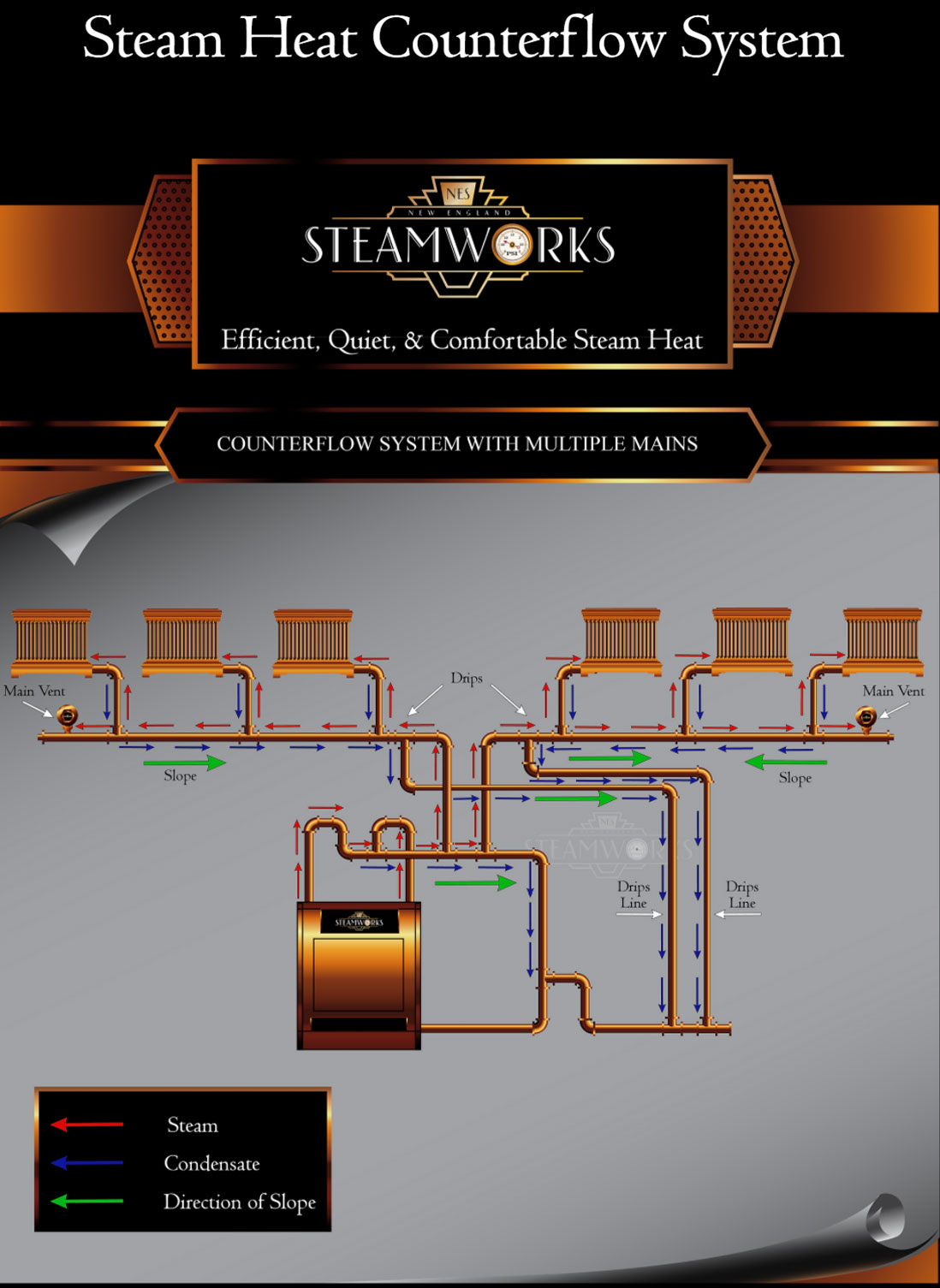 which allows for a header constructed like a typical parallel flow system instead of the fed from above tee configuration shown in my sketches and the boiler manual. NESW's configuration with drips off each main keeps the returning condensate from the mains from having to re-enter the header at all.
Feeding the steam from above to allow the condensate to drain below with minimal colliding is key in a counterflow system that doesn't have individual drip return lines on each main. That's why Pg. 28 of the boiler manual shows it that way. Ideally you'd do what @New England SteamWorks shows on one of their diagrams and get a dripped return line for each direction of the main
which allows for a header constructed like a typical parallel flow system instead of the fed from above tee configuration shown in my sketches and the boiler manual. NESW's configuration with drips off each main keeps the returning condensate from the mains from having to re-enter the header at all.  Waher
Waher
2
Good Ole Mills Steamer
Went to look at this huge church that is having some issues with the system and this old beauty was sitting in her original spot.


 EzzyT
EzzyT
4
Re: Goodman gas valve voltage is erratic
Hmmmmm. I do have a 90+ two stage that won't run on high fire. As near as I can figure, something about the intake &| flue would start to oscillate on high fire but not on low fire. The flames would start surging & lock out after a few minutes or so. This was a temp install for heat during construction, so the flue & intake were just slapped in (although meet the mfgr's specs). I got it to run by just pulling the intake off. Once the mech room is complete I'll scooch it to it's final location & rerun the piping.
I've also seen pressure switch issues with a compromised HX. Everything looked good & was within tolerances (pressure switch, etc.), combustion analyzer said things were great, but the unit wouldn't run until it was warmed up. Trane tech support condemned the HX. (It was someone else's warranty baby, so IDK what ended up happening with it.)
 ratio
ratio
1
Re: YOU WANT TO HEAR A GOOD ONE?
I had to add this for your amusement.
My Son-In-Law and I have an interesting relationship. I think it started when he invited me to out to dinner, so many years ago, to ask me for my only daughter's hand in marriage. I sprung a 10 page questionnaire on him that included things like a Financial statement request, Medical Record Access Authorization form, and criminal record history information. I told him "get back to me when you fill this out." The kid was a nervous wreck and I scared him with that nonsense.
So several Christmases ago I was given this Special 11 x 17 framed Award from my favorite son-in-law.

Last month I earned this recognition from @Erin Holohan Haskell

Can my life get any more awesome?
My Son-In-Law and I have an interesting relationship. I think it started when he invited me to out to dinner, so many years ago, to ask me for my only daughter's hand in marriage. I sprung a 10 page questionnaire on him that included things like a Financial statement request, Medical Record Access Authorization form, and criminal record history information. I told him "get back to me when you fill this out." The kid was a nervous wreck and I scared him with that nonsense.
So several Christmases ago I was given this Special 11 x 17 framed Award from my favorite son-in-law.
Last month I earned this recognition from @Erin Holohan Haskell
Can my life get any more awesome?

Re: Anyone ever seen this style steam rad?
This is in a church in Baltimore, MD. The church was sold to the Seventh-Day Adventist church back in 1950. It was originally a Hebrew Temple.@JXH , if you need some help with this system, let me know.

Re: Steam pipes/test?
Steam leaks in mains do happen and if un insulated chances are higher . If insulated look for spots that the insulation is stained or falling off clear sign there’s a leak . As for pressure testing it can be done ,remove all air vents and plug remove main vents and plug and pressurize I would say only to a max of 1.5 to 2 psi that’s it no point and in going higher system should never see that hi a pressure . I would think the easiest way would be to have ultra sonic leak detector , which should be able to pin point it . I don’t have one but it’s on the wish list reason being I have a few refregerant leak dect. And have found for refrigerates I haven’t had a need for an ultrasonic leak dect for refregerants yet but like I said in the works $$$
You should take a good look and see if there are visible signs of leakage from radiator vents and radiator supply valves . If going a replacement boiler be sure it’s sized to match the existing edr and if you have wet returns take my advise if zero maintaince has been the mantra do ur self a favor and have the wet returns checked out and even if replaced have isolation and purge valves installed ,you will be needing them to flush out everything that will end up there . One final note if hiring some one make sure they know what there doing not just a sales guy ,you want a owner / operator to do your replacement ,this way it ain’t just the sales guy w a pitch and commission and a lower price and then your looking for some one else to finish what there price did not include . I see it all the time lol
Being the home is in heating disrepair don’t think it will be cheap in this day and age . Aside from proper boiler piping and sizing ,a true steam boiler upgrade in my eyes includes new radiator vents and main vents and I hear it all the time that there new ,that’s fine cause if they don’t work and it’s not priced in you pay extra If none of that is included in my eyes you need a different contractor being without these items a properly operating would be crap shoot and there’s be extras like re do the rad vents and mains . Again take all w a grain of salt I tend to tell the truth and this is it as I see it . Get one guy make sure he s not full of Pooh so there’s no bs and check his references .
I know this as a noble truth because i see it all the time 1/2 butted jobs and they except it all straighten for peanuts lol myself I’ll hang out at home eating peanuts before I work for nothing for those looking for a bargain ,if so you got the wrong tree to bark up .In general stay away from franchise bossinesses in my experiences it’s always a half a mech doing the work and the future of workers now a day are beyond lazy just looking at a cell phone and getting home and usually milking any job they do cause nobody likes getting back to shop early to be sent out again .More concerned about there life then your heating system . Again one of the four noble truths according to the clam .
Remember steam is pretty easy w just about zero moving parts aside vents and gas valve it’s not that hard so any one who shows up in sneakers w clean hands and good back should be shown the door espically sneakers
Take it all w a grain of salt ,only the truth
Peace and good luck clammy
The sweetening of a cheaper price is soon forgotten after the bitterness of poor quality .
You should take a good look and see if there are visible signs of leakage from radiator vents and radiator supply valves . If going a replacement boiler be sure it’s sized to match the existing edr and if you have wet returns take my advise if zero maintaince has been the mantra do ur self a favor and have the wet returns checked out and even if replaced have isolation and purge valves installed ,you will be needing them to flush out everything that will end up there . One final note if hiring some one make sure they know what there doing not just a sales guy ,you want a owner / operator to do your replacement ,this way it ain’t just the sales guy w a pitch and commission and a lower price and then your looking for some one else to finish what there price did not include . I see it all the time lol
Being the home is in heating disrepair don’t think it will be cheap in this day and age . Aside from proper boiler piping and sizing ,a true steam boiler upgrade in my eyes includes new radiator vents and main vents and I hear it all the time that there new ,that’s fine cause if they don’t work and it’s not priced in you pay extra If none of that is included in my eyes you need a different contractor being without these items a properly operating would be crap shoot and there’s be extras like re do the rad vents and mains . Again take all w a grain of salt I tend to tell the truth and this is it as I see it . Get one guy make sure he s not full of Pooh so there’s no bs and check his references .
I know this as a noble truth because i see it all the time 1/2 butted jobs and they except it all straighten for peanuts lol myself I’ll hang out at home eating peanuts before I work for nothing for those looking for a bargain ,if so you got the wrong tree to bark up .In general stay away from franchise bossinesses in my experiences it’s always a half a mech doing the work and the future of workers now a day are beyond lazy just looking at a cell phone and getting home and usually milking any job they do cause nobody likes getting back to shop early to be sent out again .More concerned about there life then your heating system . Again one of the four noble truths according to the clam .
Remember steam is pretty easy w just about zero moving parts aside vents and gas valve it’s not that hard so any one who shows up in sneakers w clean hands and good back should be shown the door espically sneakers
Take it all w a grain of salt ,only the truth
Peace and good luck clammy
The sweetening of a cheaper price is soon forgotten after the bitterness of poor quality .
 clammy
2