Best Of
Re: Need new boiler
There's a lot more to it than that.
First, "burning poorly" is a service and adjustment problem. Something a competent tech should be able to remedy. A brand new boiler can burn poorly. A 50 year old boiler can burn very well.
Second, rust — without a leak — is not necessarily a problem. Is it leaking? If not, it ain't broke.
Now let's suppose that it is in fact leaking.
To replace it you first need to know what the actual heat loss or power demand of the system is. With hot water heat, there's no point in putting in a boiler which can make more heat than the building can use. Also with hot water, it helps to know what temperature the system needs to run it — which is determined partly by the heat loss and partly by the radiators or baseboards or whatever that are in there..
Then you need to choose a fuel.
Then you can begin to wonder what boilers to look at.
Oh and just one more thing. We don't quote prices on The Wall.

Re: My old Buderus
If you can't afford a lawyer, call the local news channel. Someone came in and completely wrecked your heating system, and they want to charge you more to make it right? That's not how it works.
I'm curious what model Resideo they installed.
And sorry to twist the knife, but we're not allowed to discuss pricing.
 HVACNUT
Re: Water hammer in steam system
Check the pitch first before you get carried away. I could be wrong — I have been before. On a short section of pipe like that I'd want to see at least a half inch drop back towards the main.
How to pipe it? Not sure how I'd do it… Get creative.
Re: 1920s Steam System - How to Add Main Vents
The "main". Start with the pipe coming straight up from the T on the side of the boiler in the first picture. That's the beginning of your main, and it remains a main all around the basement until you get to the very last radiator takeoff. It may split, in which case you now have two mains…
And it needs to be vented, which can be done anywhere after the last radiator takeoff and before it drops to the boiler.
Now it looks as though you have at least two drops — they're also in that first picture — and it looks as though one of them may have a pipe from a near floor level pipe, which probably picks up a drop somewhere else in the basement. Problem. Those to drops join above the water line, and that may give some problems. Have to see more to know.
Problem number two: the insulation on those pipes has asbestos…
Re: What say you ? She’s steaming
It isn't an emergency but I would try to do it as soon as you can reasonable schedule it. You could probably get through the season on that if you absolutely had to but it isn't the recommended course of action.
Make sure the LWCO and water feeders work.
 mattmia2
Re: Moving steam return in one pipe system…images in thread
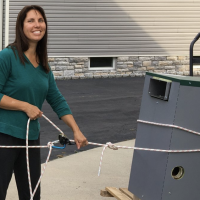
Because you don't want it near the water line of the boiler
Re: Moving steam return in one pipe system…images in thread
Rules tend to be unhelpful, because there are too many exceptions… but…
First, the pipe carrying the steam to the radiators has to be pitched to allow the condensate which it also carries to drain. It can either pitch back to the boiler or away from it. But it has to pitch.
At its lowest point it has to connect to a pipe which will carry the condensate back to the boiler. In your case, that is the pipe which you want to move. That pipe can either be high, but lower than the pipe carrying steam, in which case it must pitch back toward the boiler where it can drop to the boiler, or it must be well below the water line of the boiler — preferably at or near floor level. If it is low, it doesn't need any pitch.
The air has to be able to escape freely from the pipes. That is called main venting. Where the main vent or vents is placed depends on how high that return pipe is.
Re: National Radiator Corporation boiler- Repair???
The boiler and burner appear to be from the 1940s or so; there is no sign of piping alterations so they are probably original to the house.
Those old boilers were originally designed to burn coal and were built like tanks, but it is probably 80 years old, has undoubtedly suffered from corrosion and is not worth repair or additional investment. The burner is obsolete and inefficient; the motor is almost certainly shot and other parts will be hard to find. You would need a new oil tank as well. If the tank is underground, it may have leaked and then hazardous material remediation would be needed.
If you want to keep the steam, a new boiler correctly sized for your existing radiators— which the contractor should measure —and installed by a steam specialist would be a better investment. If you can get natural gas service, you will not need a new oil tank. You could run a steam boiler on propane, but that is an expensive fuel in most eastern markets.
Unfortunately few contractors in your region understand residential steam. Have you tried the "find a contractor" link on this site? I believe there is at least one steam specialist in Virginia.
 bburd
bburd