Capacitor replacement
Comments
-
The OP's question was basically answered early on, a few times.
National - U.S. Gas Boiler 45+ Years Old
Steam 300 SQ. FT. - EDR 347
One Pipe System0 -
Guess we scared the OP off. We beat the hell out of this one.
 1
1 -
The best part is how many run caps now say "370/440" .
Not too long ago simply putting 440 was good enough, but I guess it's not anymore. Pretty soon the wires and top of the cap will be color coded too with different size quick disconnects.
Single pipe 392sqft system with an EG-40 rated for 325sqft and it's silent and balanced at all times.

 2
2 -
The VAC needs to be than the voltage generated by the start winding. I only use 440 VAC caps anymore
0 -
The voltage needs to match or exceed the spec by the motor manufacturer.
My point was, they can't just put 440 because apparently a lot of people think they can't use a 440 on something that calls for 370.
Single pipe 392sqft system with an EG-40 rated for 325sqft and it's silent and balanced at all times.
 1
1 -
I am glad that capacitors spark as much conversation on here as they do in our shop. it's surprising how such a mundane part interests so many people. And I was joking earlier about gatekeeping the caps, I actually only sell them to homeowners because I know it will be a repeat customer (they are coming back for a contactor next) 😁
-i'm sorry i cannot help myself
 1
1 -
Cheap junk.
Caps used to last almost forever. I have had equipment that is 40 years old and never replaced a cap. Now they only last a few years. I guess when they took the "good PCBs" out they don't last anymore.
Or maybe it is a rating issue. The new caps seem to be smaller and lighter for a given rating like they took 1/2 the guts out of them.
1 -
Comments about not allowing people to work on their equipment is what sparked interest, not run caps.
I knew your previous comment was a joke though.
@EBEBRATT-Ed The reason I ended up with my first AC was because the cap died, and that one was made in 1980 and only lasted until 1986.
Single pipe 392sqft system with an EG-40 rated for 325sqft and it's silent and balanced at all times.
0 -
Typical arsonist. She lit a fire and ran away.
1 -
I have seen pcb and non-pcb varieties last a decade or 2 then fail. the ones i bought that were made in the us or Mexico recently seem to be getting a similar life. they came up with better dielectric materials probably around the late 70's so they got smaller because the material between the plates is thinner. the ones that i had only last a year or so were the commodity chinese ones that i bought from some web site that sells motors for a couple bucks each. you get what you pay for in caps. it is kinda that way with caps used in electronics too.
0 -
Nothing is made the way it used to be. Maybe heat contributes to early cap failure. Rheem/Ruud used to use grey plastic body capacitors where only the posts were in the electrical cabinet. The body was inside where the fan is. So when the condenser was running it would constantly have air moving across it. They always lasted a long time. The downside was the ratings information getting worn off from being out in the weather.
0 -
the life of an electrolytic capacitor is a function of voltage and temp.
0 -
Another complicating factor is efficiency. New stuff has high efficiency because of tighter tolerances and more complex controls.
The unfortunate side effect of that is that things wear out faster because of the added complexity and quicker loss of important tolerances.
When your specs were just, "make fire, have heat", there's just not anywhere near as much to go wrong
0 -
I've never heard that modern compressors have tighter tolerances than older ones.
Are you sure about that?
Modern systems are supposed to be charged more correctly and run the proper amount of super heat and subcooling. Condensers and evaporators might have smaller passages, but do those wear? But as far as I've heard, the compressor tolerances aren't any different than 100 years ago.
Single pipe 392sqft system with an EG-40 rated for 325sqft and it's silent and balanced at all times.
0 -
it is more that there are more parts involved so they make those parts cheaper to meet that price point. it is that we have been conditioned to thik if you are paying more you must be getting ripped off, not that you're getting more combined with institutional customers havcing policies that they have to pay the lest for something without any sort of meaningful rules to evaluate if they 2 prices are actually for the same thing.
0 -
What's funny tho is it still seems like the phrase "compressors don't die they're murdered" still usually holds true.
Why has everything else gone down in quality and reliability but compressors? For the most part, obviously there's been some exceptions to the rule. You tell anyone you had a compressor die and the first thing they're going to assume is you did something to it.Single pipe 392sqft system with an EG-40 rated for 325sqft and it's silent and balanced at all times.
1 -
I wasn't really speaking directly about compressors, but more so just equipment as a whole.
I deal mostly with pumps so in my world for example there's still plenty of 80 year old pumps still out there running with maybe 50-60% efficiency. A brand new pump doing the same duty point should be able to get 70-80% efficiency, but that's because of better hydraulic design, better tolerances on wear rings, that sort of thing. I wouldn't expect a new pump to last 60-80 years unless a building goes out of there way to very carefully maintain it.
For controls, a properly sized NEMA starter is an overbuilt tank that will run for 30-40 years easy if it's not abused and if you pair that with a pressure reducing valve on the pump discharge you get a regulated output. But you waste plenty of energy with that setup, It's like driving with the gas pedal floored and using the breaks to slow yourself down. The modern control method is a VFD, which while great at saving energy because then you just run the pump at the speed you actually need it. But I also generally expect them to last around 7-15 years depending on how harsh of an environment they're in.
2 -
but there is no reason you can't build a vfd to last 60 years. in fact i suspect there are a lot more VFDs from the 80's still out there working than from 10 years ago.
0 -
you can build anything
Does the consumer want to pay the price?
No
No way
HELL No
We live in a Walmart societyCheap
Cheaper
Cheapest
 3
3 -
We have become a throw away society.
It's a race to the bottom.
The idea is to reduce the quality and longevity to just a hair below the breaking point. So for example you get a condensing unit to last 18 years instead of 30-40 and everybody is happy plus changing refrigerants means you don't repair older units and ad that to the increased labor costs and more equipment gets thrown away in the name of efficiency.
Same thing with boilers .
Once people get used to the higher prices and lack of longevity things will be normal again.
Nobody drives a 10-year-old car anymore they buy or lease a new one especially the younger people, they are used to the payments and the higher prices. It becomes normal.
0 -
i would disagree on cars. after about 10 years of road salt the cars of the mid 80's and before were done. now it is pretty common to see cars that are 15-20 years old. between what used to be an $8k car costing $25k and the better corrosion protection and the difficulty in actually finding a car to buy you find people foxing stuff that they would have scrapped the car for 20 years ago.
1 -
Plenty of cars and trucks were rotting after only 2 years in the 70s.
Single pipe 392sqft system with an EG-40 rated for 325sqft and it's silent and balanced at all times.
 1
1 -
isn't that what i said? some fords were still doing it in the 90's
0 -
0
-
i'm pretty sure all of the compressors are good in the 4 dehumidifiers in my dehumidifier raveyard. maybe i should just get a roll of acr tubing ane make my own coils like david allen. or get a 30 year old ac evaporator and cut appropriate slabs out of it and braze on interconnections to the cut end.
0 -
@EBEBRATT-Ed was there more in that docx file than a link ?
https://www.youtube.com/shorts/kesx8hZMAmM?feature=share
National - U.S. Gas Boiler 45+ Years Old
Steam 300 SQ. FT. - EDR 347
One Pipe System0 -
Channell is "@frostschieldhvac"
Video is '"Home Depot selling HVAC Parts"
0 -
i bought a fan center and thermostat at home depot that i used to control a window air conditioner in my apartment almost 30 years ago.
0 -
No you said after 10 years in the 1980s and before.
Single pipe 392sqft system with an EG-40 rated for 325sqft and it's silent and balanced at all times.
0 -
I was surprised when I found out they did. I saw an experienced tech get his finger tip blown off by a single careless moment.
Steve Minnich 1
1 -
it usually is only possible with a start cap and even then only with a potential relay start circuit(or bad start components). with a run cap or a centrifugal start switch the motor is shorted across the cap at dc
0 -
it was a residential unit.
Steve Minnich0 -
Personally, I find a typical CAT I gas water heater to be the most dangerous thing sold in home centers that should not. However, IF a retail store is going to sell run caps, they would do themselves well to require the purchaser to sign a written warning about the hazard of severe shock.
0 -
What about circuit breakers and receptacles? Romex and MC Cable?
Sears was selling gas water heaters in the 50s and as has as I know they've always been readily available to the public.
The United States of America, land of the free has too many rules already. We don't need more.
We do need shop classes etc back, not more limiting.
Single pipe 392sqft system with an EG-40 rated for 325sqft and it's silent and balanced at all times.

 2
2 -
Amen, brother @ChrisJ .
And just for chuckles — if any of you really want to find out what getting truly zapped (but not electrocuted — that's different!) try the main power supply capacitor on a tube type high fidelity amplifier or PA amp (think around 10,000 mfd at, typically, 400 to 800 volts) or for real jollies the plate terminal on a cathode ray television tube… not so many mfd (I forget the spec.) but that 10,000 plus volts will wake you up right now…
And yes, your dimwit scribe has tried them both…
Br. Jamie, osb
Building superintendent/caretaker, 7200 sq. ft. historic house museum with dependencies in New England0 -
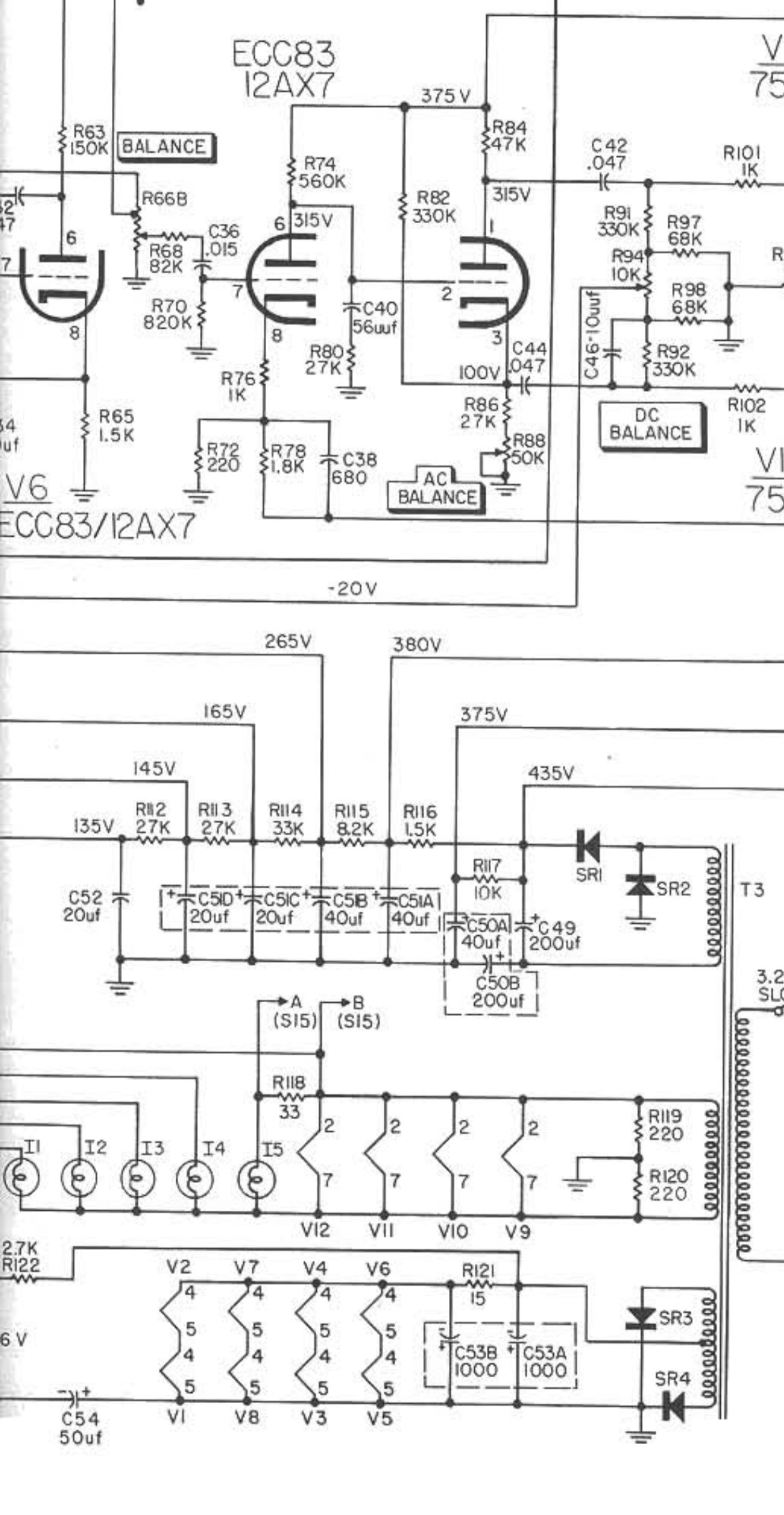
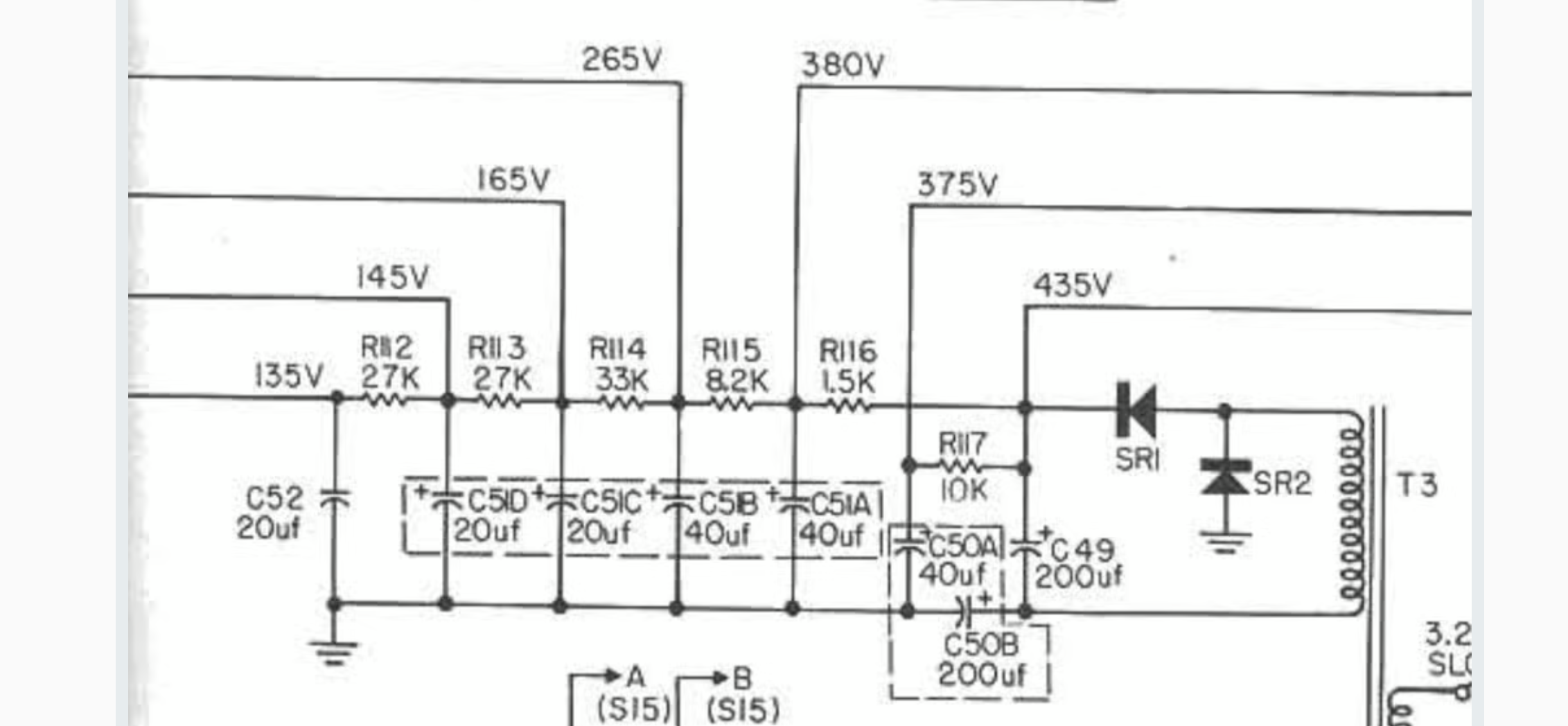
10,000 uf at 500-800v?
I've never seen that on an amplifier. It sounds like you're mixing solid state amplifier capacitance with tube voltages. Tube amplifiers typically have low capacitances like 40uf at higher voltages.
For example
Single pipe 392sqft system with an EG-40 rated for 325sqft and it's silent and balanced at all times.
0 -
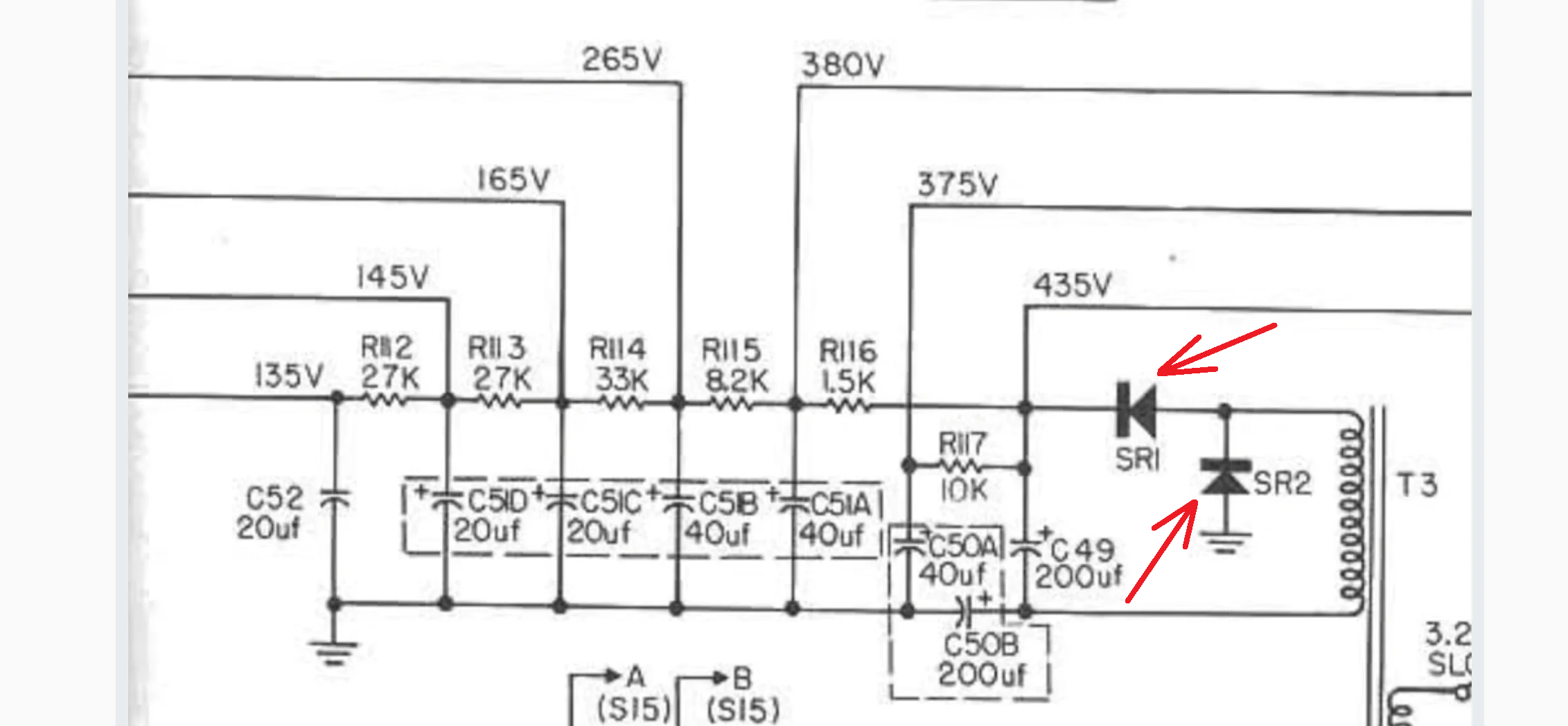
Hmmm… Amusing. A predominantly Tube piece of equipment with Solid State rectifier diodes (SR1 and SR2) as a voltage doubler circuit certainly could have had Zener diodes if needed. Maybe SR1 and SR2 are Selenium. If needed you can use tubes for voltage regulation, series and/or shunt regulation, not a big deal. Often by design tube gear really did not need any significant voltage regulation.
 National - U.S. Gas Boiler 45+ Years Old
Steam 300 SQ. FT. - EDR 347
One Pipe System0 -
selenium rectifiers existed long before germanium and silicon rectifiers. they were common in post war or so tube equipment. circuits were designed to keep the current reasonable within a fairly wide voltage range because it is far more complex to make a tube voltage regulator than a semiconductor regulator. though it is shown as a single diode there, selenium rectifiers were a stack of several rectifiers to get the needed reverse voltage rating so they had junction voltages of several to 10 or so volts.
0 -

If you don't know how to make the piece of equipment safe (to work on), you probably should not be working on it. To me, it really does not matter who sells the repair parts.
Don't do this, it may be the last thing you do.
National - U.S. Gas Boiler 45+ Years Old
Steam 300 SQ. FT. - EDR 347
One Pipe System0





Categories
- All Categories
- 87.8K THE MAIN WALL
- 3.3K A-C, Heat Pumps & Refrigeration
- 60 Biomass
- 430 Carbon Monoxide Awareness
- 133 Chimneys & Flues
- 2.2K Domestic Hot Water
- 6K Gas Heating
- 124 Geothermal
- 170 Indoor-Air Quality
- 3.9K Oil Heating
- 79 Pipe Deterioration
- 1.1K Plumbing
- 6.7K Radiant Heating
- 397 Solar
- 16.1K Strictly Steam
- 3.5K Thermostats and Controls
- 56 Water Quality
- 51 Industry Classes
- 51 Job Opportunities
- 18 Recall Announcements