Welcome! Here are the website rules, as well as some tips for using this forum.
Click here to Find a Contractor in your area.
If our community has helped you, please consider making a contribution to support this website. Thanks!
Capacitor replacement
Comments
-
" because it is far more complex to make a tube voltage regulator than a semiconductor regulator. "
Tight voltage regulation in tube gear often was simply not needed, so they did not bother. Not that they could not do it because some solid state components did not exist.
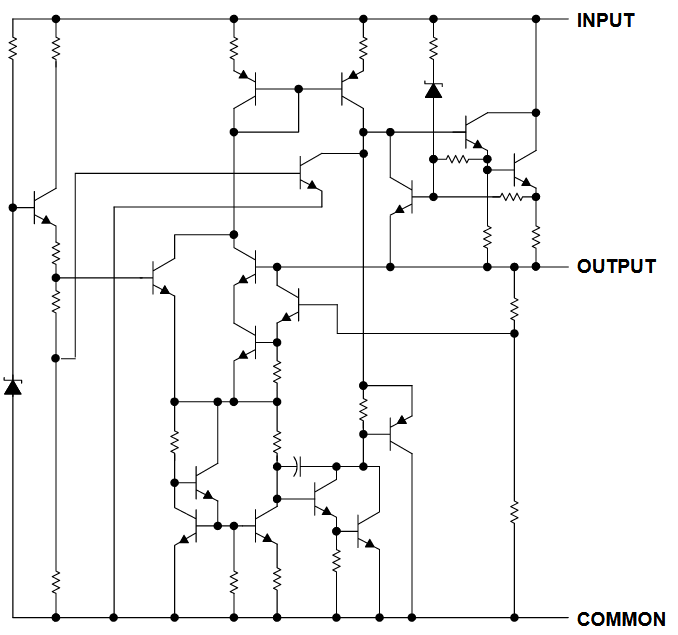
Typically solid state regulators are way more complicated than a tube regulator if you look at actual devices used inside the typical solid state regulator. An LM7805 for example is just not one transistor inside.
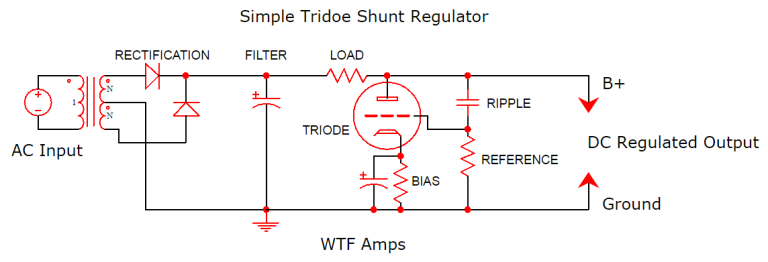
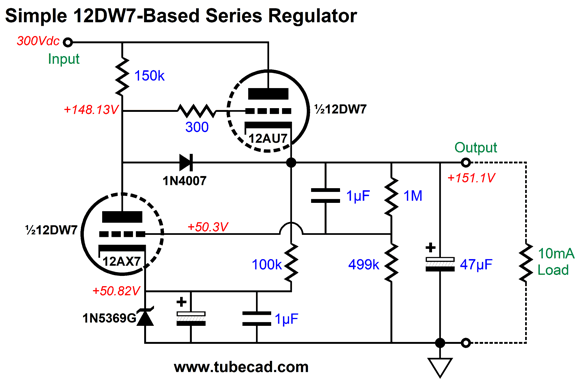
Shunt regulators tube examples (one tube per voltage)
0A3 – 75 volts
0B3 – 90 volts
0C3 – 105 volts
0D3 – 150 voltsor solid state Zener diodes are pretty simple to use.
Tube circuits are pretty simple.
 National - U.S. Gas Boiler 45+ Years Old
Steam 300 SQ. FT. - EDR 347
One Pipe System0 -
but you have a lot of extra parts to support a tube that you don' need for a semiconductor. you just design things so if the voltage changes by 30% or so the current doesn't get out of hand. tubes aren't inherently any better at working with a wider range of voltages than semiconductors, operating ranges were set where it wouldn't be a problem because regulation was expensive. 78 and 79 series ic regulators cost less than a dollar. all the extra parts to make a tube work add up. sometimes some regulation was provided by the reactance of the transformer.
0 -
Apparently you have not looked at the parts count to just get 5 VDC from a SMPS.
I never said tubes were better, all I am saying is your statement
" it makes the various voltages with a voltage divider because they didn't have solid state voltage regulators or zener diodes:"
is very misleading if not just inaccurate. They built tube power supplies with resistor voltage divider circuits because that is all that was needed for that circuit to work. No regulation needed, the voltages were set by what the circuit stage needed by picking the correct resistance between voltage rails as the load current branched off.
If they needed regulation to make the tube circuit work it was available.
Solid State is much more complicated you just don't see all the fun buried inside. And you still need support components. LM7805 equivalent circuit.
 National - U.S. Gas Boiler 45+ Years Old
Steam 300 SQ. FT. - EDR 347
One Pipe System0 -
Maybe we should change the name of this thread to Condenser Replacement?
I love this place.
 1
1 -
@109A_5 Those are silicon.
That's a 1963-64 piece of equipment and many had selenium for the filaments / bias supply but not that specific one. That was all silicon for the power supply.
Single pipe 392sqft system with an EG-40 rated for 325sqft and it's silent and balanced at all times.
0 -
That's difficult.
There's another condenser involved, which I think is actually why the name was changed to capacitor.
Single pipe 392sqft system with an EG-40 rated for 325sqft and it's silent and balanced at all times.
0 -
the parts count to get about 5vdc is 3. a ct xfmr and 2 diodes. 4 if you want it filtered. that is why they use voltage dividers for their power supply. in a voltage divider the parts count for each voltage is about 1 (plus one resistor at the end). if you use the tube filaments for some of the resistors it isn't even that.
even linear voltage regulator ICs are pretty much obsolete now because everything uses switching dc-dc converters now and regulates by regulating the switching.
0 -
The high speed switching DC-DC converters are really wonderful. Even more wonderful — and working on a similar principle — are the Class D amplifiers. Purists hate them, of course — but they do the job. One of my hi-fi systems (I still call them that, old fuddy duddy) has an older solid state, but otherwise conventional, power amp. Great unit — but big. Another one is a really old tube amp (almost never used — anyone priced the big output tube pairs lately?) The third is a a nearly new class D, and the dang thing sounds wonderful and sits in a box which is about 3 inches on a side.
Br. Jamie, osb
Building superintendent/caretaker, 7200 sq. ft. historic house museum with dependencies in New England
 2
2 -
linear amps waste a huge amount of power to make the amp run in the linearish area of gain. of course switching amps have the same problem as any other switching supply in that it is critical that you spec the caps properly for longevity. still don't think they are efficient enough that they aren't lying when they claim like 8 100 w rms channels out of a 120v 15 a ckt but they are far more efficient than class ab or class a amps. the quiescent current is really what kills the efficiency of linear amps. they have to be using like 4x the output power even with no input signal. all the stuff we use for classrooms and auditoria is switching now.
0 -
That looks like an early 1960s HH Scott…
0 -
Oh man…
Avery is rolling in his grave at that comment.
Single pipe 392sqft system with an EG-40 rated for 325sqft and it's silent and balanced at all times.
0 -
i don't know what it is but it looks like pretty much every piece of tube equipment with a xfrmr power supply.
0 -
Did you reverse search that picture? 😉
Single pipe 392sqft system with an EG-40 rated for 325sqft and it's silent and balanced at all times.
0 -
No, I fed all this into Google
"what audio tube amp circuit schematic has 435 380 375 265 165 145 135 voltage rails and V6 is a ECC83/12AX7 output may be 7591". There is also a redrawn Sams Photofact available too.
I wanted to see the rest of the circuit. I grew up with tube technology. It is amazing what they could do with tubes, Audio to X-Ray. And all these circuits used capacitors.
National - U.S. Gas Boiler 45+ Years Old
Steam 300 SQ. FT. - EDR 347
One Pipe System 1
1 -
If you look up a Fisher X-100 you'll see them using the output tubes essentially as rectifiers for the preamp tube filaments.
If you turned it up fairly loud, getting close to clipping, the filaments of those preamp tubes got brighter with the music.
Single pipe 392sqft system with an EG-40 rated for 325sqft and it's silent and balanced at all times.
2 -
NOOOOOOOOOOOOOOOOOOOO!!!!!!!!!!!!!!!! My shame in unimaginable right now..
I have a small collection of Fishers, including two X1000 integrated amps, one was my dad's that he bought new in 1962 and the other I bought on ebay in 1998.
2 -
Yes, that is an interesting circuit. Eliminates the need for the negative bias supply rail and maybe a few parts. Someone noticed that 4 times the EL84 / 7189 Anode current is close to the DC filament current of the ECC83 / 12AX7. Or the tube design engineers had that topology in mind. DC filaments can help improve the Hum specification.
I also wonder if slightly delaying the warm up of the Pre-Amp and AF-Amp stages has any benefit.
National - U.S. Gas Boiler 45+ Years Old
Steam 300 SQ. FT. - EDR 347
One Pipe System0 -
How much time did you guys spend in Radio Shack?
1 -
Very little.
They had very little knowledge, limited parts etc.
Single pipe 392sqft system with an EG-40 rated for 325sqft and it's silent and balanced at all times.
0 -
I'll have to dig out the circuits for my Dynacos and Citation. They're around here somewhere… They originally used selenium rectifiers, and all of them used DC on the tube filaments. That I do remember. The solid state Dynaco which is still my preamp — a PAT 4 — I upgraded a couple of years ago to a much better power supply (there's a guy in Pennsylvania who designs these things). MUCH better. Which, considering the performance before the upgrade is saying a lot (it went from a barely audible hum when both it and the power amp were cranked up all the way to none, even with an oscilloscope).
How much time in Radio Shack? Back in my day for these things they were pretty good — but so was Knigth (remember them?). And Heathkit…
Br. Jamie, osb
Building superintendent/caretaker, 7200 sq. ft. historic house museum with dependencies in New England0 -
The nice thing about Fisher equipment is you didn't have to modify it to not have hum. 😁
Single pipe 392sqft system with an EG-40 rated for 325sqft and it's silent and balanced at all times.
 1
1 -
"I also wonder if slightly delaying the warm up of the Pre-Amp and AF-Amp stages has any benefit."
Yeah, well - supposedly. For years they talked about "cathode stripping" from driving an output tube before the B+ was fully up (those with tube rectifiers) and/or before the tube plate was fully warmed.
Given that, I had planned to modify all my tube equipment with delaying the signal to the output stage but then realized that I ran probably thousands of hours in a Fisher X1000 through the 1970s on the same set of 6CA7s and they were still good when I replaced them with some Sovtek EL34s, so I never did.
I now just turn the amp on and let it sit a minute before switching in the source. Whether there's any benefit is anyone's guess.
0 -
I never could afford Fishers. Or Macinttosh or any of those wonderful things. All my electronic stuff was — and remains — kit built by yours truly. The residual hum on the PAT-4 phono preamp stage was about 60 db down from peak to peak output, as I recall, and over the years (60 since I built it) mine had risen to where I could actually hear a very slight hum. At full power — keep in mind that I live in a very rural environment (a car on the highway is audible at night, 2 miles away) and still have excellent hearing, despite advanced age. The new power supply DC output is flat. More important, the new power supply has far better shielding and modified wire routing; at those levels even minor changes in wire routing — never mind shielding — can make a huge difference.
When class D amps first came out, I was skeptical — for the same reasons that I regarded the first CD with suspicion. Now? with very high speed (approaching megahertz frequencies) switching, the problems have pretty well vanished — it doesn't take much capacitance to short out the megahertz switching artifacts! — and at those switching frequencies the IM distortion problems of early CDs disappear, too.
Br. Jamie, osb
Building superintendent/caretaker, 7200 sq. ft. historic house museum with dependencies in New England1 -
every amplifier adds some noise. you have to design your gain structure to keep the noise below the signal…
0 -
i spent time in radios hack until i was maybe 15 or so when the stuff i needed wasn't stuff they had so i went to the electronics wholesaler and paid less for somethingbetter.
i don't know exactly how old @ChrisJ is but they weren't treeible in the 80's. in the 90's they still had stuff but only people who knew how to sell cell phones and by the 2000's all the stiff was crammed in to a parts cabinet the you had to find the person that knew were that was and what they had was pretty limited. eventually i figured out that i could buy exact semiconductors for a whole lot less than the ecg/nte stuff from the wholesalers.
0 -
I started going there in the late 1980s.
Single pipe 392sqft system with an EG-40 rated for 325sqft and it's silent and balanced at all times.
0 -
I'm a dinosaur I guess. Or maybe a fossil… The PAT-4,1970. The Citation, 1968. The FM-3, 1963…Heathkit Color TV, 1972… I have bought some newer stuff or non-kit stuff. Turntable 1, Empire 698, 1973. Turntable 2, B&O RX, 1984. Turntable 3, Lenco variable speed 1960, set up for 78 (more or less!) rpm, horizontal or vertical modulation, Reel to reel, AMPEX 750, 1968. Newer TEAC CD player (they don't last as long) and Sony cassette deck. Much newer current main power amp.
How did we get onto hi-fi and sound systems anyway?
Br. Jamie, osb
Building superintendent/caretaker, 7200 sq. ft. historic house museum with dependencies in New England0 -
It’s a slippery slope from capacitance to amplifier gain.
0 -
I'm not sure.
But, older stuff from the 1950s-60s it was very common for homeowners, I'm sorry, DIYers to do their own repair on this equipment and no one was complaining about stores selling 400v-600v capacitors to DIYers. Actually, if memory serves I believe a lot of them were rated 630v and even 1000v.
Correct me if I'm wrong, but the general public was also often buying and changing tubes themselves too, from what I understand? Now we have labels to not eat desiccant.
Single pipe 392sqft system with an EG-40 rated for 325sqft and it's silent and balanced at all times.
0 -
Oh indeed. Tube testers were common in department stores (think Woolworth's, not Walmart) and hardware stores… and common tubes were actually stocked. Things like good quality 12AX7s and the like. Different times.
Br. Jamie, osb
Building superintendent/caretaker, 7200 sq. ft. historic house museum with dependencies in New England1 -
i think the labels to not eat the desiccant in sugar packets was concurrent with this.
 1
1 -
Drug stores even had tube testers.
Generally speaking getting zapped by removing a tube from a socket may be hard to do. The exception was tubes like the 807 (audio) and others like the Horizontal Output and Damper tubes in televisions where the plate (anode) connection was on the top of the tube. Hopefully the bleeder discharge path remained intact.
Capacitors in tube type consumer electronics are probably harder to change than the capacitor in an AC compressor / condenser unit. You needed some soldering tools and skills.
National - U.S. Gas Boiler 45+ Years Old
Steam 300 SQ. FT. - EDR 347
One Pipe System0 -
@MaxMercy I've read about "cathode stripping" years ago, I thought it was prominent in another service of vacuum tubes, not audio. And then was it with directly or indirectly heated cathodes or maybe it did not matter. I'd have to revisit the subject to have much of an opinion with audio amp output tube service.

In any case I suspect you would have to delay the tube's anode voltage until its filament is fully heated.
With tube rectifiers the B+ would come up slow. So not sure where the issue actually is. Or if it is just more of Audiophile folklore.
 National - U.S. Gas Boiler 45+ Years Old
Steam 300 SQ. FT. - EDR 347
One Pipe System0 -
An old rule from the days of early to mid-20th century amateur radio:
"Filaments on first and off last!"
I spent my tween years listening to a Heathkit SA14 tube amp built by my uncle in 1958, and replacing filter caps in old radios that had developed a loud 60 Hz hum… and tubes in our TVs. I was taught to do so safely by the TV and radio repair shop owner I used to hang out with on free afternoons. We had a ham operator next door, and I was fascinated by his equipment.—
Bburd1 -
but the tube actually being the problem wasn't all that common…
0 -
When the old TV would quit my old man would pull out the box of old tubes never knowing what was good or bad. Look inside the TV to see what tubes were not lit then look to see if he had one. If not down to DelPadre who ran a big TV store in Springfield to test the old tubes or buy a new one.
Luckley my cousin took radio and Tv in high school in the late 50s and worked for RCA for years before having his own business working out of his house so that put an end to that nonsense. He used to work on radios for all the local police depts.
0 -
usually it was the paper caps and whatever components it took with it when it shorted. normally when tubes fail it isn't the heater but either the emissions declining, some element shorting or the envelope leaking.
0 -
Back in the 1980s at Ft. Monmouth in New Jersey where I was working I would visit the Pulse Power Laboratory on occasion. It was in the business of developing rail guns for the Strategic Defense Initiative. They had capacitors of 5 farads and up. The equipment was surrounded by red wooden fencing to remind folks not to get within arcing range of it. I noticed an medical oxygen bottle next to the copying machine and asked about it. I was told it was there because one of the physicists had been knocked out more than once. It's been my experience that scientists are the least safety conscious of the professions.
0



Categories
- All Categories
- 87.8K THE MAIN WALL
- 3.3K A-C, Heat Pumps & Refrigeration
- 60 Biomass
- 430 Carbon Monoxide Awareness
- 133 Chimneys & Flues
- 2.2K Domestic Hot Water
- 6K Gas Heating
- 124 Geothermal
- 170 Indoor-Air Quality
- 3.9K Oil Heating
- 79 Pipe Deterioration
- 1.1K Plumbing
- 6.7K Radiant Heating
- 397 Solar
- 16.1K Strictly Steam
- 3.5K Thermostats and Controls
- 56 Water Quality
- 51 Industry Classes
- 51 Job Opportunities
- 18 Recall Announcements