Capacitor replacement

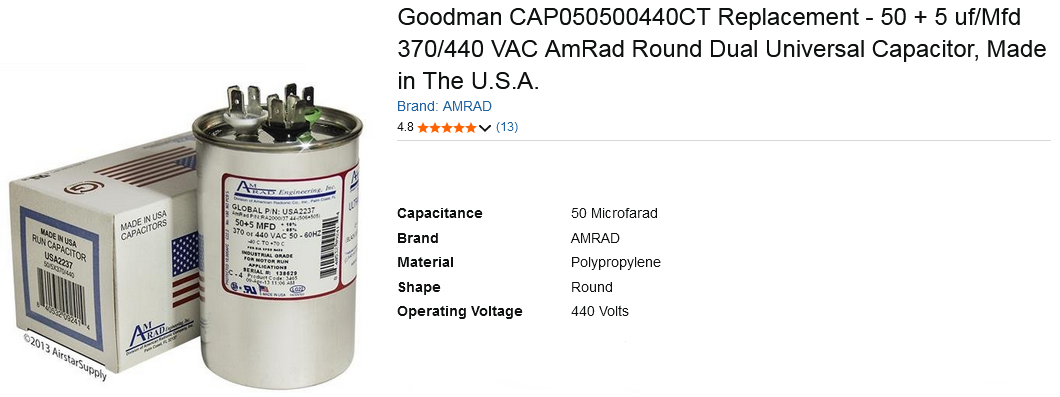
Our AC isn't working and we want to replace the capacitor to see if that's the problem. Our capacitor says cap050500440ct on it.
Home Depot sells one by Titan with the same specs but it's quite a bit smaller than the original. How do we know if it's ok to use?
Thank you!
Comments
-
what is it doing that makes you think the capacitor is the problem?
can you take a picture of the cap? that seems like a part number or date code rather than the value of the capacitor. there may be markings on several sides of the can.
0 -
It has to match the microfarad rating and at least the voltage rating on the original capacitor. There are plenty of youtube videos showing you how to discharge and replace a capacitor. Maybe it will fix it, maybe it won't.
But I hope you don't make it worse.0 -
HD shouldn't be allowed to sell capacitors.




 3
3 -
There are few parts on anything that are easier to change than a cap, and a homeowner should be allowed to repair whatever they want on their own house, provided it's done to code and approved by the AHJ.
And we all know tech who's first recourse is to bill someone for a round of the parts cannon.
1 -
As we all know now capacitors used to almost last forever. Now it is probably one of the most common services calls there is. I had been in and out of our local hardware store a few times looking for something in the electrical isle and was very surprised to see they had a few contactors and capacitors. They never had them before.
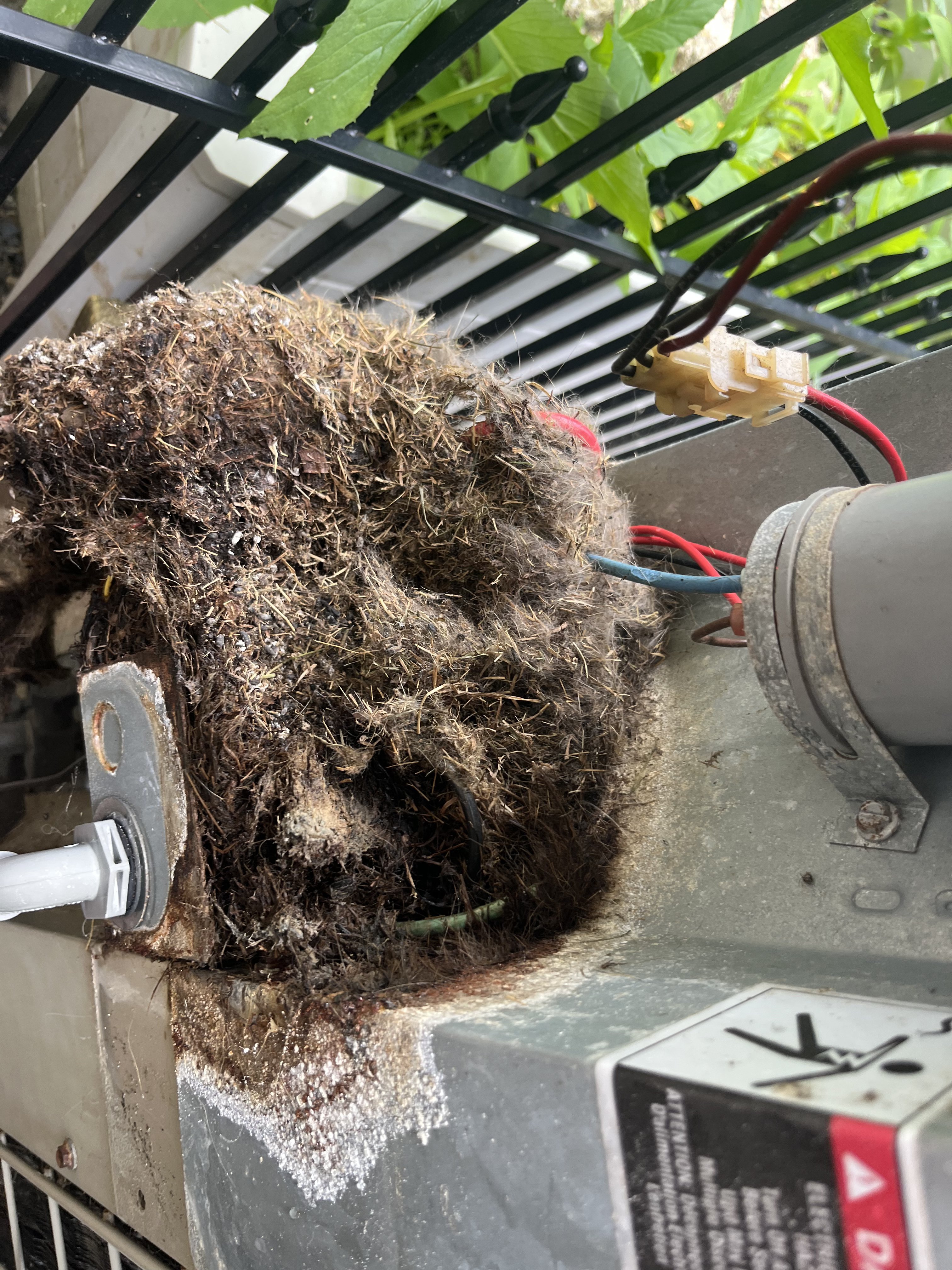
My Neice's AC went down two weeks ago on a Sunday due to a mouse nest in the condenser. The cap was ok but chewed up wires and the contactor was disgusting.
I remembered the hardware store which was only 5 miles away and I bought the last contactor they had
 0
0 -
Look on the old capacitor. You want to know the microfarad rating and the symbol for that is "UF"
If the capacitor is wired to both the fan and compressor (most are) it will be a dual capacitor like 30/5 UF, 50/5 UF 45/5 UF etc
Also the voltage rating may be 370 or 440 volts. If yours is rated 370 volts you can use either a 370 or 440 volt rated capacitor. If rated 440 it needs to be a 440 replacement/
All you need is the voltage and the UF ratings. The capacitor may be smaller physically and that is ok.
Make sure to shut the power off while changing and use a screwdriver to short across the capacitor wires before removing. Make sure the wires go back on the correct terminals. If the old cap is bulging at the top or leaking oil it is bad for sure.
0 -
@EBEBRATT-Ed did you repair the hole in the condenser housing so they can't get back in ? Otherwise they will be back.
National - U.S. Gas Boiler 45+ Years Old
Steam 300 SQ. FT. - EDR 347
One Pipe System0 -
They crawled in through the wire openings. I didn't have anything with me so I told my brother to pick up some duct seal and plug the holes. I don't think they will like eating that.
Unit has a leak probably in the condenser I had to add a little gas. Not a big leak but the first one its ever had its 31 years old and the condenser fins are starting to rot off and the furnace is the same age. I didn't have my leak detector with me.
0 -
that looks like what a chipmunk did in my grill. it hopped up on my trash can then jumped on the back of the grill and in the vent slot at the back of the lid.
0 -
I couldn't believe how much stuff they dragged in there. That chunk of stuff was probably 6 x6x6. Disgusting. Wore gloves took everything out of the cabinet, cap, contactor etc and sprayed it with Lysol and then a garden hose
0 -
They may not like it, but it would not surprise me if they did chew through it. I like more substantial methods of blocking their invasion. Have you brother makes sure he does not seal any inside.
National - U.S. Gas Boiler 45+ Years Old
Steam 300 SQ. FT. - EDR 347
One Pipe System 1
1 -
Can you explain your reasoning on this?
Single pipe 392sqft system with an EG-40 rated for 325sqft and it's silent and balanced at all times.
 1
1 -
Because people tend to be stupid. Example: "I don't own an electrical meter that reads uF. I don't own an electrical meter at all. I don't even know what "uF" means. But I saw a video of a guy and it looks easy and its cheap."
What shape are the spade connectors in? Snug fit? What's the compressor start and run amp draw when the new cap is in? Checks need to be done after replacing a capacitor. Will the new capacitor fit using the same strap? Let it hang or drill for a new strap and maybe drill through the coil? (Which I've seen.)
And don't we preach to not throw parts at the appliances?
They put razor blades behind lock and key, but a repetitive voltage jolter is easy pickings.
0 -
I might agree, on the theory that the average homeowner shouldn't be playing with things like capacitors. Except that in my humble opinion the average tech. shouldn't be, either. More generally, perhaps, there are many things — in many stores — are available for sale to people who really aren't qualified.
If we go down the route of only qualified certified people can do or buy X or Y, we rapidly get into the situation where no one can repair or work on anything, and some nameless faceless bureaucratic office decides what we can do (very little) and can't do — for our own safety, of course.
Yes, certain activities which have the potential to do large scale damage to others should be limited, perhaps, or be subject to second party inspection — installing gas or lp gas lines, perhaps. Driving any vehicle on the public roads with a GVWR over say 8,000 pounds. Operating a power boat with more than say 25 horsepower. But where do you draw the line?
Br. Jamie, osb
Building superintendent/caretaker, 7200 sq. ft. historic house museum with dependencies in New England

 6
6 -
There's many things in stores that are far more dangerous than a 5/40 run cap.
If we use that reasoning, people shouldn't be allowed to buy camping stoves or match books either.
Cartridge razor blades are locked up because of their cost and size.
Single pipe 392sqft system with an EG-40 rated for 325sqft and it's silent and balanced at all times.
1 -
Camping is a hobby. I'm simply referring to people who have no idea about anything electrical, went to YouTube and found a low cost gamble by replacing the capacitor. If that's the fix, awesome! But its probably not. Then what, more videos?
0 -
before we lost the people that were good at leak checking stuff before sending it out the door that was usually the problem in small single phase installations. even 50 years ago oem quality capacitors only lasted 10-15 years.
fortunately about a decade ago when the cap failed on my condenser on a sunday the local good hardware store had caps. even with test equipment unless the top of the can has bulged out or it is completely open is it a bit of an educated guess based on the compressor trying to start and tripping out the overload or the fan not seeming to get up to speed.
0 -
I really don't see the problem here. For instance, people will buy spark plugs to fix an engine skip that's caused by a bad coil, ECM, or even a bad valve because plugs are cheap and easy to replace. But what's the loss in the scheme of things if the plugs don't fix the issue? Motor caps do fail, they're cheap, they're available, and if it doesn't fix it, not much is lost compared to the big picture of what's coming next to get the AC going or replaced.
1 -
While many homeowners may be capable of replacing a capacitor, and while in general I believe you should be allowed to work on what you own, I don’t think it’s a good practice for Home Depot to be selling capacitors.
Here’s why:
- There’s the danger of electrical shock. Most homeowners don’t have a good electric meter or necessarily know how to use one to determine if the power is off. Quite often they think the power is off if the thermostat or furnace is off. I’ve frequently seen where the disconnect switch has been bypassed leaving the circuit hot. Many also don’t know about discharging the capacitor.
- The risk of damaging the equipment by mis-wiring because they don’t understand circuitry. It constantly gets posted in online forums of how to reconnect the wiring because they don’t understand terminal identification or circuitry. They also don’t understand that there’s a separate 24v circuit present and that wires that are the same color may not be the same.
- Selecting the wrong component. Not to be unkind, but look how the OP listed what appears to be an irrelevant part number instead of the specs for the cap to determine what they need. Let them take that to HD or to a hardware store and ask a sales clerk for help. What’s the chances of getting a correct answer? What if it’s a dual or universal replacement? The chances of mis-wiring or mis-application are then increased.
On the other side of the coin, many HVAC contractors overcharge for replacing a capacitor, so I can see why a homeowner might want to attempt this.
Bob Boan
You can choose to do what you want, but you cannot choose the consequences. 2
2 -
if they take it to stadium hardware or carpenter bros. or jack's hardware the chances of them getting the correct replacement are quite high.
home depot sells electrical distribution equipment and building wire and service cable, there are plenty of far more dangerous things you can do with stuff you can buy from home depot than with a capacitor. i think i was like 12 the first time i changed a capacitor in a window air conditioner.
1 -
Ummm…


The OP posted the part number on the part, it seems to be a valid and correct part number to me. The OP also stated "with the same specs". The speculation that the part number was not a part number or otherwise useless was by a popular HH poster and that opinion seems erroneous to me, apparently zero due diligence, just opinion. Many things being replaced are done simply by the part number.
Also going by the part number, maybe the manufacture updated the part to something different that provides better performance or longevity.
Pros screw things up daily too, hopefully it is just less than the amateurs (and not fatal for either). Pros should have a better chance of recognizing their mistake and correcting it before anyone else finds out, but not always, that's life. If they (the amateurs) don't find it at HD, than ebay or Amazon is next (or maybe first these days), the thing is, they will find it, if they keep trying.
And for all I know @missfox has a BSEE degree.
National - U.S. Gas Boiler 45+ Years Old
Steam 300 SQ. FT. - EDR 347
One Pipe System1 -
I am on the fence on this. There is no right or wrong. I am not against a HO working on their own equipment if they know what they are doing.
On the other hand there unfortunately, many service tech's if you can call them that that can't use a meter and have no clue
4 -
I changed the cap on my own unit a few weeks ago. No, I'm not the typical homeowner, I get that.
It was 11pm at night, I was ready for bed and realized the system wasn't running.
I went out, pulled the cover off, looked at the error code on the PCB, felt the cap which was still fairly warm, swapped a new cap in and waited for it to start, or not.
It started, sounded great, I put the cover in and went to bed. No meter, no tools other than a drill and a 5/16 hex driver. I have several meters, good meters, scopes etc.
Didn't need it for that, but that comes from experience and understanding what's going on. A few days later I did test it using my Fluke 179 just out of curiosity and it still tested good. But, that's not under load.
Single pipe 392sqft system with an EG-40 rated for 325sqft and it's silent and balanced at all times.
0 -
Did you test the ESR (Equivalent Series Resistance) ?
National - U.S. Gas Boiler 45+ Years Old
Steam 300 SQ. FT. - EDR 347
One Pipe System0 -
No, I don't have a way to do that yet.
Single pipe 392sqft system with an EG-40 rated for 325sqft and it's silent and balanced at all times.
0 -
It's an interesting philosophical and political problem. The actual question we are debating here — and we are not likely to come to a solid conclusion! — is this: to what extent should "society" (which effectively means a bureaucratic regulatory body or sometimes a Guild or other trade body, such as a union, to which the authority has been delegated) protect an individual from doing something ill-informed which has the potential to injure that individual? To what extent does that extend to doing something which has the potential to injure other individuals?
And then, having answered that question, what means are available to mitigate the hazard? And what enforcement might be required?
Is the enforcement or are the restrictions commensurate with the hazard?
In more recent years, the question has extended from individual human beings to animals or other living things, or to the earth itself, but the basic underlying philosophic question remains the same.
Various societies have answered — or partly answered — the question in various ways…
Rabbit Hole Warning!
Br. Jamie, osb
Building superintendent/caretaker, 7200 sq. ft. historic house museum with dependencies in New England

 3
3 -
I frequently hear people on this site referring to the "parts cannon". When something can't be properly diagnosed, just start replacing parts. Just because the part is cheap doesn't make it right IMO. Lots of wrong cheap parts could cost more in the end. To me there's a process in diagnostics. If you don't follow the process, it'll be anarchy. Human sacrifice, dogs and cats living together, mass hysteria. Maybe that's what the OP is afraid of with hiring an HVAC tech and getting charged an arm and a leg by the parts cannon.
0 -
Professionals shouldn't be parts cannons.
That doesn't really apply to anyone that's not a professional IMO.
Single pipe 392sqft system with an EG-40 rated for 325sqft and it's silent and balanced at all times.
0 -
Follow the evidence.
Test don't guess.
Know what you SHOULD be doing.
National - U.S. Gas Boiler 45+ Years Old
Steam 300 SQ. FT. - EDR 347
One Pipe System0 -
personally I gatekeep the caps at the supply house, yup lock and key. if you can't prove you have a bad a capacitor, produce your EPA card and mechanical license, and satisfy at least 3 techs inquiries to your credentials on reddit you are not allowed to purchase them. nope not at all. definitely not sarcasm 😁
 3
3 -
you could do it with an ammeter, voltmeter, and light bulb if you really wanted to.
0 -
What about a picture of the label on the compressor and fan motor to confirm it's actually the correct cap and a tech didn't swap in the closest thing he had at one point?
Single pipe 392sqft system with an EG-40 rated for 325sqft and it's silent and balanced at all times.
1 -
or someone changed the fan mortor without changin the cap or any number of other inconsistency things tha happen….
0 -
i've sort of wondered how many places would sell me 608 stuff with my 609 number…
0 -
Only slightly off topic… it's one reason why our farm tractors are Massey-Ferguson, not John Deere. The MF dealer lets me buy parts when (rarely) I need them. The John Deere is a fine machine, but the dragons at the parts desk wouldn't sell you a washer. Likewise cars and trucks. I love the engineering of some of the European and Japanese vehicles — but I can maintain my Chevys. And so on.
Br. Jamie, osb
Building superintendent/caretaker, 7200 sq. ft. historic house museum with dependencies in New England2 -
Home improvement stores also sell Muriatic acid.
I feel that's far far more dangerous than a run cap
Single pipe 392sqft system with an EG-40 rated for 325sqft and it's silent and balanced at all times.
1 -
it’s the HO equipment
As far as I know no manufacturer has lost a suite over a HO being stupid!
Evenrude did and things changed, now There are warning labels everywhere!
0 -
The OP never came back.
0 -
that never stopped us before
 4
4


Categories
- All Categories
- 87.8K THE MAIN WALL
- 3.3K A-C, Heat Pumps & Refrigeration
- 60 Biomass
- 430 Carbon Monoxide Awareness
- 133 Chimneys & Flues
- 2.2K Domestic Hot Water
- 6K Gas Heating
- 124 Geothermal
- 170 Indoor-Air Quality
- 3.9K Oil Heating
- 79 Pipe Deterioration
- 1.1K Plumbing
- 6.7K Radiant Heating
- 397 Solar
- 16.1K Strictly Steam
- 3.5K Thermostats and Controls
- 56 Water Quality
- 51 Industry Classes
- 51 Job Opportunities
- 18 Recall Announcements