Welcome! Here are the website rules, as well as some tips for using this forum.
Need to contact us? Visit https://heatinghelp.com/contact-us/.
Click here to Find a Contractor in your area.
If our community has helped you, please consider making a contribution to support this website. Thanks!
Best Of
Re: oil furnace sooting extensively
I've never refilled a nozzle assembly, 30+ years. Seems like a ridiculous idea.I know, doesn't it, But there are those occasions that come up where the air that is in the assembly and high pressure line will compress as oil rapidly fills the void and compresses some of that air. Did you look at this illustration above?
 How would you go about solving this problem if you came across it?
You also need to remember WHEN I was taught that procedure. It was in the 1970’s when there were still lots of those old 1725 oil burners that were designed by folks in the garage or basements of their home. Have you ever come across a PARK oil burner that was designed and sold by a couple of brother in Atlantic City? The high pressure pipe that assembly was the support chassis for all the other parts were in some cases ⅜” iron pipe. Not like the assemblies today with a piece of metal rod inside it to reduce the interior volume. And the nozzle adapter did not have that air trap design that needed to have the word TOP on one of the hex sides in order to have that minimum amount of air expelled more efficiently.
You are right by today's standards Steve, It is ridiculous. But it has served me well over the years. I don't like to mess with success. And the fact that the person who taught you the trade did not have a 200 PSI pressure gauge with 2 flare fittings and 2 flare caps just made fuel pump pressure testing have an extra step with whatever gauge setup you were taught with. It's not a bad thing, it's just different.
I find it a very effective tool to go into a service call where the customer hit the reset button ONLY ONCE LOL. I would remove the high pressure line from the assembly and place the gauge on the high pressure line. (exception would be if I were going to start a maintenance call and want to see if the burner operates before taking anything apart) Now when you hit the reset button, you are guaranteed that there will be no flame. You can listen for spark, you can see if there is pressure. You can see what the pressure is, you can see if it gets to operating pressure quickly or if it rises slowly, and you can time the safety lock out, all because the gauge is preventing the oil from getting to the nozzle.
This is not a slight against your abilities @STEVEusaPA . Not in the least. The fact that you were taught differently from me does not make you better than me, or I better than you, I believe we are both very competent oil burner men. A rare breed today. It's just that I always have a cap for the other end of the nozzle assembly therefore it was easy to fill the assembly with oil. Not better, Just easy, and it works for me. Perhaps with today's oil burner design, it is a little of overkill but with my method of operation, it is almost an automatic thing. And I have experienced almost no "BAD NOZZLES" on first commissioning in 45 years. Not many burner men can say that.
Let me tell you that the John McGarry from Weil McLain was impressed with my pressure gauge and the fact that I paced it on the high pressure line before stating the burner. He was called out by a contractor on a problem job with a 78 series oil fired boiler with a Carlin CRD 601. Check it before dumping more oil in the pot.
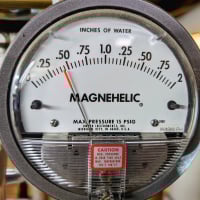
Here is the gauge I would carry with me on every service call. The left is what I built for use on multiple burners, the right is the simple version for someone that is working on only one type of burner.

It is easy to make and the parts are available on line. Special note: get at least four 3/16" flare caps and put them in a place you will forget about when you need one. They get lost easily.


Re: OWB Vertical lift with extremely low gpm's issue
The cooler water returning to your forest eater is fighting against the water weight in the boiler.
Make sure you remove the check valve in the existing circulator when you install the second circulator as well.
 leonz
leonz
1
Re: Pipe Inspection Camera
I duct taped a harbor freight security camera to a sewer rod when i needed to look at my own sewer but that isn't locatable.
 mattmia2
4
Re: Boiler Backup
@ Jamie Hall. Yeah, I'm afraid this is looking more like a backup generator solution instead of battery backup. That's a lot of power for a boiler ignition module and a control board! Thanks to all for the input.It's the blowers on that boiler that are killing you.


Re: Steam Pipe vs. PVC Pipe
Let it melt if he is so smart he will be back there fixing the pipe and the ceiling
Steam Pipe vs. PVC Pipe
On this job, a 1-1/2" PVC drain crosses directly over a 1-1/4" steam steel radiator runout at right angles. They nearly touch other. The intersection will be in an inaccessible ceiling.
We're imploring the plumber to use copper or galvanized for the drain. He thinks a sheet of rubber or half-inch Fibreglas insulation will suffice. We know it will not.
Any thoughts or suggestions here?
A good New Year to all our Wall old friends.
We're imploring the plumber to use copper or galvanized for the drain. He thinks a sheet of rubber or half-inch Fibreglas insulation will suffice. We know it will not.
Any thoughts or suggestions here?
A good New Year to all our Wall old friends.
