Best Of
Re: furnace over heating hi return temp
What's the return temp before & after the bypass ties in? That's a pretty big furnace, if just one zone closes you're going to be bypassing more than a bit of hot air. Is it a two-stage unit? Some zone control panels can stage down the unit, or just disable high heat.
You can also see about adding more minimum air to the zones, so you bypass less, too.
 ratio
ratio
Re: Radiant Heat. Should I raise the temp?
I have to disagree with Eds statement here :)

Truth is Higher flow, tighter delta= higher AWT = hotter overall heat emitter = higher BTU output. You cant cheat the laws of thermodynamics
1 Hot goes to cold always
2 The rate of heat exchanges is based on the ∆. Hotter emitters in a room that is of any lower temperature increases the heat output.
Various ways to get there.
Heat exchangers that we maximize transfer from run tight ∆. Solar thermal we look for 3-5°. We want heat in the tank as fast as possible the avoid loss to the ambient.
Plate heat exchangers can design to "close approach" temperature with 3° with high flow rates.
Every single heat output chart you find for any heat emitter shows a selection of flow rates ∆s to see output differences.
Putting a fan behind a finned water coils (forced convection) "speeds up" the air movement, "speeds up" the heat output. It works on both fluids and air.
Google this article.
Floor coverings limit the amount of BTUs you can deliver. Base slabs, tile floors, and hard surface you want to keep around 82° surface. 82-70 X 2 = 24 btu/sq ft as a reasonable heat delivery. Colder ambient increases output 82-65 X 2 =34 btu/ sq ft. That may be fine in a work shop, but 65 ambient is a bit cold for my home :)
Perhaps the first part of a loop is a bit higher surface, above 82° it dissipates as it travels. The AWT tells more of a story.
It is easier and more linear to increase heat output by increasing SWT- AWT, instead of flow increases..
You cannot "fix" a delta T in a system, it goes where nature takes it! Trying to fix or "constrain" a ∆ is basically putting the brakes on the system. Loads are dynamic in a home, building, let your hydronic system also be dynamic, it will find thermal equilibrium if you don't screw it up :)
If you are a just a bit short, a few degrees try upping the SWT 5° first. You have the ability to do that without any component changes.
 hot_rod
Re: copper pipe feedback
You would need to add up the EDR of all the radiators in the house and then look at the rating plate on the boiler to know if the sizing is even close. Given the piping, I doubt they know how to size and probably just went off the old one, but the EDR numbers would tell the story. If you need help with this, let us know, it's easy and we can walk you through it.
Do you know if this is one pipe steam or 2 pipe steam? Pictures of a radiator will tell the story if you aren't sure.
Can an oversized boiler be made to work acceptably? Yes it can, but expectations need to be realistic about performance. You should be able to get it to heat quietly and comfortably even if oversized, it's just going to take some figuring out.
That said, that boiler piping will not allow any amount of fiddling to get there. What is truly infuriating about this is that manufacturer actually sells a piping kit for those boilers to help the contractor not screw it up.
Post a pic of the rating plate for the boiler we can look up the proper piping. It's not just about pipe arrangement, there is also pipe sizing. That boiler should have a 3" header, you currently don't even really have a header. It's a mess, got to think baby steps here.
I would not have high expectations that the contractor will make any effort to correct this even though they should. I'd be prepared to spend some money, if you can find a contractor that is either knowledgeable or willing to listen to direction on what needs done.
Couple things to always keep in mind along this journey. Steam should heat comfortably, evenly, and quietly/silently. Don't let anyone tell you otherwise. Steam making noise should always be considered a cry for help.
 KC_Jones
Re: Most reliable wallhung?
SFB has been great. The combi version is the SFC. I have dozens in the field been lights out. I even have one in my own home. No issues whatsoever…
NEVER navien.
 kcopp
kcopp
Re: Vaillant Oil Boiler
Combustion was ok, but not as good as I prefer. I believe there may still be a little soot in the passages that I just couldn't get to well enough affecting my numbers. Started out with CO at around 260, and I noticed stack temp was at 590. So I figured might still be some soot in there. Then I changed to a smaller nozzle and things got better.
It was getting better and better as I let it run,, and after I cycled it off then on again several times. Probably had it running about an hour or so all together while checking and adjusting.
Bottom line for now, best I could get CO was down to 67. This was with O2 at 6.5% and no smoke, and stack temp around 480. If I cut the air back, CO started to climb, so that's no bueno. Stack draft was also high at around .07 - .08 in the flue with barometric wide open. The chimney was really sucking.. lol. Might need to add another barometric to control draft. I plan to go back in a couple days to re-check combustion and go from there.
 gpjazz
Re: Most reliable wallhung?
Those mentioned above are good. I'm a bit partial to Rinnai. Give them a look.
 Intplm.
Re: Most reliable wallhung?
Look at what you want to do with it too. Some Lochinvar and Viessman models especially have built in controls for multiple zones with multiple setpoints and things like that. If you just need a similar boiler HTP's now discontinued UFT line was inexpensive and lacked some of the controls fancier models have but was a reliable boiler for a simple installation. Also look at turndown ratio and what your needs for turndown are. Many boilers are 10:1 now which may or may not be important depending on what zoning you are doing and what sort of load you have on a mild day vs design day.
 mattmia2
Re: Most reliable wallhung?
Maybe IBC? With any of the brands I would suggest avoiding the budget models with a "tankless water heater" style heat exchanger IBC calls that one the SFB.
Most of the firetube style residential boilers have heat exchangers made by AIC, and have very similar internal parts. The brands mentioned above have a good track record of honoring any warranty issues. My usual suggestion for brands would include to buy one from a source you are comfortable with. Ideally someone has parts and knowledge nearby.
I put a Viessmann B1HE-85 in my house. I know the boilers and stock parts myself so its a no brainer for me.
 GGross
Re: Most reliable wallhung?
Lochinvar, Viessman, HTP. There is another one which I keep confusing with the one with the chronic HX failures.
mattmia2
Re: Water hammer - novice question
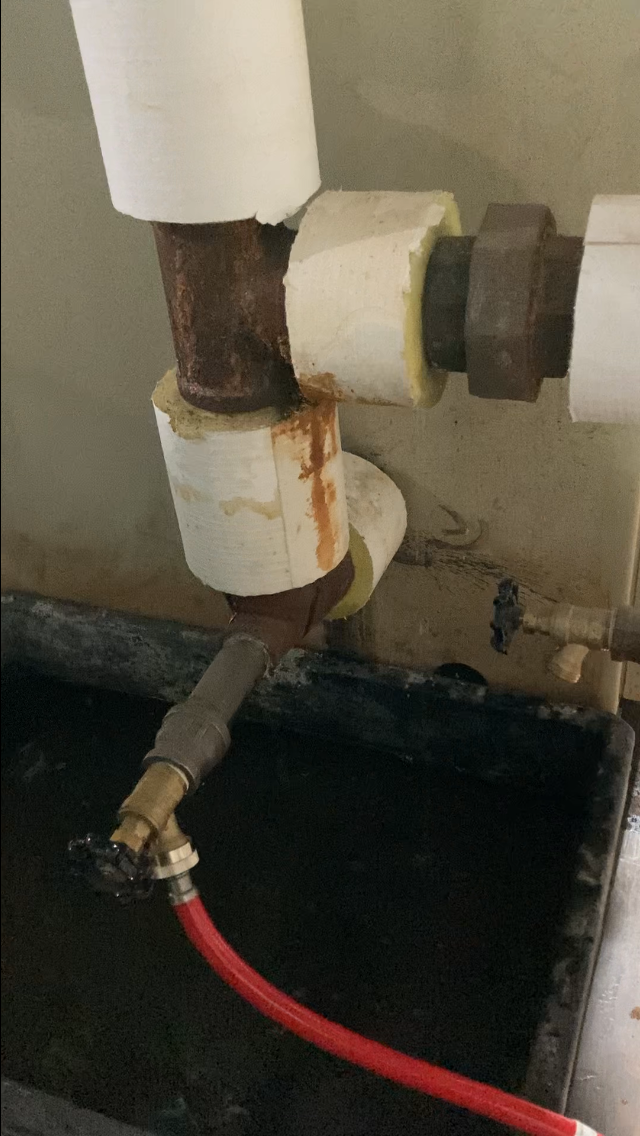
Ahh, the insulation…. It was like that when I moved in this past summer. I am speculating it used to have asbestos wrap and after remediation they replaced with fiberglass on the straight sections only.
No hammering the past several days so I’ll see if I can localize it more next time it happens.
FWIW this is the only photo I have of the leaky pipe layout prior to their replacement.