Best Of
Re: Remodeled House. Now Radiators Are Way Too Large
Not over sized… sized for max efficiency.
Did this w/ my own home. Cast iron rads. love it.
 kcopp
kcopp

Re: heating oil tank manufacturer's warranty voided by transfer of oil from the old tank?
" Tank location should be chosen in accordance with the following requirements: ▪ The tank should be placed in an area where it is unlikely to be adversely affected by normal household activities; ▪ The tank should be placed in an area where it can be visually inspected from all sides; ▪ Under new NFPA guidelines, any outdoor steel tank fitted with a side outlet or installed in a top-draw configuration must be a double-bottom or a double wall tank. ▪ The tank label must be visible; ▪ If possible, tanks should not be located directly under house eaves where they may be subject to falling snow and ice or dripping water. Protection should be provided if there are no other placement alternatives; ▪ Tanks should not be placed in intimate contact with walls or structures since leaves and other organic matter can accumulate and cause external corrosion of the tank; and ▪ Tank location shall respect the local code for distance to property lines, to other energy sources or to other storage systems."

Re: repairing a neglected chimney, flue, thimble, liner, and leaks
Ed. I have considered that option too, a new stack. I even looked into a faux chimney facade to maintain the traditional look. many advantages to new stack, especially considering the condition this is in, and just like everything in this house has been neglected by previous owners. Agreed, do it right or don't do it at all.
 BigMak
Remodeled House. Now Radiators Are Way Too Large
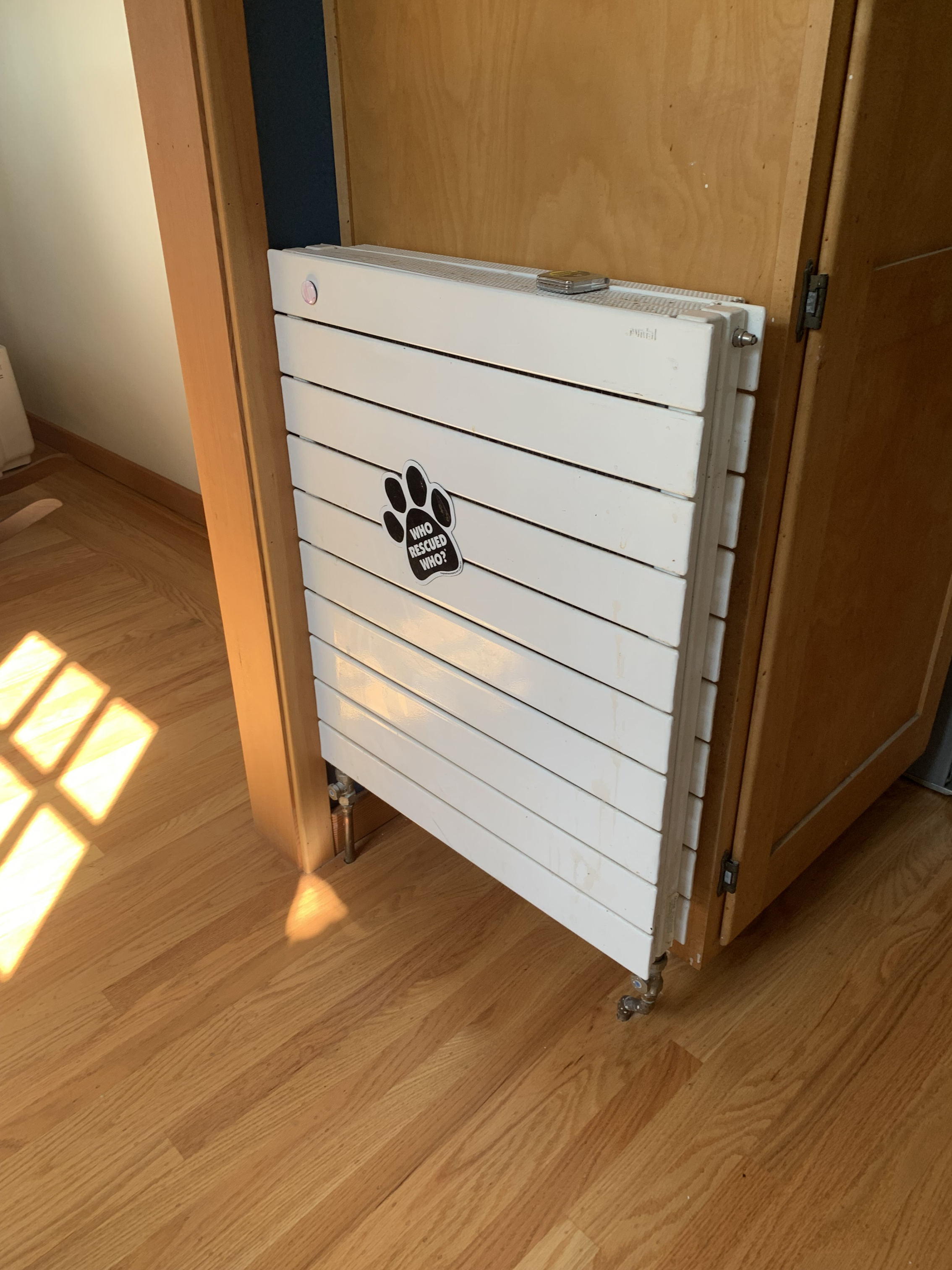
We installed this boiler and radiator system in 2017 when the owners purchased this house. Nothing had been done to the building since it was built; single glazed windows, no insulation.
I sized the radiators for 130F water temperature as I wanted the boiler to condense and they turned out very large. My supplier says I order larger radiators than anyone else. I suppose that’s a compliment.
Recently remodeled, the radiators are now way oversized and I can drop the heating curve even lower. It’s now set to 1.1 with zero offset and the radiators will only get warm, not hot. Safe for their new children and more savings on their utility bills.



Re: Smoke smell in house with oil boiler
Update: I had a chimney liner installed yesterday and both chimneys (furnace and woodstove) cleaned. Hope that solves the problem. Thanks very much to everyone who chimed in on this problem.
Update Nov 2025: Now that the heating season has started, I can report that the liner improved the odor in the house by 95%. Yesterday was very windy and I did smell it again. Today no wind and no odor. I guess I'm happy with the result, compared to what it was like before. I'm probably more sensitive to odors than most people. I'm a fresh air freak and sleep with the window open when it's 25 degrees outside.
 Hemlock

Re: Needing help with propane furnace.
that plastic trap, you might wanna pull the hoses and pull the trap and blow through all that drainage stuff. I worked on that same furnace this past winter, it was plugged solid. Everything worked beautifully after that.
 GW
GW
Re: Should I stick with tankless coil?
I don't agree for the simple reason that not everyone takes the time to turn off the switch in the summer, and only turn it on for the few minutes it takes to shower. The vast majority of boilers with tankless coil water heaters are left turned on 24/7.
Kudos to @burnout for being the exception.
My understanding of common water heaters and the cost to operate them.
- Electric water heaters are 100% efficient but the fuel is rather expensive compared to the alternative fuels. They are not connected to a vent so the stored heat in that tank will stay there longer.
- Gas Automatic water heaters for the most part are connected to a vent (like a chimney) allowing for constant movement of air thru the heat exchanger that can transfer stored heat in the tank to that moving air. So in my opinion, they are less desirable than a storage tank that is not connected to a vent. The fact that natural gas and in some cases propane costs so much less. That makes the down time loss is more desirable than the higher cost electric fuel
- Oil fired water heaters also are connected to vents and therefore are less desirable than a tank that is not connected to a vent So the same as a Gas Automatic.
- A coil in a heating boiler used for DHW is connected to just about the most inefficient system. No matter how efficient your burners are (Oil or Gas) the boiler will be set at a higher temperature by design, than the actual water temperature desired at the shower. That makes the temperature difference between the air that flows thru the boiler to the chimney during the down time much lower than the water temperature. More heat will transfer from the boiler to those passing air currents so more heat will be lost up the chimney. If you happen to have an inefficient burner connected to that boiler, then you have a real fuel wasting machine.
- The best water heating system is to use the most efficient heating boiler available for heating your home. That will have a very high recovery rate when connected to an indirect water tank. (much higher than the burners that come with Gas Automatic water heaters). Now by using the super high efficient burner system to transfer heated water to the indirect tank. When that tank is satisfied and there is no longer a call for hot water, the burner in the super efficient boiler will stop heating the water. Since the DHW storage tank is not connected to a tank, there is no heat transfer to the vent from the tank. That tank, if no hot water is used because everyone is at work or sleeping for hours, will not need the burner to run for as long as 20 hours. That means that when the boiler cools off as a result of being connected to a vent, the burner does not need to turn back on to maintain a higher temperature for DHW as it would with a tankless coil.
- The most efficient water heating systems are instant tankless water heaters. There is no stand by loss which is the largest waste of energy. No tank to get cold when no one is using hot water. There are two major problems with tankless water heaters
- They seem to make enough hot water for more than one shower at a time unless you install the largest model. That usually involver getting a larger electric service or larger gas pipe to feed all that energy on demand.
- They are expensive to install and repair because they have so many more moving parts.
- But they have been getting better over the years.
So I recommend an indirect with a new boiler
