Best Of
Re: 2 floor, 2 unit home with two old oil steam boilers. Can I replace with 1 gas boiler, with 2 zones
I never met the dead man that installed the 1920s Smith one pipe steam boiler system in the basement of that church in Cape May NJ I used to work on. But it was originally installed in a basement. I could tell by the covered up chimney opening in the corner of the basement. The boiler was close to a window that was obviously used to deliver coal to the basement. At some point that boiler may have been under water since much of Cape May is below sea level and flooding is a regular occurrence for those buildings with basements.
At some point in time (1940s or 1950s) the church upgraded the boiler to operate on oil heat and so a section of the parking lot was used to build an above ground boiler room. You can’t have an oil burner and all the related electrical controls getting flooded out. This must have been an interesting feat of engineering to move the basement boiler (all 16 sections) to the new boiler room that was above the steam mains in the basement. There is a condensate return pump in the basement that was connected to three steam dry returns that dropped to the floor after passing thru steam traps from each return.
So now the returning condensate goes into the return pump reservoir and gets pumped to the boiler thru a small tunnel that contains the steam main, and the return pipe from the condensate return pump, some electrical wiring from the thermostat(s) and power for lighting and the boiler, along with Hot and Cold water piping for a commercial water heater that is vented to the same chimney as the boiler.
At the time of the boiler being moved there were some Honeywell motorized valves added to the three mains so the entire building would not need to be heated. This was a very large building that included the main church building. Then an annex was added that was 2 stories. It was about as big as the original church building with two floors. The first floor had the equivalent of 2 class rooms and 2 activity rooms. The second floor was one large auditorium that was used as a basketball court at times and other activities that required a stage at one end of the hall. There was a third area that connected the church and the hall that included a small chapel that accommodated about 40 people in the pews and a small altar at the head of the room. Just behind the chapel was the connecting hallway from the main church to the annex hall. The restrooms and the parson’s office and secretary's office were on the first floor. A full commercial kitchen on the second floor. This was quite a large building.
When the dead men moved the boiler that fed the three steam mains, the zone valves were included in the project and for the life of me, I don't understand it but there was no banging and the valves when closed did not create a problem with the one zone that was open. And that happened a lot. There are other stories about this building that I have shared on HeatingHelp.com but I figured this one about the zone valves was appropriate for this discussion.

Re: 2 floor, 2 unit home with two old oil steam boilers. Can I replace with 1 gas boiler, with 2 zones
I assume the two boilers were installed in order to be able to let each resident pay for their own heat (even though the one on top gets free heat if it is an upstairs downstairs situation). Out of curiosity, is that situation going away?
Re: Intermittent vs. Interrupted
From the little bit of experience I had it seemed like interrupted was quieter. It also probably wears the electrodes less and uses less electric, no?
 ChrisJ
The Loneliest Place, my new article for PHC News magazine.
This is my first article for PHC news and Im looking forward to many more. In this article, I talk about how it feels to be a service tech on a no heat call on a Friday evening. There's no one to call and the pressure is intense; lots are at stake. I would love knowing your thoughts and you similar experiences. Loneliest place

Re: Burnham Boiler Issue
Should be a wiring schematic inside the front cover, or in the manual. We need to see what else is in that circuit.
Is there a vent damper on the boiler? That is a common cause of no fire conditions.
 hot_rod
Re: Intermittent vs. Interrupted
Short answer is in the last paragraph.
75 years ago the oil industry was the king of home heating taking over from Coal from 100 years ago and older. Since all the gas boilers and furnaces used standing pilots, that was just the way it was back 75 years ago, so it did not need a name like "constant ignition". All the heaters had pilots. The oil heat controls were set up so that the ignition transformer was always on with the burner motor. That meant whenever the burner motor was on the ignition was constant. So the RA116 stack mounted relay was used for constant ignition. And it said constant ignition right on the box.
Some oil burners operated better if the ignition transformer was not on the entire call for heat, so the RA117 Stack mounted relay was used to let the burner operate without ignition. That was called intermittent ignition and it said that right on the box. Once the burner flame was lit, the sensor in the stack dropped out the relay that operated terminal 4 and the ignition transformer no longer was powered, so no spark.
Now fast forward from the 1950s to the mid 1970s and you have an energy crisis. Gas furnaces were made with spark ignition and hot surface ignition and spark to pilot ignition. And all sorts of other configurations. Some oil heat folks were also doing gas heat work and vice versa. This became confusing so Honeywell and other oil burner control manufacturers decided to fix it.
Now you have a constant ignition that is a standing pilot that is on constantly 24/7. That was inefficient. So constant on oil controls were not the same as constant on gas controls. But that was the way it all used to be, and we now need to call constant ignition on the oil burners where a spark is involved something else.
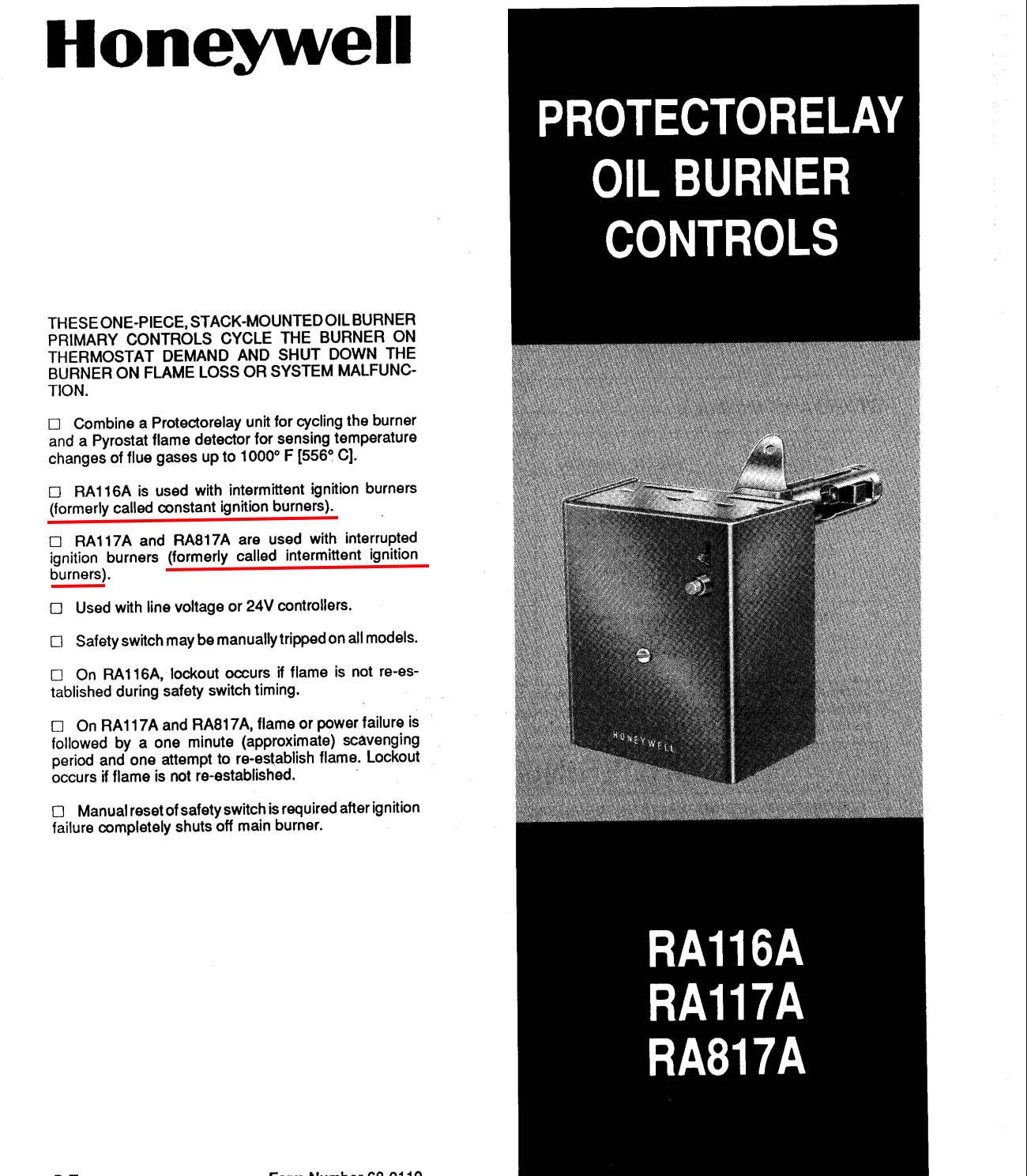
Spark the whole time the burner is operating is now intermittent ignition (Formerly constant ignition) and it said that right on the new boxes of the R116A relay and any other control (like the R8184G relay for oil heat) This was confusing for the old timers that only worked on oil heat but eventually they got over it, (or died off).
Then there were gas controls that sparked or heated up only until the flame was proven, then the ignition dropped out as the flame continued to burn. On oil burners that is now called interrupted ignition (formerly intermittent ignition) and it said that right on the box for the RA117A oil heat control and many other oil heat controls that performed the same way.
It has been long enough that the “Formally constant" and “Formally intermittent” are no longer printed on the box because all the old heads that remember the old names are retired by now.
- Constant ignition = 24/7 ignition (standing pilot)
- Intermittent ignition = ignition lit as long as the main burner is fired (spark to pilot or Spark for oil burner on the entire time the burner is flaming)
- Interrupted ignition = Spark or HSI to get it started, then ignitor or spark goes off when main flame is proven.
Hope this makes it as clear as mud!
Re: Can't get new oil water heater to stop locking out.
Yes they do. It used to be that. They changed it sometime in the last couple years. I went through that with Carlon on the phone. I initially thought it was the wrong burner because they said the same thing you did. Eventually they figured out it changed. It's now .6 at 155psi.
The Becket burner for the Bock 32 I believe is still the .7 or .75 at 100psi.
 2x_Tom
Re: Main air vent location
The returns can't vent air if they are full of water. they have to be pitched if the radiator is heating normally.
 mattmia2
Re: Main air vent location
Thinking on this a bit more, I wonder if those condensate returns are a bit problematic? They may have been okay to be that skinny when new, but how clear are they now. And the apparent lack of pitch makes me think they may be nearly full of water a lot of the time (and thus corrosion products).
Have you opened any of these lines and tried to blow through them (with compressed air)? I have some unpitched dry returns i suspect of constraining my venting on certain radiators.

