Best Of
Re: Post Purge
Not having proper post-purge is the biggest mechanical defect on all equipment today that has some type of mechanical venting, whether it is gas or oil. It is not provided because of a fictitious efficiency reduction on the AFUE.
I first started using post-purge on gas and oil furnaces that were retrofitted into homes that had heat pumps and no flues, so they were power vented. Usually within days water was running out of the seams of the flue pipes because there was no post-purge. Depending on the length of the run, 3-5 minutes was necessary to clear 100% of the moisture from the flue pipe and heat exchanger on gas appliances. This seems long but that is what trial and error testing confirmed.
Oil appliances need a longer time, usually a minimum of 5 minutes and many times 8 minutes. Are were losing some heat. Yes! But a sooted up oil furnace is going to lose a lot more. On oil it is not just the gasses, moisture and smell that is a problem. I have found that if there is not adequate post-purge, the heat of the combustion chamber radiates back into the burner tube. This heats up the oil in the drawer assembly and can cause a delayed after-drip. It also causes glazing and blackening of the nozzle.
About the only equipment I have found that can use less than 2 minutes would be a packaged unit.
The only reason 80% furnaces started condensing in flues is because of lack of post-purge and not the supposedly oversized chimney which is a bunch of foohpah.

Re: My steam boiler water got a little contaminated, so what can we learn?
in one of your previous videos you had great success with Squick. any reason not to go that route first?

Re: My steam boiler water got a little contaminated, so what can we learn?
the manual is a compromise of multiple factors, some of which may not apply to your situation. among other things they are probably trying to cover les than ideal near boiler piping. probably the conditions it was tested under for the various certifications and it was probably somewhat arbitrarily picked.
 mattmia2
Skimming, cleaner and temperature concerns
Happy new year all. We've had a new 10 section Weil Mclain 80 series oil fired boiler installed and the skimming done by the installers was not as thorough as it ought to have been. We're priming and surging and foaming and dancing and occasionally tripping out in low water. I boiled a sample and it frothed like crazy. Getting the guys back is going to take time and I'd honestly rather do it myself.
- I'm thinking of using TSP since I'm familiar with it and it's readily available here. Does anyone feel strongly about washing soda vs TSP? The installers used nothing but water.
2. We've got a new feed water tank controlled by the primary low water cutout, so I can't open the feed valve to adjust the water level. Where would you connect feed water? There's a garden hose style valve at the bottom beside the return. Forgive the terrible photo.

3. How much of a concern is thermal stress/shock during skimming, draining, filling and restarting from cold? Our previous boiler cracked and the suspicion is that cold water entering a hot boiler and excessive thermal cycling were to blame (building owner is 90 years old and will insist on setting back the thermostat as soon as his rads get warm. Combined with electric heaters in his office satisfying the thermostat, the old boiler would run as little as 2 hours a day. Long story. We've put an aquastat on the header to keep the boiler from going cold and a steam injector on the feed water tank to try and keep cold water away from hot castings. Am I concerned over nothing?
Any other tips or thoughts?
Thanks in advance
 Gateacre

Re: How long is a steam radiator supposed to stay on before cycling?
A radiator — one pipe or two doesn't matter — will continue to make heat as long as the boiler stays on. It will only stop when the boiler stops
What happens on one pipe is that when the vent closes the air is out, but steam will keep coming in and condensing as long as the boiler runs. The only way you can stop it from heating is before the boiler starts — if you close the vent then, it simply won't heat up.
It would seem that your building's boiler is just staying on…

Re: How to completely turn off a Vent-rite #1
turn the valve off completely instead of relying on the air vent or screw in a TRV with an integral vacuum breaker like this one:
 Waher
Waher
Re: My steam boiler water got a little contaminated, so what can we learn?
It sounds like we both agree that lower isn’t good and this is why I don’t like people relying on auto-feeders. They spend too much time at lower levels
Totally agree with that.
 Precaud
Re: Wiring Weil-McLain AquaPlus to a Taco SR503-5
For DHW priority.
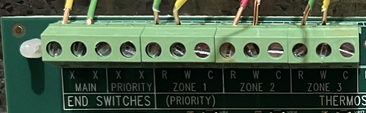
Red on the aquastat to R Zone 1 (priority) on the zone panel.
White on the aquastat to W Zone 1 (priority) on the zone panel.
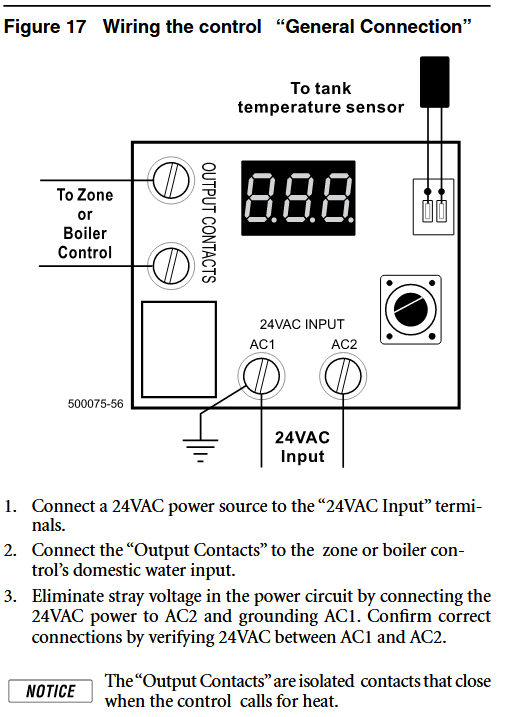
Yellow on the aquastat (AC1) to Zone 1 (priority) C on the zone panel. (AC1 shows it as the grounded side)
Green on the aquastat (AC2) to R on the zone panel.
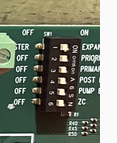
Enable the priority, the switch array on the Right hand side.
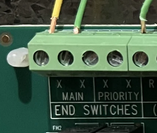
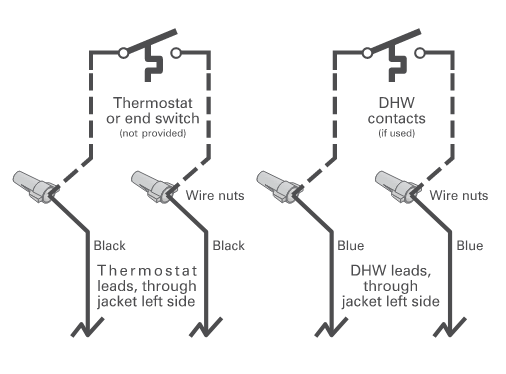
Connect the Main X-X and Priority X-X (DHW) End Switch terminals to the appropriate place on the boiler.
Connect the heating zones to Zone 2 and Zone 3.
Make sure the circulators are wired appropriately.
 109A_5