Best Of
Re: At my whit's end with banging pipes, squirting vents and No heat! Please help!
in NYC, call 311 and report no heat. the landlord will get 24h to fix the violation.
how many units are in this apt building?
do you have access to the basement to snap a photo of the boiler install? if so, post the photos and many knowledgable people will give your landlord a "free" advice.
long story short: water is not draining from the pipes and prevents steam to get to the radiators. it could be caused by "wet steam" due to bad header install; too high pressure; uninsulated pipes, badly pitched pipes; lack of proper venting -- just to name a few.

Re: What type of steam system do I have?
They don’t belong on the wet returns. Just something to clog.

Re: How much does size matter?
I need to tread lightly here. Some of my comments have been removed in the past and I don't want to get banned. I think I did this one properly.

Re: How much does size matter?
When I read the post title, I had visions of what your comment would be😊

Re: Can a new steam system be installed in a new residential house?
Yes. It certainly can be done in this day and age. Especially with the thoughts expressed in your original post.
A form of gas used (LP or NG) with a standing pilot. And have the system designed with more modern convenience controls, and have the radiators designed with the decor of the home. There are some beautiful cast-iron radiators out there that have been refurbished, or can be purchased new, that look beautiful and can offer a level of comfort that (IMHO) does not and cannot compare to much of today's heating systems.
Below is an example of one I found on a job I thought was extra interesting.
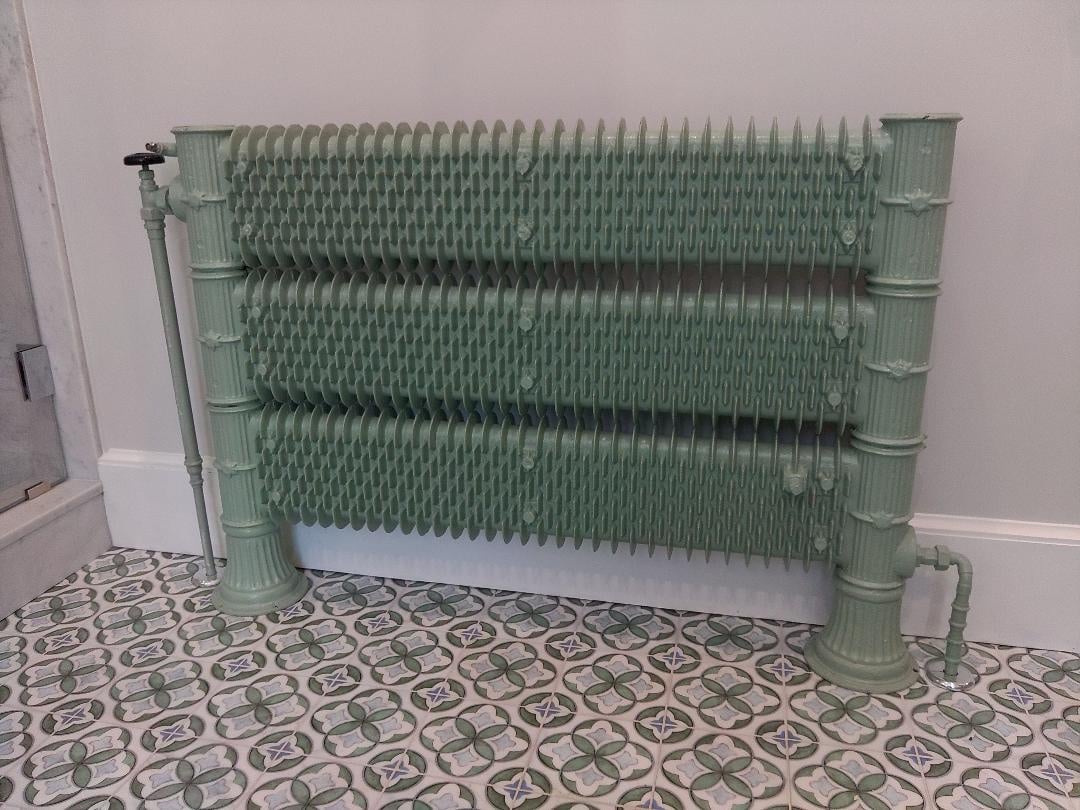
And above is an old post from this site that shows some examples of really nice radiators.
 Intplm.
Re: Honeywell R8991a1019
When was the last time it was professionally serviced? Looks a little neglected. And compression fittings? In 2025? No delayed oil valve.
 HVACNUT
Re: Can a new steam system be installed in a new residential house?
Dear original posted
I believe long time steam heating expert Mad Dog provided you the answer to original post:
"Of course you could install a Steam system from scratch, but finding a person capable of designing it, installing it and then servicing it are the issues. I did it in my gutted 1899 Victorian Farmhouse in the early 2000s with Period radiators.
Unless you can find such a person, I would recd that you install a multi-zoned Hot Water system with Period reproduction radiators. Same look, much easier to zone and control. Mad Dog"
All the best to your project, please post final result
Regards,
RTW
 RTW
RTW
Re: B+G Circ Pump making noise, coupler fine, bearing feels smooth
A clattering or clicking noise is usually a bad coupling because the rubber motor mounts are worn and the shaft of the motor is misaligned with the pump shaft.
Try replacing those parts and see if it stops. They’re inexpensive.
Don’t over oil: that’s usually what causes the mounts to fail.
 Ironman
Re: B+G Circ Pump making noise, coupler fine, bearing feels smooth
The coupling is usually the most common failure but yours looks ok, then bearing assembly then motor in that order.
B& G parts are $$$. You may want to consider a modern wet rotor circulator as a replacement.
They are usually less $$. The only downside is if you have a lot of rust sediment in the system they may not hold up as well without a strainer/mag filter.
You may want to run the motor while disconnected, check coupling etc and try to find where the noise is coming from. Eliminate those two and then it would have to be the bearing assy or impeller
Re: B+G Circ Pump making noise, coupler fine, bearing feels smooth
You’re probably not gonna find the impeller available as a separate part. At the least, you’ll have to buy the bearing assembly.But that circulator is 1950’s technology and an energy hog.
A Grundfos ups15-58 reverse flange (or equivalent) will bolt right back in there and cost a third of that dinosaur.
Like Ed mentioned, you may need to flush the system and add a dirt mag.
The piping is less than ideal with that ell that close to the inlet of the circulator.
A simple solution would be to remove the circulator, bolt a circulator flange directly to the one on the boiler and run the return piping up to where you can work on it. Then relocate the circulator, preferably to the supply side, down stream of where the expansion tank connects to the system - aka the Point Of No Pressure Change. This will help if there are any issues with air in the system.
Ironman