Best Of
Re: Riser, Header, Main pipe sizing
Tell him to install a boiler.
Problem solved.
 ChrisJ
Re: Odd ignition failure - temporary fixed by turning gas main off/on.
Could be moisture in the propane tank icing up the regulator. Propane starts out as liquid. When the pressure is reduced it flashes into a gas and acts just like a refrigerant and it boils off it can freeze any moisture in the pipe or regulators. It usually happens in the regulators as that is where the pressure drop is. Shutting of and turning on the gas maybe unsticking the regulator.
Its a guess but it is possible.

Re: Can’t figure out the banging noise in the radiator
If the condensate pipe from that radiator connects back to the steam main, steam is probably backfeeding up that pipe looking for the air vent. I ran into that situation many years ago:
The solution is to run the condensate pipe into the wet return, like I did, or install a water seal in it roughly three feet deep to block the backfeeding steam.

Re: Dielectric Union question
I used to work for a company that moved one of their PMs (who was previously a secretary and had absolutely no field experience) into a VP position so he was suddenly all about penny pinching. I was running a $25M remodel job in downtown Minneapolis where we had a dual temp system feeding fan coil units throughout the building and the 8" mains ran down the center with multiple 3" branches running down adjacent corridors to serve all the units. The plan didn't show any isolation valves on ANYTHING after the boiler room so I took it upon myself to add 3" butterflies on each branch at least, during the first floor portion. Mr fancy pants VP came through one day and tore me a new one for wasting money on those valves, and made it very clear that I was NOT to deviate from the plan again. Okay then, sorry for trying to help. Fast forward about 8 months, we're up to the 13th floor and one of the brickies tears off a live 2" hot water line on 4th (everything below was now occupied) with his forklift mast. Not a valve to be found anywhere, so they dumped about 3500 gallons of water through 4 floors of office space and caused millions of dollars in damage. Building owner and mason jointly sued my company for not having valves on each floor (rightfully so) and the VP clown had the audacity to blame it on me after he had time to alter the plans to show valves. I had screenshots in my iPad as well as an extra set of paper plans in my truck to prove that it wasn't my problem, but that was also my last day working there. Last I heard, they were filing for bankruptcy- all because of a couple thousand dollars worth of valves.
 GroundUp
Re: Gorton vents is there a way to test them?
I just reviewed the other thread about your boiler. You mention that with the old boiler you had a main vent spitting so you plugged it and left it like that.
To be very, very clear. You should not have water in the vicinity of any vent with volume adequate to come out of said vent, it just shouldn't happen. If it does you have issues with the system somewhere. This entire thing sounds like pitch or sag issues, maybe even poor piping and now the new boiler which is most likely surging is amplifying those issues.
I'd speculate the vents are working just fine. Water hitting the vent cools it down and opens it back up.
I'm of the opinion you need to have the boiler skimmed again, and probably need to do it a few more times. After that, review the entire system and see what's going on. I agree with your contractor, you need main vents, it dramatically alters system performance in a good way.
 KC_Jones
Re: Gorton vents is there a way to test them?
I've seen vents work after taking them off and dumping out the water and maybe boiling in vinegar, but not always. You need to find out how water is getting to the vents first. With a new boiler installed there are lots of possibilities although insufficient skimming is the most common. Don't worry about adding an additive (8-way) until skimming brings satisfactory performance. I look at additives as just optizing pH to minimize corrosion more than anything else.

Re: Buderus G115 Strangeness
What type of tubing is in floor?
Are you sure its O2 barrier? Is it Onex epdm tubing?
Are you sure the circulator(s) is running? Any chance to shoot the floor out for temp? Flir camera?
 kcopp
kcopp
Re: Navien NFB-200h combi temps for space heating and domestic hot water?
the bottom of the finish flooring will see the surface temperature of the subfloor material. So right over a transfer plate would be the highest expected temperature
Yes any floor covering adds some r-value and so the floor “panel” output needs to account for that.
Bottom line without the original design, or a reverse engineering, I would maybe start at 110 SWT, the coldest days is when you will make the fine tuning. There are cases where the radiant floor alone cannot cover the heat load of the room or space, and supplemental heat is needed.
Running the boiler on an outdoor reset curve will adjust and vary the supply temperature. This adds comfort and can reduce operating cost. On mild days maybe 100 covers the load, in the coldest days maybe it needs to ramp to 130?
82 surface temperature of the final flooring is a common limitation number you see in design manuals from various radiant manufacturers . Above that it becomes uncomfortably warm to bare feet. The sweaty foot syndrome 🤔
There are various opinions on how hot the bottom of the subfloor where the plates touch should be allowed to run. The plywood manufacturers have opinions on that number
It will be a fun learning experience to get it dialed in to your liking.
 hot_rod
Re: How to bleed the Radiant Floor Heating System
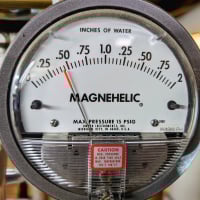
The pic of your gauge shows the pressure high for the temperature reading. These gauges do go bad so you should probably verify the accuracy with another screw on gauge on the boiler drain as stated. 12PSI for one story house and 15PSI for two story house when the boiler is cold. That's what I do.
If the technician bled the air out of the sys and that solved the problem, why would you need to do it again? Where is the new air getting into the sys? That's the question. I have never had to extract air repeatedly.
I can think of 3 ways that air is getting into the sys. 1) fresh city water entering the sys, 2) a failure of the Expansion tank, 3) air being sucked into the sys thru the air vent because of improper piping and pump placement.
1 & 2 would be most probable, I would think. You could shut off the fresh water supply to the boiler and see if the pressure gauge falls to zero, indicating a leak somewhere in the sys. You can shake the E-Tank and see if it is sluggish, indicating that water has leaked into the air side of the bladder. You can push the tire valve on the bottom of the E-Tank, quickly, and see if water comes out.

Re: copper pipe feedback
Yeah, i'll reiterate the 2 or more mains thing. If the mains go off in several directions from the boiler, they should not be teed together at that ceiling but should individually come down to individual tees in the header. There will be some additional fittings and nipples beyond what comes in the kit required to do that.
 mattmia2