Welcome! Here are the website rules, as well as some tips for using this forum.
Need to contact us? Visit https://heatinghelp.com/contact-us/.
Click here to Find a Contractor in your area.
If our community has helped you, please consider making a contribution to support this website. Thanks!
Best Of
Re: Water source heat pump piping
In both of the situations you quote, @WMno57 , there was almost certainly enough ground water movement so that you would be extracting heat primarily from the moving ground water, and not -- strictly speaking -- from the ground. And as we know, moving water is a grand way to move heat around! Particularly if Mother Nature does it for you...
So in those situations, it is likely that having all or part of the heat exchange grid pipes under the house world have worked quite well. Not any better than somewhere else on the property, but not much worse, either.
So in those situations, it is likely that having all or part of the heat exchange grid pipes under the house world have worked quite well. Not any better than somewhere else on the property, but not much worse, either.

Re: shut off valves turn but don't work
You can add a mini ball valve before the vent if this is one pipe steam

No air out = no steam in
No air out = no steam in
 dko
dko
4
Re: The case of the backward flow, this Friday's case
Oh wow I was agreeing with earlier post about check valve assuming everything was piped correctly. Never would’ve thought of them stuck closed. Thanks everyone made me think here about things I would have not thought of . I’m still learning things every day
 John732
1
Re: The case of the backward flow, this Friday's case
@gerry gill Most welcome sir
@dko They didnt appear to be full of slide. I pushed in with my screwdriver and they were stuck closed
@SgtMaj I learned a lesson that day. Never assume. I get humbled regularly in this industry LOL
@dko They didnt appear to be full of slide. I pushed in with my screwdriver and they were stuck closed
@SgtMaj I learned a lesson that day. Never assume. I get humbled regularly in this industry LOL

Re: Old Toledo 1-A pipe threader
I used to thread pipe 10 hours a day, 5 days a week. Borderline OCD about it and every single one had to be perfect. When I started I compared my results to a domestic factory made nipple and domestic fittings. It is usually 2.5-3 full rotations you can do with just your fingers. I carry only SIAM made imported fittings, and they too are only 2.5-3 rotations. It varies more once you get into the cheaper imports.
Your tool is fine it seems. 4-5 is pretty high, would definitely aim lower. Unless you're talking about full grip hand and going as much as hard as you can without a wrench, but even then I'd want it at most 3.5-4. This also means you are thinning out the pipe that much more at the tip.
I use a ridgid 300 and 1224. Should never follow their guide lines. not accurate whatsoever. I'm always above or below the line a little. I can adjust it maybe 1/16" and its a difference of the nipple going all the way inside a fitting without resistance, only going half a turn, and just right. So your teeth wearing out even a little can make a huge difference.
Your tool is fine it seems. 4-5 is pretty high, would definitely aim lower. Unless you're talking about full grip hand and going as much as hard as you can without a wrench, but even then I'd want it at most 3.5-4. This also means you are thinning out the pipe that much more at the tip.
I use a ridgid 300 and 1224. Should never follow their guide lines. not accurate whatsoever. I'm always above or below the line a little. I can adjust it maybe 1/16" and its a difference of the nipple going all the way inside a fitting without resistance, only going half a turn, and just right. So your teeth wearing out even a little can make a huge difference.
dko
2
Re: NEST With Two Wires
If anyone is interested, I believe the NEST uses a circuit basically like this to switch the R and W wires. N-Channel Mosfet Transistor. Very low trigger current compared to a coil of a relay or a TRIAC.
The NEST version is probably more complex since they may use the transistors to multiplex commands to the Nest Power Connector when used.

The NEST version is probably more complex since they may use the transistors to multiplex commands to the Nest Power Connector when used.
 109A_5
2
Re: Polaris hot water heater not bringing water up to temperature
Good catch, I remember now that Polaris shipped with intake air filters.
Probably save a lot of expensive mod con repairs, having an intake air filter. The mod con may even tell you when the filter is plugged and intake air blocked alert.
Probably save a lot of expensive mod con repairs, having an intake air filter. The mod con may even tell you when the filter is plugged and intake air blocked alert.
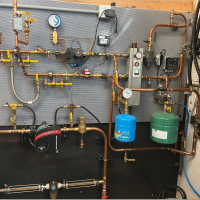 hot_rod
1
Re: Mitigating Point of use hot water wait time
Hi @scootersyme , There are a few things you can do. First is the reduce the volume of water between heater and point/s of use. 3/8" tubing is code, using appendix M in the UPC. This can go a long ways in speeding hot water delivery. If you have 60 psi and no long runs, 1/4" tube can give you 1.5 gpm and hot water in seconds. I've got the engineering document to verify this along with its compatibility with code. A different approach is to use demand controlled pumping. This approach requires you push a button or activate a motion sensor to prime the line with hot water. Another way is to use a small tank at the point of use, and have it be fed by the hot line. As long as the tank holds at least three times the volume of the line, you get steady hot water. The simplest and my favorite approach is a well insulated copper manifold directly on top of a tank, (so it stays full of hot water) and 3/8" or 1/4" tube from there to the points of use. This is "instanter" hot water than a tankless heater can provide 
Yours, Larry
Yours, Larry

Re: Sad
A tragedy, and although we don't know all the facts, probably preventable.
My condolences to the family.
I'm posting the home here, not to be disrespectful, but because many of us are visual thinkers and solve problems we can see.
https://www.zillow.com/homedetails/357-Woodview-Ave-Spartanburg-SC-29306/11829154_zpid/
Instead of speculating on DIYers skills or lack thereof, I'd like to challenge the contractors and small business owners here:
Glenwood Fowler was 82. So born around 1942. 20 years old in 1962.
In 1962, could young Glenwood or his parents have called any contractor in Spartanberg, South Carolina? Or would they have been limited to contractors on their side of the tracks? Were there any contractors on their side of the tracks? There may be long standing reasons why Mr. Fowler and his family DIY. Reasons that a lot of us haven't experienced.
DIYers DIY for many different reasons. I DIY because I like to. I don't really care if some of you think I'm qualified or not. It's my house. Although Mr. Fowler and I had different means and backgrounds, I respect his family's right to DIY, whatever their reasons were. I'm saddened that it may have caused his death, and the death of his girlfriend.
Some here do an outstanding job of sharing their knowledge. For the rest of us, let's try harder to share our knowledge.
My condolences to the family.
I'm posting the home here, not to be disrespectful, but because many of us are visual thinkers and solve problems we can see.
https://www.zillow.com/homedetails/357-Woodview-Ave-Spartanburg-SC-29306/11829154_zpid/
Instead of speculating on DIYers skills or lack thereof, I'd like to challenge the contractors and small business owners here:
- Would you service this home?
- Would you service a home in a community of color?
- Would you hire (and mentor) a young unskilled man from this community?
- Would you donate work pro-bono to a family in need?
Glenwood Fowler was 82. So born around 1942. 20 years old in 1962.
In 1962, could young Glenwood or his parents have called any contractor in Spartanberg, South Carolina? Or would they have been limited to contractors on their side of the tracks? Were there any contractors on their side of the tracks? There may be long standing reasons why Mr. Fowler and his family DIY. Reasons that a lot of us haven't experienced.
DIYers DIY for many different reasons. I DIY because I like to. I don't really care if some of you think I'm qualified or not. It's my house. Although Mr. Fowler and I had different means and backgrounds, I respect his family's right to DIY, whatever their reasons were. I'm saddened that it may have caused his death, and the death of his girlfriend.
Some here do an outstanding job of sharing their knowledge. For the rest of us, let's try harder to share our knowledge.
 WMno57
4
Re: How Do I Connect This Wire?
Thank you for your wiring posts. They are most insightful. I will share that in my experience with
Thank you for your posts. They are most insightful. I will share my experience with
the NEST thermostats. I find it essential to have the NEST thermostat operate a dry contact isolation relay for the control of the "T-T" connection on a host of modern wall hung boilers that use electronic control boards rather than mechanical relays for their operation. The NEST as well as most electronic thermostats use triacs for switching power to operate the heat source. Triacs are not the same as a dry contact old style mercury or bimetal thermostat. Triacs allow a trace amount of "bleed current" to pass which will often fool an electronic control that is simply looking for voltage or continuity of a contact closure to initiate a heating cycle. You cannot simply walk away from these thermostats presuming they are set up properly until you witness the system cycling on and off with the thermostat demand.
A second issue I have discovered is that many electronic / hydronic thermostats will employ what I believe is called pulse width modulation (PWM), as they near their setpoint. This mode of operation begins cycling the thermostat on and off as it nears the setpoint. Presumably to prevent a boiler from overheating a radiant zone. I find that the cycling PWM thermostat will interfere with outdoor reset control temperatures and will often not allow the thermostat to attain its temperature setting. The constant on/off cycling induced by PWM will cause a low mass wall hung boiler or geothermal hydronic system to cycle repeatedly yet never attain the set temperature. The only solution to this issue is to change thermostats or closely study the thermostat installation manual prior to ordering a hydronic thermostat to determine if it is using PWM and if so, is there a way to change the program to omit this function when using outdoor reset for operation efficiency.
Thank you for your posts. They are most insightful. I will share my experience with
the NEST thermostats. I find it essential to have the NEST thermostat operate a dry contact isolation relay for the control of the "T-T" connection on a host of modern wall hung boilers that use electronic control boards rather than mechanical relays for their operation. The NEST as well as most electronic thermostats use triacs for switching power to operate the heat source. Triacs are not the same as a dry contact old style mercury or bimetal thermostat. Triacs allow a trace amount of "bleed current" to pass which will often fool an electronic control that is simply looking for voltage or continuity of a contact closure to initiate a heating cycle. You cannot simply walk away from these thermostats presuming they are set up properly until you witness the system cycling on and off with the thermostat demand.
A second issue I have discovered is that many electronic / hydronic thermostats will employ what I believe is called pulse width modulation (PWM), as they near their setpoint. This mode of operation begins cycling the thermostat on and off as it nears the setpoint. Presumably to prevent a boiler from overheating a radiant zone. I find that the cycling PWM thermostat will interfere with outdoor reset control temperatures and will often not allow the thermostat to attain its temperature setting. The constant on/off cycling induced by PWM will cause a low mass wall hung boiler or geothermal hydronic system to cycle repeatedly yet never attain the set temperature. The only solution to this issue is to change thermostats or closely study the thermostat installation manual prior to ordering a hydronic thermostat to determine if it is using PWM and if so, is there a way to change the program to omit this function when using outdoor reset for operation efficiency.
 Geosman
2