Welcome! Here are the website rules, as well as some tips for using this forum.
Need to contact us? Visit https://heatinghelp.com/contact-us/.
Click here to Find a Contractor in your area.
If our community has helped you, please consider making a contribution to support this website. Thanks!
Best Of
Fixing two pipe system
I am working on fixing a two pipe system. There is a lot wrong with it. There is steam in the returns very soon after it starts making steam. Some radiators were added and traps were never installed on them but there is also steam coming back through a pipe that comes off the header and ties directly into the return. The only original radiators are on the second floor. They all have traps but they also have vents. The vents look like they were added at some point because they are in the top corners rather than where they’re supposed to be. I know I need to add traps to the radiators that don’t have them. I need to add a lot more venting. I think I need to get rid of the radiator vents. I’m not sure what to do at the end of the mains. They’re definitely not original. There are two mains and two dry returns. They took the ends of the two mains and tied them in together and ran a 3/4 drip to one of the dry returns with no trap. I can’t figure out what it originally did. I don’t see any evidence that they went to wet returns. Maybe the connected to the dry returns through traps? There are crossover traps that look original. Would they have needed the crossover traps if the mains tied into the dry returns through traps? What they originally did I guess is less important than what I need to do with them now which I can’t figure out. I’ve attached pictures of the ends of the mains and near boiler piping. I am thinking maybe there was a boiler return trap that was removed at some point and they thought they needed to tie the header into the dry return. I’ve attached a picture of this and I am planning to get rid of that pipe. I’ll also add a vaporstat. I also have a video of the whole system but I don’t know how to post it. Thanks 


Re: Primary , secondary loop design
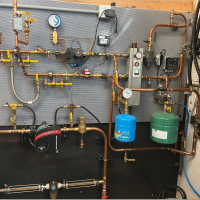
The primary loop is the loop that has the expansion tank in it. Sometimes it is the boiler loop, sometimes the system loopSgtdng said:It’s a noritz combi boiler currently and noritz finally decided to ship me a new boiler since the heat exchanger blew all to hell. The current piping on the primary is 3/4 and the secondary is 1 inch. Noritz was trying to tell me a couple years ago that the piping was all wrong causing the combustion issue that I was having at the time . I wanted them to send me just a heating boiler, but they said they don’t have one just for heating and said they had to send me another combi boiler. The reason I originally bought a combi was so I could add domestic water to the shop. I have not been able to get domestic water from the house, down to the shop. So I am only using it for heat till I can possibly get a shallow point well done.I believe the pump should go closer to the zone manifold, but the expansion tank should still be at the highest point. ( noritz wants it lower) with the exception of the valves, expansion tank, safety valve, and pump, what else really needs to be in this loop?Here is a screen shot of the manifold they are sending me, a shot of the generic design they sent.


 hot_rod
2
Re: Punctured Kitec Pex-Al-Pex lines - best path forward?
You need to find the Kitec specific coupling. Or a transition coupling to go to cts size Pex.
You might shop e bay, someone has a stash of them.
However, the thin o rings on Kitec fittings would go bad after storing them for years. They crack and crumble when you try to use them. You need two good soft o rings for them to seal. And chamfer the ID of the tube will to insert the fitting, with some lube. Or you roll the o ring out of the groove.
I scrapped a 5 gallon bucket of old Kitec fittings once the word got out about the dezincification issues. Plus all the o rings were cracking.
Maybe shop some of the online Euro sites, I think a 7mm compression fitting may work. PAP compression fittings will have a brass, not plastic ferrule. A standard pex compression fitting will not work on PAP, even if you find the correct ID and OD.
Caleffi still offers PAP compression fittings, but I’ve checked in the past, the Kitec is just too large of an OD to fit
If the company I mentioned above has 3/8 couplings, that is where I would got. Tolerances are correct and you get fresh o- rings😏
You might shop e bay, someone has a stash of them.
However, the thin o rings on Kitec fittings would go bad after storing them for years. They crack and crumble when you try to use them. You need two good soft o rings for them to seal. And chamfer the ID of the tube will to insert the fitting, with some lube. Or you roll the o ring out of the groove.
I scrapped a 5 gallon bucket of old Kitec fittings once the word got out about the dezincification issues. Plus all the o rings were cracking.
Maybe shop some of the online Euro sites, I think a 7mm compression fitting may work. PAP compression fittings will have a brass, not plastic ferrule. A standard pex compression fitting will not work on PAP, even if you find the correct ID and OD.
Caleffi still offers PAP compression fittings, but I’ve checked in the past, the Kitec is just too large of an OD to fit
If the company I mentioned above has 3/8 couplings, that is where I would got. Tolerances are correct and you get fresh o- rings😏
hot_rod
2
Re: Is the pump dying?
I think the PSC motor Star series exists just for the US market. Most everywhere else has gone all ECM technology.
I keep hearing the DOE is going to phase out fractional HP PSC type pump motors and require all ECM. But that date keeps getting pushed out. I've heard by 2025 lately.
If you have more than one zone an ECM in delta P mode will save operating cost and allow your system to have cruise control. The pump with automatically adjust itself to changing flow requirements.
Probably find that Star or equivalent brand on e-bay for cheap Generally expired date code stuff.
I keep hearing the DOE is going to phase out fractional HP PSC type pump motors and require all ECM. But that date keeps getting pushed out. I've heard by 2025 lately.
If you have more than one zone an ECM in delta P mode will save operating cost and allow your system to have cruise control. The pump with automatically adjust itself to changing flow requirements.
Probably find that Star or equivalent brand on e-bay for cheap
Generally expired date code stuff.hot_rod
1
Re: Anyone ever seen this style steam rad?
@SKYPAINTER Your comment was made under the premise of being the "devil's advocate". On that basis, you are well qualified. However, you seemed to be not so qualified on the basis of science or engineering, other than the assumption that "new is good and old is bad".
If you are going to figure "efficiency", you need to know on what basis you are figuring. On the basis of amount of heat coming out of a radiator compared to the amount going in, the efficiency of the radiator is 100%. Yes, 100% efficient.
If you are going to figure "efficiency", you need to know on what basis you are figuring. On the basis of amount of heat coming out of a radiator compared to the amount going in, the efficiency of the radiator is 100%. Yes, 100% efficient.

Re: High Efficiency Exhaust Facing up OK?
That tight 90 deg turn adds more restriction then a sweep 90 degree.
 pecmsg
1
Re: High Efficiency Exhaust Facing up OK?
Concentric vents exhausting out of roofs always face up. Never an issue because the exhaust is also a drain. Check the installation manual though because some manufacturers spec an inline Tee with a drain on the horizontal run. Manufacturers are very specific on venting. It's all in the book.
 HVACNUT
2
Re: NEST With Two Wires
Here's a really 'way outside of the box' work-around to using resistors that you may find acceptable:
Install an ecobee thermostat in the boiler room (where you can run the Common wire easily).
Place one of the remote 'Smart Sensors' in whatever room you wish. They are wireless & simply get plunked down somewhere.
It will use the temperature in that room to turn the heating/cooling on and off. (Set point)
You can install more than one sensor per thermostat. They can be set to "follow" you around, using whatever room you are in as the thermostat set point.
Manual adjustments to the thermostat (temperature +/-, fan on-off, schedules, heat-cool-off-auto, etc) are done with the phone or computer or tablet.
This is just an idea to help you get out of using resistors.
Paul
Install an ecobee thermostat in the boiler room (where you can run the Common wire easily).
Place one of the remote 'Smart Sensors' in whatever room you wish. They are wireless & simply get plunked down somewhere.
It will use the temperature in that room to turn the heating/cooling on and off. (Set point)
You can install more than one sensor per thermostat. They can be set to "follow" you around, using whatever room you are in as the thermostat set point.
Manual adjustments to the thermostat (temperature +/-, fan on-off, schedules, heat-cool-off-auto, etc) are done with the phone or computer or tablet.
This is just an idea to help you get out of using resistors.
Paul
 PGB1
PGB1
2
Re: Expansion tanks going bad very quickly…
The OP calls themself @Heatintheboat... Is this system on a BOAT? Are you running sea water in the system? That might explain a lot. Especially if the system is serviced by a boat yard mechanic. The are not familiar with this stuff.

Re: can manual isolation or zone valves control heat?
It may be possible to add zone control, really need to see the piping to know for sure.
For now you can try closing down the dampers on the baseboard in the rooms that you want less heat.
The damper is the long metal strip at the top of the fin tube baseboard, it should rotate to open, closed or in between to adjust the output.
Here is an example of a common fin tube from Slant Fin. #4 shows the damper operation.
For now you can try closing down the dampers on the baseboard in the rooms that you want less heat.
The damper is the long metal strip at the top of the fin tube baseboard, it should rotate to open, closed or in between to adjust the output.
Here is an example of a common fin tube from Slant Fin. #4 shows the damper operation.
hot_rod
3