Best Of
Re: 007 Circulator “getting tired”?
as always there can be other reasons. I have found too many new small pumps on systems that had B&G 100 on them. And flow checks. I started checking pump curves against the system head calculations and find some barely meeting the requirements. So bad or wrong pump, or other should also be considered.
 Lance
Lance
Re: 007 Circulator “getting tired”?
You could also take a look at the age of the circ, there should be a date code stamped on the electrical box showing a month and year of manufacturing.
 Dave H_2
Re: 007 Circulator “getting tired”?
More apt to be a seized circ and maybe gravity flow doing the heating. Or air locked.
When they seize, or air lock you basically have a 78W heater.
Being a wet rotor, fluid cooled design they run pretty close to the system fluid temperature, if fluid is moving through them.
An simple amp draw check would tell you more.
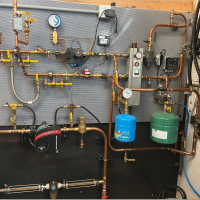 hot_rod
Re: Short cycling boiler. I'm stumped.
a great explanation by Ed. I would not think that all expansion tanks lose 1 psi per year? If so many boilers would be popping relief valves 5 years down the road. I can’t remember ever checking my expansion tanks over the years? You will need to isolate and relive any pressure to check it get an expansion tank valve with the bleed off port, if you plan on a yearly check.
Your system is steel and copper as far as I can tell, no open seal circulators so not many, if any places for O2 ingress?
After a short period of time the O2 in the H2O that you filled with is consumed in the oxidation process so you have mainly nitrogen left. Nitrogen is used in tires because it doesn’t migrate out as quickly as air, same in your expansion tank now.
Rumors abound that expansion tanks are pre-charged with nitrogen, so if that were true the charge will stay for a long time, nitrogen on both sides of the butyl rubber
My Amtrol connections have never confirmed the Nitrogen charge, but they do use use refrigerated air, which pull the moisture out, to lessen the rust potential on the air side
I would suggest the Extrol Pro tank, it is a plastic lined tank, stainless nipple.
Sizing is important also, from the looks of your system a #30 is adequate.
hot_rod
Re: Zoning two rooms on one radiant slab
Then you can use one manifold and try this idea. set all the manifold flow rates manually, as needed to maintain the temperature wanted in the garage. Then on only the loop that is in the boiler room, add a two wire zone valve actuator. Put that on a thermostat in the boiler room, no end switch needed. The function of the boiler rom thermostat will be to close off that loop only if the boiler room has sufficient heat while the garage thermostat operates the pump and boiler in the normal configuration.

This way the boiler and pump only runs when there is a need for heat in the garage. If the boiler room is also cold, that loop will be allowed to operate. If the boiler room is up to temperature, then the valve will close and more heat will be available for the garage, and the boiler room will not over heat.
I call this type of thermostat operation an Allowance thermostat, as opposed to a full function thermostat the operates more than just a zone valve

Re: Beckett furnace keeps tripping
Sounds like he needs to call a professional. I bet you or I could fix this problem in less than an hour if the OP was in one of our areas.
We can easily conclude that "he needs to call a professional" for just about any post on here. I am positive you can fix this problem in less than 30 minutes if you were there.
The challenge, for you or I, is to attempt to solve the problem via wire. It's not always easy and we aren't always successful, but we give it our best shot without risking the safety of the boiler or the individual.
We both know that the "professional" that arrives might not always be "skilled" and will take the H/O for a ride by simply changing parts. We can do better than that…………in many cases…………even if we're 1000 miles away.
The website is titled "Heating Help" for a reason.
BTW, I'd bet $100. that it is an R8184. And, that control could very well be part of the problem.
 LRCCBJ
Re: Can you combine Energy Kinetics with Rheem hot water tank?
The way the Energy Kinetics boilers produce hot water is extremely efficient due to the use of the brazed plate heat exchanger and the way it uses two circulators to transfer heat from the boiler to the hot water storage tank. Also the low mass of the boiler and the thermal purge feature of the energy manager ensures that as much of the heat created by the fuel you are burning is transferred to with the space you are heating or the hot water storage tank. It's a very slick and well designed system. I would love to have one in my own home. The design of the hot water storage tank also plays a part in the efficiency of the system. I don't know how easily you would be able to convert a different tank to work in the same manner.
I can't comment on what option for producing hot water would be best for you. It depends on fuel costs, electric rates and how much hot water you use. All I can say is that I never get any complaints from my customers about the efficiency of the EK systems. No complaints about running out of hot water either.

Re: Happy Holidays! Clogged supply/return line on slab house
any way to easily isolate the circuit in the slab and blast it with city water pressure, 60 psi or so?
Putting a fill valve in to fast flow gets you more pressure, but not a lot more flow. In 3/4 copper you need about 7 gpm to get up over 5 fps velocity.
5 feet per second is when solids start to move along the tube.
/
hot_rod
Re: Lingering return pipe noise ... poor venting?
I do believe it. Really. As I've said above, no you should not throttle the vents. That pipe should be at atmospheric pressure at all times, and never, ever, ever have steam or pressure in it.
Find the actual problem traps or cross connection and fix the problem. Don't keep trying to put a bandaid on it.

Re: Lingering return pipe noise ... poor venting?
Steam in return pipes will cause all kinds of mischief. Some expected, some not. Your very first step is going to be to find out where that steam is coming from. You likely have several traps here and there which are failed, and you need to find all of them and repair them before you look at anything else.
The second place to look for trouble in your system is any drips where condensate can come from a steam main down to a wet return pipe. Those drips must have fundtioning traps on them — most conventionally F&T, and you need to check size — they're probably too big.
So long as you have steam coming out of the condensate receiver vent, you have a problem — which must be resolved.
Now. I'm puzzled by your comment about the vent for the returns. If these really are dry returns, that vent should be always open, and steam should never get into them. An automatic vent does need to be there, but it should never close. If steam is getting into those dry returns, go back to the beginning here and find the villains. Could be either the device traps or those drips I mentioned.
I might add that both of the things you are complaining (rightly!) about are almost certainly caused by either bad traps or those drips.