Best Of
Re: Boiler sight glass water condition
I can't say that I necessarily agree with Paul's instructions. The idea that adding water and immediately draining it, is detrimental to the boiler, is still a theory (I think). But having sludge and mud in your water is not good for anything. I would suggest putting a bunch of eight way in. Doesn't really matter if you're overloading, because this is only temporary. Jack up the thermostat and let the boiler run until it starts to steam. Shut boiler and wait a few minutes. As long as boiler is hot, the eight-way will do its thing. Wait 10 minutes or whatever, and then turn boiler back on until it starts steaming again. Repeat for 30 to 60 minutes. Afterwards drain, fill to the top of boiler, drain, fill drain fill until water comes out clear. If you happen to have a water transfer pump, will be quicker and easier. Once water is clear, fill to normal water level and add some eight way. Run the boiler immediately and let boiler Steam for a bunch of minutes, to boil out the oxygen. You may need to repeat a few times initially, due to sludge getting dislodge from the returns and things like that.

Re: Boiler sight glass water condition
don’t follow the directions. They want you to use too much.
At 896 sq ft that is a big boiler. I assume you have a big house.
I would try like 1/3 cup is all then see what happens. It will likely free up a lot of sediment and/or scale.
Be prepared to have to drain that off if your boiler surges (throws water into the mains resulting in a dramatic drop in the water line).
If you have to drain some or all the water due to that, add a little less when you refill.
Then let it be for a week or two. Then see if you can drain a little more to let out more chocolate milk.
The goal is to drain as little as possible to eventually get clean water
Your water is very clear in your photos. If you’re lucky you won’t have to do much
Re: Should I be worried about what I am observing and hearing (radiant heat install in process)?
Heat load divided by room sqft.
Most manufacturers show data for standard house setup. That is 3/4" subfloor with either tile or hardwood over it. Even if your subfloor is 7/8" planks, it won't change the heat transfer enough to worry about. So if your flooring close enough to standard, you don't need to worry about R value.
Most manufacturers also show how much insulation they want under the emitters to meet required btu output.
You can use the data from tables the manufacturer provides for loop spacing and number of emitters. I would aim for 140F water at design time which should get you good efficiency out of a condensing boiler.
It never hurts to add more emitters than required, this will only bring down the water temperature required which again helps with efficiency. It doesn't change how hot the floor will feel so not much drawback except a bit more material cost.
 Kaos
Kaos
Re: The "equalizer" is mis-named. It does nothing to equalize anything.

My drawings (which I haven't heard complaints about) show that the PSI is the same in the boiler, and at the boiler end of the wet return regardless of the existence of the "equalizer". Please explain that.
The pressure is the same even if there is no "equalizer". The "equalizer" is doing nothing to the pressure. We all have seen boilers without it, and somehow the water gets back into the boiler. This is because the main delivers close to the boiler psi to the start of the wet return. It's a little less which lets the water level be higher there, as in my drawing.
To @The Steam Whisperer
With or without it, the boiler pressure is present at the return pipe into the boiler. Look at my second drawing in my original post. Is there anything wrong about it? The "equalizer" is just another path that delivers the same pressure. It changes nothing. No?
To @109A_5
Without the Equalizer the pressure at point A will raise the water level at point C 27.68 inches per pound.
The "equalizer" does not decouple anything. In all my drawings, the pressure at the boiler and at the wet return's entry to the boiler are always the same, "equalizer" or no. Tell me where those drawings are wrong, and then tell me again what the "equalizer" is supposedly doing, thanks!
With or without the "equalizer", the
Re: Help choosing a new boiler (part 2)
I am unfamiliar with the IBC equipment. I worked mostly in Philadelphia PA and Southern NJ and never had a chance to see one in operation. I looked at the installation instructions for the SFB-99-1 and the SFB-120-1 and they appear to be a well built product. Their maintenance instructions take up 6 pages in their manual, This seems pretty comprehensive. If you have a reputable contractor that is familiar with the equipment, I see no reason to avoid this product. just make sure to have a professional maintenance completed every year.
Of course I can't indorse it without having looked at it up close or knowing about its longevity. I can say that this will not be your last boiler since none of the condensing boilers have a life expectancy of more than about 17 years, however with proper maintenance there is no reason that it can't have a useful life span of 20 years or more.
These new fangled things just don't last the way the old cast iron standing pilot boilers did. That is progress. Planned obsolescence in order to make you purchase something "Better" in the future.

Re: Should I be worried about what I am observing and hearing (radiant heat install in process)?
A bit on the high side for the warmer climate based on the envelope description but probably in the ballpark.
So most of your rooms are 10BTU/sqft, there are some a bit higher with the big room at 20.
The existing staple up will work no problem up to 10BTU/sqft. For the higher loss ones, I would go with either heat plates or ultra fin. Size the spacing of the heat plates to supply the /sqft load in those rooms.
It might also be a good idea to extra heat to the tiled spaces and have the balancing set for those to supply the bulk of the space heat. For example during the shoulder season the floor heat in my bathroom will supply enough heat without needing to run any other zones and keeps the tiles there nice and toasty.
Something to keep in mind that at 10BTU/sqft your floors will not feel warm even on the coldest day. They won't be cold and the house will be comfortable just don't expect toasty toes feeling. It is not real winter here yet, 25F outside, and my floors are at 75F.
Kaos
Re: Valve and thermocouple good. Pilot will not stay lit
 David37
Re: How to Size and Pipe Buffer Tanks
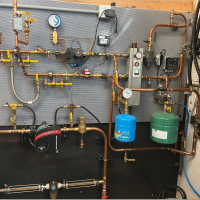
I've used tanks as small as this six gallon, up to 500 gallon!
A 3/4 mip X 1-1/4 copper adapter shown below works on tanks with 3/4" ports.
Larger electric tanks with 1" element holes, use a 1X 1-1/4 copper to male adapt.
This connection size, 1-1/4 is good up to 100,000 maybe 120,000 BTU/ hr loads
I like 2 or 3 pipe buffers, depending on what connections you have to work with. The math for calculating tank size.
 hot_rod
Re: Help choosing a new boiler (part 2)
@RandomLady , this is not Rocket Surgery. 40 years ago, I took a class from Dan Holohan (The guy who started this website) and from that day on, I would do a heat loss calculation. I measured the walls, windows, ceilings, floors, and doors. Put all those measurements on a form, used the appropriate multipliers and came up with a number. It was often 50% or more lower than the old heater that I was replacing. This was impressive to my customers because none of my competitors did that. I also guaranteed that the smaller heater would do the job or I would install the larger one at no additional charge. That is how I grew my business.
The heat load calculation was not the most accurate calculation by design, It was a short form sheet of paper and I used the next lower multiplier just to be sure it was a little oversized. But it was enough for me to know that the selected size was not too small. Granted I may have still been a little over sized but I would rather it be a little over sized than it be undersized. The smaller heater still was a better choice than using the same size as the old one, my competitors quoted. Once computers became popular, I got more accurate numbers.
With the new modulating boilers, you don't need to be as accurate. If your home needs 81,254 BTU per hour on the coldest day of the year and you select a 120,000 BTUh heater that modulates, then that oversized heater will only be an 81,254 BTUh heater on the coldest day of the year. That is the way they work. So the oversized heater is not really oversized at all. The fact that one model will go as low as 8,000 BTU and another will go as low as 10,000 BTU is nit picking in my opinion. All that means is that your boiler can’t modulate when the outside temperature is above 59°F or 57°F (15°C or 14°C) so it will just cycle on and off when it is 16° or warmer outside, if you even have the heater on when it’s that warm. You did pick Ontario Canada to live in…
For my retirement I choose to go south. I digress
I would not stress over the low end of the turndown ratio. If you happen to select the lower one because the contractor is the better choice in your opinion, then good for you. If you believe the other contractor is the better choice then go with the better contractor. Look at the reviews online to see if they offer better service after the sale. Get recommendations from friends. The contractor that stands behind the equipment they sell is always the better choice. The brand of equipment is secondary to your choice.
A final note: when I taught my one day seminar on Hydronic heating to professionals, I would often mention that selecting the proper size boiler based on the heat loss of the home may oftentimes render the boiler too small for the DHW demand of the homeowner. In this case you should select the size based on the DHW demand even though it may be oversized for the home’s heating requirements. With the modulating boilers that makes more sense now than before because the oversized boiler will adjust down to the correct size when not being used for DHW. Just don't go overboard with a 199,000 boiler when your load is only 50,000 BTUh. That is just wasteful ignorance on the part of the contractor.
Re: Help choosing a new boiler (part 2)
I don't think that you should worry much about the modulation BTU output. its going to about 4' of baseboard difference. I think you should concern yourself with getting the best installer you can find. the installer is the most important part of the install. If you follow some of the threads on here you can read about all the improper installs. They are continuing headaches for the homeowners. And the contractors just turn around and blame the manufacturer. Its like a never ending story. I had one service call where the customer complained to me that she saw the contractor more than she saw her husband.
 pedmec