Best Of
Re: Is this a common piping configuration
No i would not remove the pipe insulation from the heating pipes in the crawl space. All it will take for it to freeze is an air pocket to develop in the branches to stop the water flow and then the exposed piping will freeze. I would not only insulate that piping but also box it in. Expose piping in a crawl space will not heat the crawl space enough to prevent it from freezing. The only way is to keep the water moving but circulators don't last forever either. I can't tell you how many times this is attempted and the pipes freeze. Just lowering your thermostat overnight to save a couple of bucks is all it takes.
The piping going to the left is a common monoflow piping arrangement. There should have been a lot more space between the tees. It is concerning because the pressure drop between the tee's is what allows some of the water to flow to the branches, hence the wall heater. Although the Tee's are installed with the arrows facing each other to maximize the pressure drop, the tee's being so close together might negate that. Only you as the homeowner can check that with the heating system on. You can feel if the hot water is moving.
i'm in Boston and every year we fix issues like this. Everybody wants to use the mud room, 3 season porch, or enclose there porches for an extra bedroom without thinking about how to protect the piping. i personally would never recommend putting heating pipe exposed outside in a crawl space. If you do extra precaution should be taken. I honestly can't overstate what a bad idea it is to leave pipes exposed to freezing temperatures. Also keep in mind that most residential piping systems, at least in massachusetts, are done with type M tubing, which is thin wall. only the fin tibe piping is thinner. So frozen piping will split relatively quick.
i hope i understood your question correctly
 pedmec
Re: Failed Pex
Foolproof reliable methods of joining pipes & tubes are probably expensive if they exist.
 jumper
Re: The Hidden Hydronic Problem Nobody Checks: Water Velocity
Still waiting on the alternate explanation for why:
1- the boiler was no longer leaking and kettling, and
2- water was no longer short-circuiting through the radiators.
The answer was slowing the flow and redistributing it through the boiler, period. I would not have written the articles were that not true.
Some younger folks on here likely don't understand the concept of "dwell". When servicing a vintage engine using breaker-point ignition, the points (which are basically a switch) had to stay closed long enough for the electrical field to build up in the ignition coil, so that when the points opened and the field collapsed, it would produce a good hot spark. This was the dwell period, and could be varied by adjusting the gap of the points.
The same principle applies here. If the water is moving too fast through a boiler or radiator, it doesn't spend enough time there to either absorb heat from the boiler or transfer it to the radiator. That old Spencer was an extreme example.
I've done the same on countless systems and they always heat faster and produce better comfort. Plus, a smaller circ uses less power. That's a win-win if there ever was one.

Re: Ditching the manifold?
young people cant read/write cursive and dont know what the little hand on three and big hand on the four means. Not shocked that gages would be hard to read. Digital stuff probably costs more=higher profit
 SlamDunk
Re: Condensate Drain Pan Overflow
The problem isn't the trap drying out, it's that when it does the surface tension of the dry sides of the pipe is too much for the water to overcome before the pan overflows. If the trap were further below the tray it would create some pressure to push the water through the trap. Even a few inches more head is going to make a difference.
It can be frustrating to get water to flow when you want it to!

Re: Do I need a buffer tank?
The 6" concrete over 4" buys you pretty much nothing except more cost. My heated floor has a 1.5" overpour and the response time is already too slow. More just makes it worse, there is a lot of hand wavy stuff about flywheel and thermal mass which does squat.
As other have said, with the amount of concrete you have, you don't need a buffer tank. I would check the minimum flow rate on the Combi, but most likely you can direct plumb the setup if you bump up the flow rate in each loop. The extra flow won't change operation much except reduce striping and lower delta T.
Some combi units even come with a built in expansion tank, with such small volume you won't even need another one.
With the low load, I would limit the CH firing on the combi to near your design load as it will further help with cycling.
 Kaos
Kaos
Re: Do I need a buffer tank?
You do not need a buffer tank for the basement heat. The concrete is your buffer tank. Your boiler, if running at its minimum firing rate, would have to run approximately 2 hrs to heat the slab ONE degree. With proper settings and controls you can do nice long cycles.
 JMWHVAC
Re: Please sanity check my main vent placement?
Assuming your system is working correctly, you want the steam to get to all rads at more-or-less same time. If R3 is getting steam last you can increase your venting rate if that leg.

Re: How rich is too rich
any time i've planted corn in my garden i got an ear the size of a aa battery that was full of earwigs or rot
 mattmia2
Rinnai Leaking Help
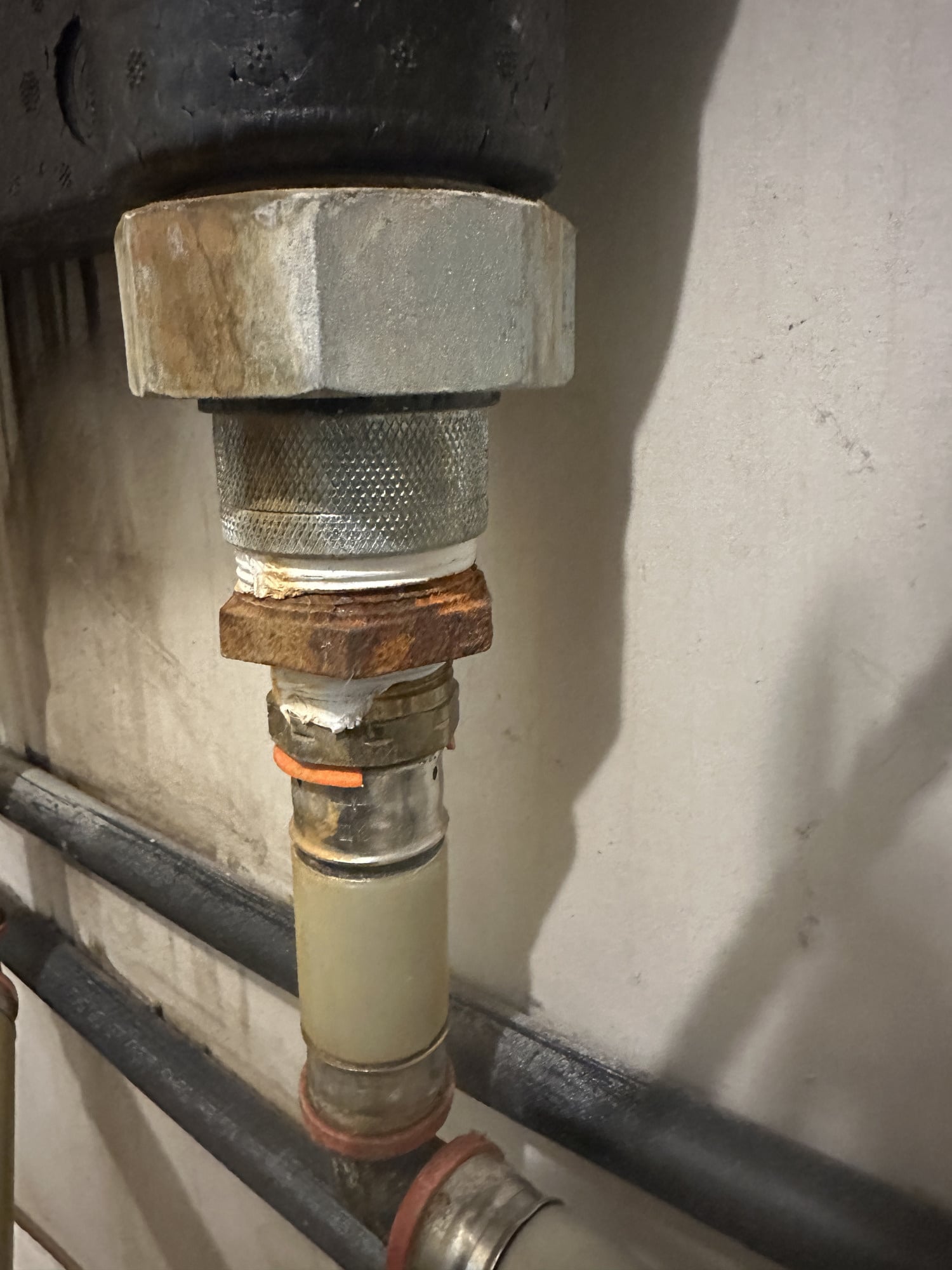
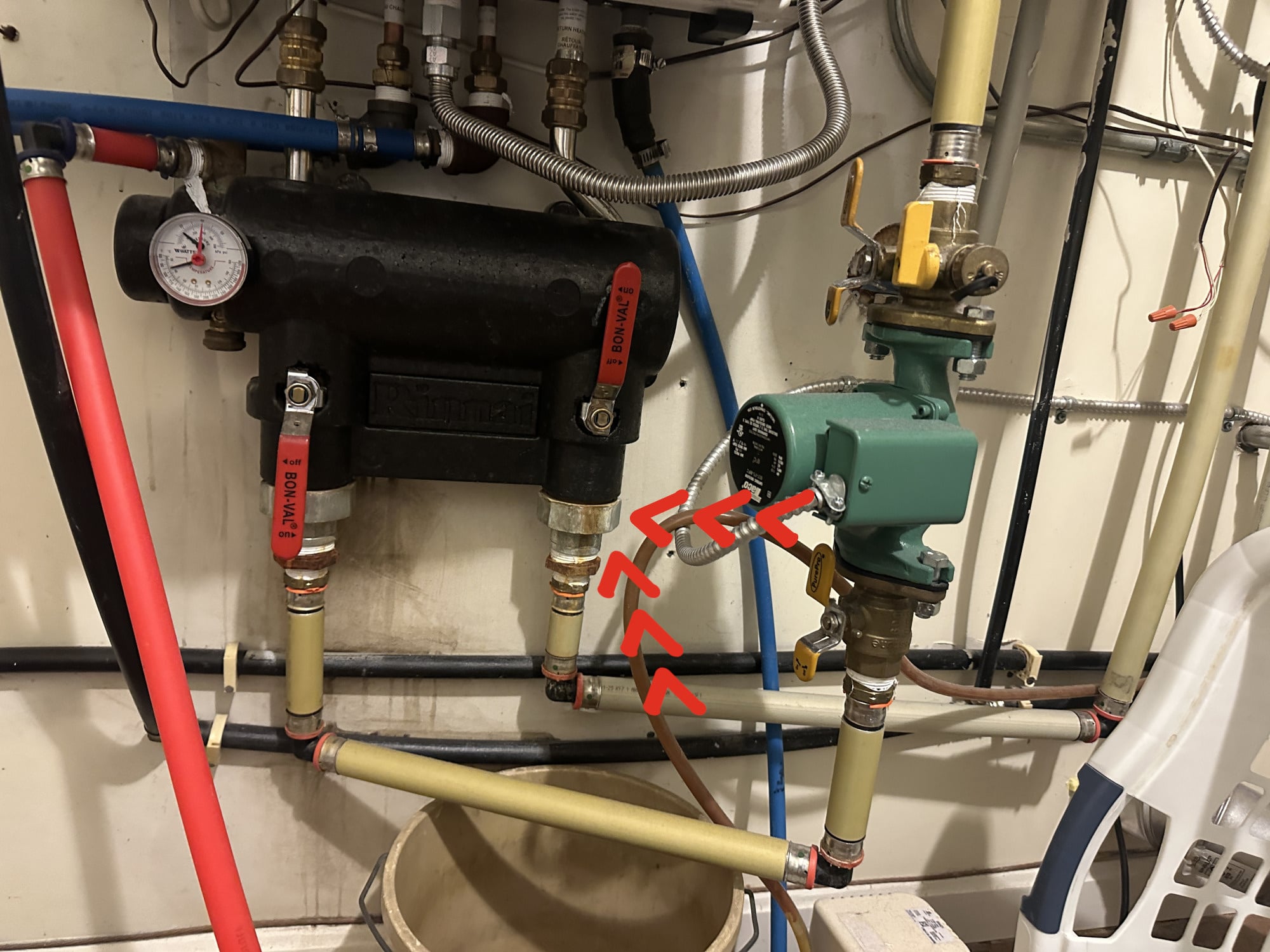
In this image on the right I think this is the cold water inlet. It is leaking. It is a larger diameter pipe and was wondering has anyone dealt with this type of leak before? What type of gasket is under there?
 lindylex