Welcome! Here are the website rules, as well as some tips for using this forum.
Need to contact us? Visit https://heatinghelp.com/contact-us/.
Click here to Find a Contractor in your area.
If our community has helped you, please consider making a contribution to support this website. Thanks!
Best Of
Completed Restoration of original American Radiator Rococo units
Our 1770s home has 19 cast iron radiators, all of which are the Rococo model made by American Radiator Co. They were performing very well but were covered with many layers of lead paint that was flaking off, creating an imminent health hazard. On top of that, most of the fine detail was lost under all the paint.
We wanted to restore them but don't have the equipment to do them here and did we want to pollute our home or property with lead paint flakes and dust. We considered chemical stripping and painting but ruled both out due to concerns about odors and off-gassing. We retained a local company to have the radiators sand blasted and powder coated.
Color is a subjective decision, and we wanted them to be an architectural feature but not loud or gaudy. Plus we wanted a color that we thought we could be happy with for the next several decades with no regard to design trends. When selecting colors, we looked at about 60 different variants of metallic pewter and silver. The color we chose was Starnight Silver PMB 5752 by Prismatic Powders. We ended up using 60 lbs. of it, which is pretty staggering in terms of scope.
We are delighted with the results. Aesthetically, they are incredible. There is no more lead flakes, and there are zero odors or off-gassing. I checked their heating performance before and after with my heat gun and it is identical. There are no leaks either.
We wouldn't change a thing about the process, materials or results.
Here are some photos which I thought you all might enjoy.
BEFORE:


DURING:


AFTER:


We wanted to restore them but don't have the equipment to do them here and did we want to pollute our home or property with lead paint flakes and dust. We considered chemical stripping and painting but ruled both out due to concerns about odors and off-gassing. We retained a local company to have the radiators sand blasted and powder coated.
Color is a subjective decision, and we wanted them to be an architectural feature but not loud or gaudy. Plus we wanted a color that we thought we could be happy with for the next several decades with no regard to design trends. When selecting colors, we looked at about 60 different variants of metallic pewter and silver. The color we chose was Starnight Silver PMB 5752 by Prismatic Powders. We ended up using 60 lbs. of it, which is pretty staggering in terms of scope.
We are delighted with the results. Aesthetically, they are incredible. There is no more lead flakes, and there are zero odors or off-gassing. I checked their heating performance before and after with my heat gun and it is identical. There are no leaks either.
We wouldn't change a thing about the process, materials or results.
Here are some photos which I thought you all might enjoy.
BEFORE:
DURING:
AFTER:

Re: Munchkin updated
And here’s some afters . I try
Peace and good luck clammy and in case your wondering it was all permitted and inspected as it should be .


Peace and good luck clammy and in case your wondering it was all permitted and inspected as it should be .
 clammy
6
Re: Propane Explosion Destroys Building- Bird-in-Hand, PA
40% of electricity generated in 2022 was with NG, so fossil fuels are more and more the fuel for generating electricity.This is true since the anti-fossil fuel lobby is very coordinated but the truth of it all is that even with the handful of oil, natural gas or propane fuels experiencing catastrophic failures, electric fires and loss of life and property is a significantly greater concern. Just look how many homes have fires due to electric heaters or appliance being misused, batteries failing while a toy or vehicle is charging inside the premise. I still believe fossil fuels are the best for reliability and safety compared to the new religion alternatives.Yeah, propane will do that now and then. So will natural gas. Oil won't.You can preach oil safety all you want but in the end such explosions hurt all fossil fuels.
This will be used as another excuse to ban fossil fuels for safety reasons, including oil and more pushing for all electric.
Even though such problems are very rare compared to electrical fires, those are ignored for some reason. Gas stoves seeping minute amounts of fuel so small no one could ever tell is an issue and all over the news but an electrical fire burning the joint down is fine.
Although in my home state of Utah, 3 Uranium mines are reopening and one in Arizona. Utah a has the highest amount of Uranium. So possibly we see more small scale nuke plants being permitted and built.
57 nuclear plants under construction worldwide, two in Georgia one at 99% completion.
 hot_rod
1
Re: Wood-fired Steam Heating
I'm not saying that heating with wood -- whether steam or water or air or direct -- isn't a viable solution. For some people. I did it myself for a number of years in Vermont. What I am saying, as I say so often, is that it is one option which can, and should, be considered when evaluating how to accomplish the goal, which is adequate and feasible comfort -- and that there are considerations involved which limit its applicability.
On the other hand (where is my soapbox? Ah... there it is), unless you have a large woodlot and know, understand, and practice sustainable forestry, it is NOT a sustainable jolly green option. Somewhere around 1 cord per acre is about what is feasible for sustained yield in the more northern climates -- including Canada.
On the other hand (where is my soapbox? Ah... there it is), unless you have a large woodlot and know, understand, and practice sustainable forestry, it is NOT a sustainable jolly green option. Somewhere around 1 cord per acre is about what is feasible for sustained yield in the more northern climates -- including Canada.

Re: Will Tigerloop help our situation?
In my experience there are too many technicians that have never learned to make a proper flare on the end of a copper tube. There are plenty of YouTube videos that show the incorrect way to make a copper flare. A partially rolled over burr on the interior of a tube made by the cutting tool will cause the tubing to fail to make an airtight seal. Gravity does the rest.
The siphon created by the overhead line has the heavier than air liquid fuel at the high point. The lighter that oil atmosphere leaks into the flare fitting and allows the oil to drop back into the fuel tank. The longer the off cycle, the more air is found in the overhead line. When the oil burner starts, that air may cause noisy operation until the air is purged. If enough air accumulates then there is a possibility that the fuel pressure will not be enough to force the fuel past the nozzle port. That is because the air will compress when it reaches the pressure regulator at the nozze port of the fuel pump. This results in a lockout by the primary control safety.
To fix this you need to get a technician with an expensive flaring tool that knows how to use it to make all the flare connections over, properly. In a perfect world, that would be easy to do. mist technicians that work on oil burners have the inexpensive flaring tool and don't know how to properly prep the end of the tube for an air tight seal. In that case the tiger loop gets them out of that jam of incompetence.
The other fix to to have the fuel line lower than the bottom of the tank, so any leak will present as a wet spot that is much easier to locate and repair. Incompetence will be a wet leak in that case.
The siphon created by the overhead line has the heavier than air liquid fuel at the high point. The lighter that oil atmosphere leaks into the flare fitting and allows the oil to drop back into the fuel tank. The longer the off cycle, the more air is found in the overhead line. When the oil burner starts, that air may cause noisy operation until the air is purged. If enough air accumulates then there is a possibility that the fuel pressure will not be enough to force the fuel past the nozzle port. That is because the air will compress when it reaches the pressure regulator at the nozze port of the fuel pump. This results in a lockout by the primary control safety.
To fix this you need to get a technician with an expensive flaring tool that knows how to use it to make all the flare connections over, properly. In a perfect world, that would be easy to do. mist technicians that work on oil burners have the inexpensive flaring tool and don't know how to properly prep the end of the tube for an air tight seal. In that case the tiger loop gets them out of that jam of incompetence.
The other fix to to have the fuel line lower than the bottom of the tank, so any leak will present as a wet spot that is much easier to locate and repair. Incompetence will be a wet leak in that case.

Are bushings & plugs leakers?
JMHO they are not the best fitting to use, but sometimes you don't have a choice. Putting a vent alarm in an oil tank for instance. 2" tapping in the tank and the vent alarm is 1 1/4 in some cases. Yeah, you could use a 2" VA with a reducing coupling on it but that's extra $$$$$
I learned my lesson once about bushings and pipe plugs. MA used to have their own oil code which required the manufacturer to pressure test their oil tanks to 5psi. (both inside and underground tanks) I know for a fact some did not do this.
Working for an oil company back in the day we installed a lot of tanks. Everything from 275s up to 20,000 gallons and 50 years ago New England was 80% heated by oil.
In MA. the local Fire Dept. is responsible for oil burner and tank inspections. We had one town that would make us pressure test any underground tank after it was set in place but before being backfilled.
The Chiefs reasoning was even if it was factory tested it could have been damaged on the road or while being set in place. The tank companies you to have the big tanks delivered on a low bed tractor trailer. The driver would show up with a bunch of used tires and a rope. He would tie the rope to the tank lifting lugs and around the trailer tie down to act as a pulley and push the tank off onto the used tires .
Back to the bushings and plugs. So I had one to test and it would not hold 5 psi after being set in place and the GC was getting on my nerves about wanting to backfill and the fire chief was scheduled to show up after lunch and at 19 years old I barely knew what a pipe wrench was. As it was a 20,000-gallon tank I had to go rent a huge tow behind air compressor (like you would use for a jack hammer)
I called my boss and told him it was leaking where the plugs threaded into the tank bungs, and I had taken them in and out used big wrenches and Teflon tape and 3 different kinds of pipe dope.
He told me to take out any plugs and bushings and replace them with 6" nipples and caps. I did that and it worked the first time and passed the test.
When I got back to the shop, he explained that sometimes when the bungs are welded in the tank, they may get more weld on one side than the other. The weld metal shrinks when it cools and makes the bung not truly round maybe slightly oval. A plug or bushing being cast iron can't conform to the hole, so it leaks.
Putting in a long nipple and a cap give the nipple a chance to "go oval" and conform to the shape of the bung.
That is why bushings and plugs tend to leak, not always their problem it's what it is being threaded into. Same think with close nipples.
I learned my lesson once about bushings and pipe plugs. MA used to have their own oil code which required the manufacturer to pressure test their oil tanks to 5psi. (both inside and underground tanks) I know for a fact some did not do this.
Working for an oil company back in the day we installed a lot of tanks. Everything from 275s up to 20,000 gallons and 50 years ago New England was 80% heated by oil.
In MA. the local Fire Dept. is responsible for oil burner and tank inspections. We had one town that would make us pressure test any underground tank after it was set in place but before being backfilled.
The Chiefs reasoning was even if it was factory tested it could have been damaged on the road or while being set in place. The tank companies you to have the big tanks delivered on a low bed tractor trailer. The driver would show up with a bunch of used tires and a rope. He would tie the rope to the tank lifting lugs and around the trailer tie down to act as a pulley and push the tank off onto the used tires .
Back to the bushings and plugs. So I had one to test and it would not hold 5 psi after being set in place and the GC was getting on my nerves about wanting to backfill and the fire chief was scheduled to show up after lunch and at 19 years old I barely knew what a pipe wrench was. As it was a 20,000-gallon tank I had to go rent a huge tow behind air compressor (like you would use for a jack hammer)
I called my boss and told him it was leaking where the plugs threaded into the tank bungs, and I had taken them in and out used big wrenches and Teflon tape and 3 different kinds of pipe dope.
He told me to take out any plugs and bushings and replace them with 6" nipples and caps. I did that and it worked the first time and passed the test.
When I got back to the shop, he explained that sometimes when the bungs are welded in the tank, they may get more weld on one side than the other. The weld metal shrinks when it cools and makes the bung not truly round maybe slightly oval. A plug or bushing being cast iron can't conform to the hole, so it leaks.
Putting in a long nipple and a cap give the nipple a chance to "go oval" and conform to the shape of the bung.
That is why bushings and plugs tend to leak, not always their problem it's what it is being threaded into. Same think with close nipples.

Re: Any hope for my National Heat Extractor 100 series oil boiler?
Gosh, I have seen a lot of old stuff but never saw an 1150 motor on a burner before. Condenser fan motors on air conditioners and some other stuff.I dug up a Dead Man's Book ("Better Oilheating", a compilation of articles from the old Fueloil & Oil Heat magazine, which has a lot of John W. Schultz classics including his treatise on venting steam systems) and in one article it mentions different motor speeds and how they affect the way a burner works. Some burner makers used these different motor speeds to get different capacities out of the same chassis and fan. Higher speeds would of course move more air, resulting in a burner that could fire more oil per hour.
Must have been a nice quiet burner!!
A couple more recent examples of this:
1- The Sunray Golden Cup flame-retention burners, where the same basic chassis were fitted with 3450-RPM motors as the industry moved to the higher speed. The capacity of a given chassis model (GC, HC etc) went up drastically when fitted with the higher-speed motor (GC-34, HC-34 etc).
2- The Beckett "S" chassis. Several burner models have been built off this basic chassis, but the examples here are the SF and SR burners. These are both flame-retention burners, but the SR's capacity was 0.40-2.00 GPH with its 1725-RPM motor, whereas the SF with its 3450-RPM motor could fire 2.50-5.50 GPH. The two burners used the same chassis part number, and one of the two fans listed for the SF is the same as for the SR. The main difference was the motor speed. The SF sounds like a scaled-up AF when running, but the SR gets rid of a lot of the fan noise as compared to an AF.
Too bad I'll never hear this old Esso burner running.

What is this thing
Does anyone know what this device is ?
I’m not getting heat transfer from the primary to the secondary piping.
I’m not getting heat transfer from the primary to the secondary piping.
No heated water is making it to the closely spaced T’s.
 Ceacel
1
Re: Any hope for my National Heat Extractor 100 series oil boiler?
You are an asset to to all of us Frank. Thank youWe need to add a "blushing" emoticon to this board.............. @Erin Holohan Haskell ?
Here are the pics I promised. The first two are the burner still in place but with the motor removed- they turned out kinda dark:


Here's what it looks like out of the boiler:
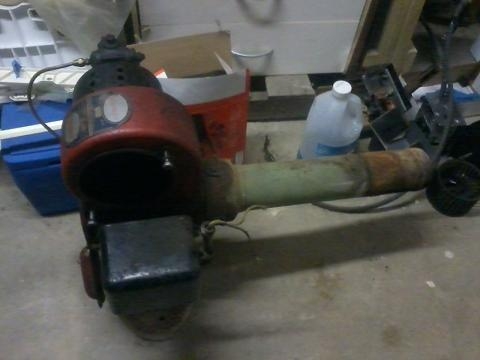
Here it is in our shed, sitting next to another AF I had sitting around. Look at the difference in size, also note how the air tube gets smaller a few inches away from the chassis. This seems to reinforce the theory that they used the same chassis for several different capacities, and used higher motor speeds (and bigger air tubes) for the higher capacities:

Finally, the combustion test. The most recent tag we found was from 2012, with what sounded like "rag-and-tags" in more recent years. This photo isn't downsized as much as I usually do so it may take a bit longer to load. But I wanted you all to see what was on the tag and also what was on my Wöhler's screen. Looks like I lied about the combustion efficiency, it actually got up slightly above 80%.

The Esso had a 1.00x80B nozzle, which I'm assuming was running at 100 PSI. The firebox was what looks like a recent model Lynn bathtub type, which is rather shallow. Not sure if that B (solid cone) nozzle was slamming the flame into the back of the firebox. I really regret not being able to fire the Esso and see what it was doing.
The Beckett is firing a 0.75x80A (hollow cone) at 140 PSI, for a rate of about 0.90 GPH. The flame neatly fits the firebox without impinging on it.
The draft regulator resisted my attempts to adjust it, so I just went with what I had. The baffles certainly helped offset the excess draft.
It's obvious there are some air leaks into this boiler, or it's downfired too far, or both. The nameplate shows a capacity of 1.35 GPH, which of course is with an old-style burner. Dropping this about 15% to accommodate the hotter flame from a modern burner takes us down to 1.15 GPH, so 0.90 doesn't sound excessively low. I suspect air leaks, but we don't want to remove the jacket on a boiler this old for obvious reasons. It's better than it was, and isn't too bad, which is what counts.
Enjoy!
Re: Any hope for my National Heat Extractor 100 series oil boiler?
Well, the lady is up and running. Good thing we stock 13-inch air tubes, nothing shorter would have worked.
Between the baffles, the more-efficient burner, brushing & vacuuming, sealing the doors and proper tuning, we got the stack temp down by 150 degrees or so, and the combustion efficiency up from 72 to 79-and-change percent. The stack relay is gone- she now has a proper 15-second primary with valve-on-delay.
I did take some pics of the Esso, but it's time for bed. I'll post them soon, probably tomorrow.
Between the baffles, the more-efficient burner, brushing & vacuuming, sealing the doors and proper tuning, we got the stack temp down by 150 degrees or so, and the combustion efficiency up from 72 to 79-and-change percent. The stack relay is gone- she now has a proper 15-second primary with valve-on-delay.
I did take some pics of the Esso, but it's time for bed. I'll post them soon, probably tomorrow.