Best Of
Re: Single pipe vented steam heat
If the water is dirty, you should drain out the dirt. Other than that it shouldn't need draining. We don't want to add more water to the boiler than needed, since a lot of fresh water will shorten its life.

Re: Steam main help
1" is more than adequate to vent the air as fast as the steam can heat the main. are you measuring from when the boiler starts steaming? it will be a lot faster when the system is still warm from a recent cycle than from cold. you can take the vent off and run the boiler until steam gets there, it isn't going to get any faster than that with a bigger vent.
others will know relative sizes of different vents.
 mattmia2
Re: Low temps Lochinvar Knight Boiler
If you read through the manual you can customize the settings.
You can set the control to factory default settings, the manual shows those deault settings. On the default settings it should run up to 180° I believe.
The manual is online if you do not have a hard copy.
 hot_rod
Re: DHW tankless coil in a oil fired steam boiler - cold feed heating up
but if you add a check valve then you need to account for expansion of the water as it is heated. A loop of pipe forming a heat trap may also solve the problem.
or there is a cross connection between hot and cold at some fixture.
mattmia2
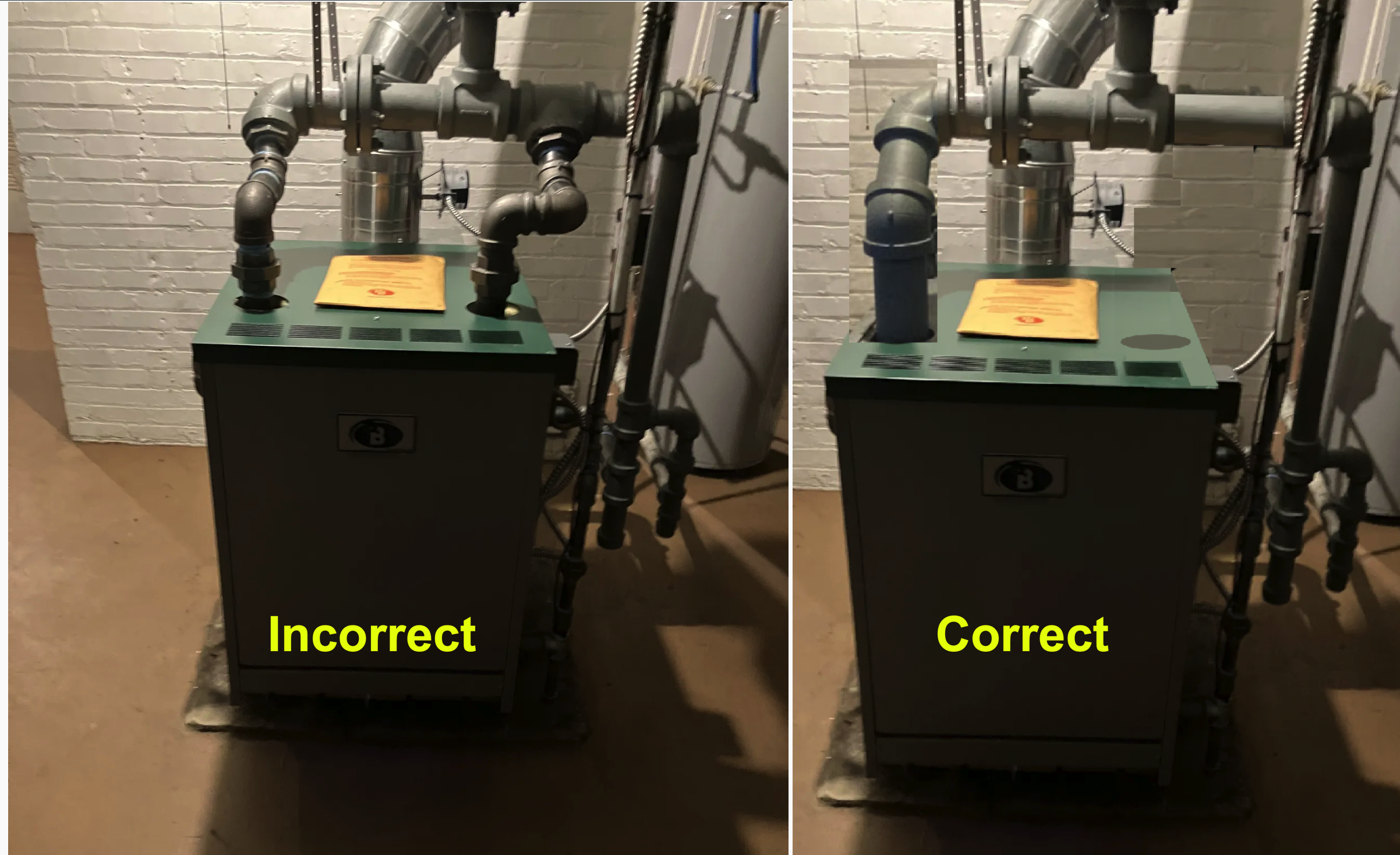
Re: Can you please critique this boiler setup that was installed in my house two wks ago
After reading @EBEBRATT-Ed's earliest post, I have this doctored photo that is be the easiest fix for you @RCooper.

Monoflow System
Hi all, Our monoflow heating system doesn't seem to be working very well. we have a 120000 Pennco boiler with 100 ft of 1.25 iron pipe with 16 mono flow tees single loop 130 ft of baseboard on a taco 1.25 zone valve on one zone. other two zones are on 3/4 zone valves and about 38 ft of base board on a loop, one taco circulator 007 f5. I feel the taco 007 is too small I don't know how to calculate the head per monoflow tee. any help would be helpful.

Re: Attached EDR vs Boiler SF of steam

Re: Attached EDR vs Boiler SF of steam
The EDR rating on a boiler includes the 33% pickup factor.
I'd never exceed that rating my self. IE. if the boiler's rating is a hair under, do not go to the next size bigger, it's a mistake.
 ChrisJ
Re: Attached EDR vs Boiler SF of steam
Or go with a different brand boiler. For example the chart posted above the Peerless 63-04L is 383 Sq. Ft. if that makes you more comfortable.
My old 300 Sq. Ft. boiler and 347 of EDR works fine, even when it is below zero Fahrenheit outside.
 109A_5
Re: Attached EDR vs Boiler SF of steam
I’d go with the 350.
you can always tighten up the envelope if needed
 pecmsg