Water Tanks on Roofs?
Comments
-
There's the question if wimpy showers save h2o? Perhaps they encourage baths?
0 -
That would fall right in line with low consumption toilets when you have to flush twice to get rid of everything.
0 -
After graduating high school in ‘78, I became a cook on Amtrak to pay for college. We actually cooked real food back then. I had three routes; Los Angeles, Seattle, and New York City. In New York, we’d get a day layover and they put us up in the Hotel Edison. The city was gritty at the time and that area was a little tough. I didn’t care though, I was from Chicago. But, what I remember most about that route is looking out my hotel window and seeing wooden water towers everywhere across the city’s landscape. I loved the look! I’d never been in a building high enough in Chicago to see them, but from Edison’s window they were everywhere. I had no idea what the purpose was, but to this day I save black and white photos of them. I hope this helps 😂
Steve Minnich 1
1 -
-
-
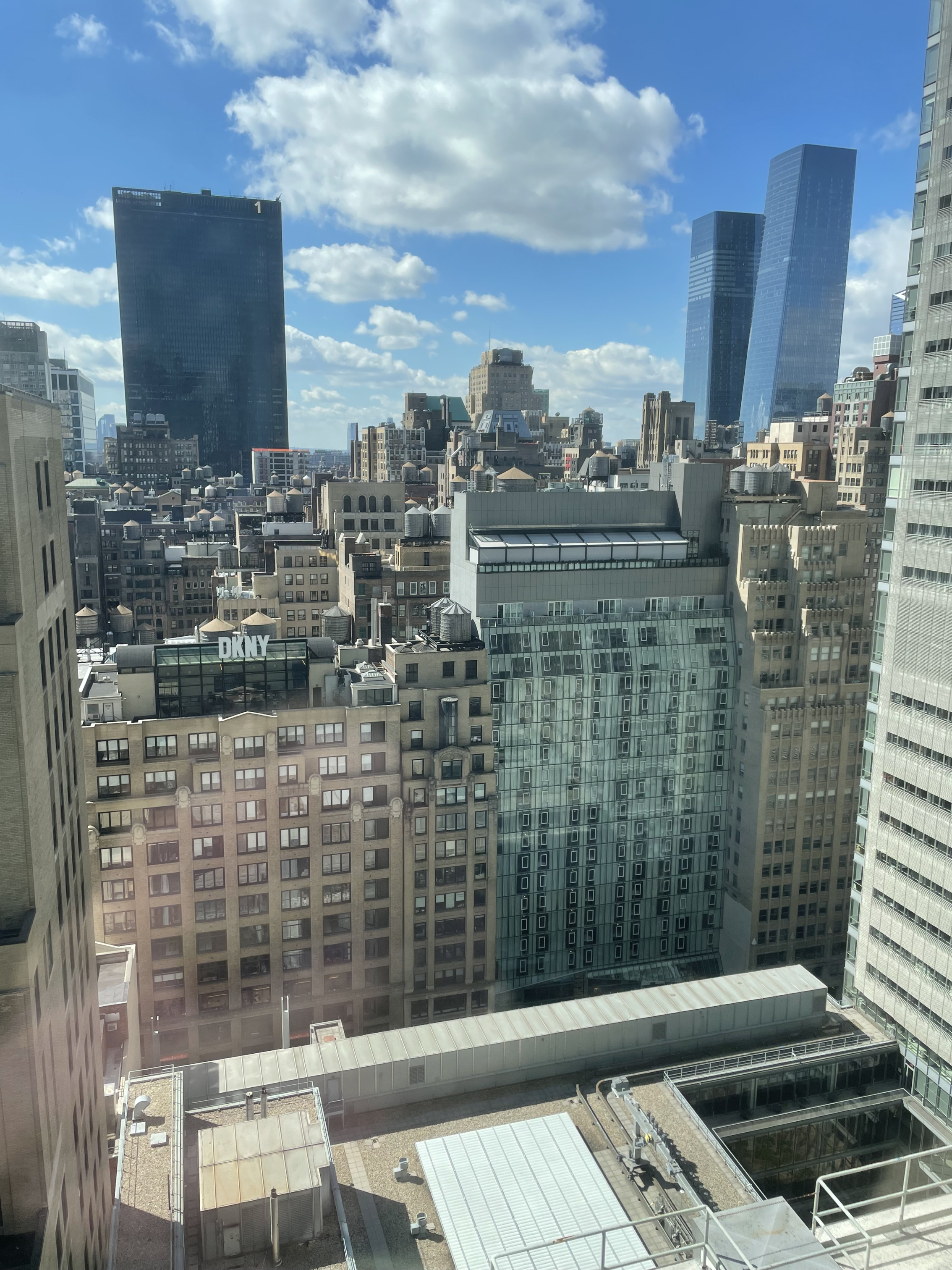
I took that from my room window at the Hilton in times square. St Patricks day 2024
 2
2 -
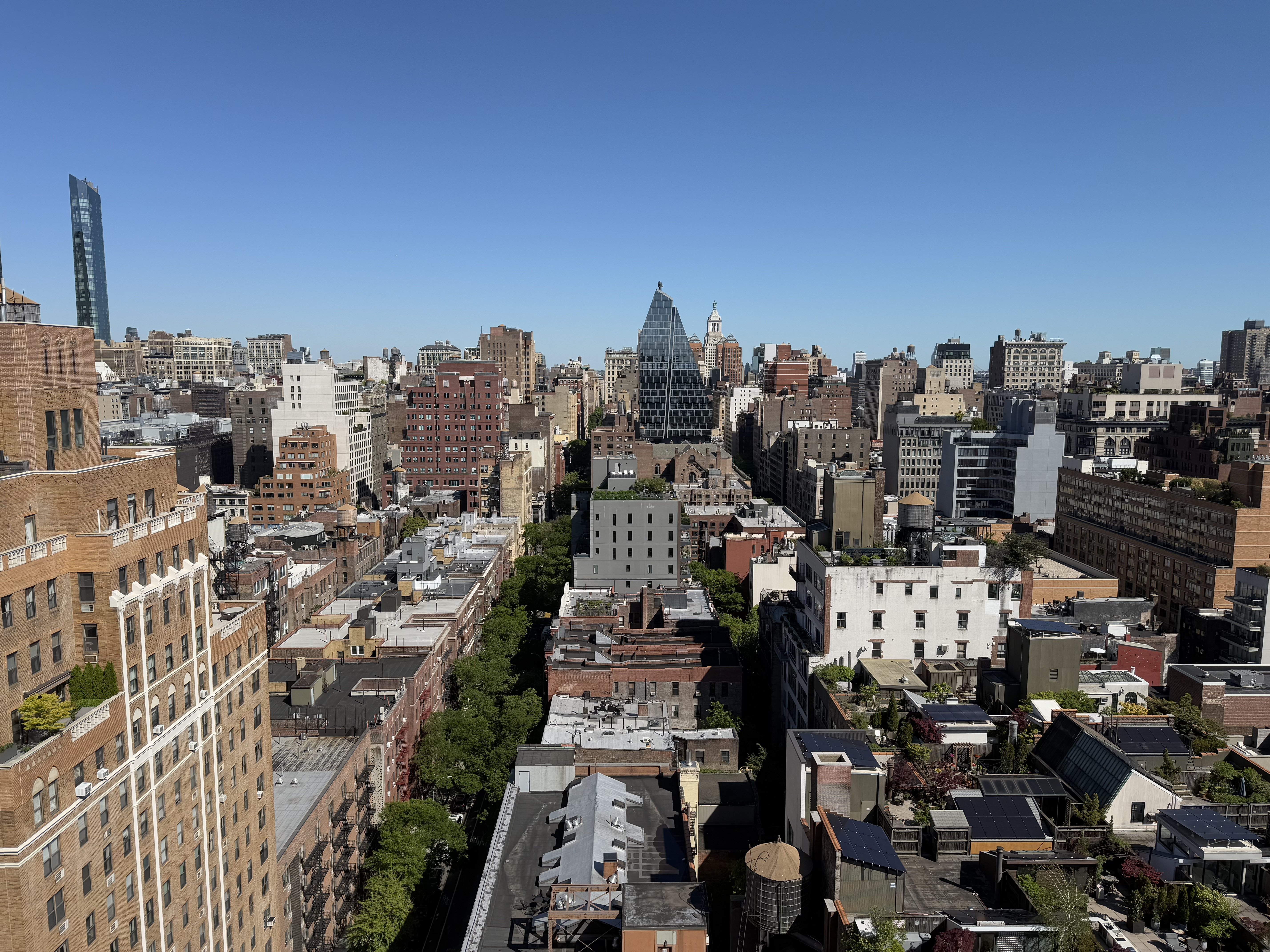
Took this photo the other day from the top of a roof tank, and as you can see there's plenty more around. I always take a moment to enjoy the views I get and sometimes get some nice photos
2 -
I believe the Unadilla Silo company built a great number of these water tanks.
1 -
I understand they're wood, but I'm still surprised they do not have freezing issues with these during weeks where it's really cold consistently.
Single pipe 392sqft system with an EG-40 rated for 325sqft and it's silent and balanced at all times.
0 -
Wooden silos made from hardwoods were use for ensilage and water both and are great insulators.
0 -
The R value of wood is fairly low compared to insulating materials.
Single pipe 392sqft system with an EG-40 rated for 325sqft and it's silent and balanced at all times.
0 -
Is there is enough mass in the water tank and the movement of water into and out of the tank through constant use that keeps the temp above freezing? Maybe an ice cake forms on top of the water at the most. Something must work well or there wouldn't be so many of them.
0 -
The water tanks made of wood were used for decades in cold climates when water was needed for coal and wood fired steam engines.
When the railroads switched to using concrete water tanks at water stops in cold climates they had to install oil fired heaters under the elevated concrete bases of the water tanks to prevent them from freezing from what I remember of them.
www.farmshow.com/article.php?aid=5321
0 -
for the most part there is enough movement of warmer water in to the tank from the supply to keep them from freezing but several people have also mentioned that they have worked on systems with steam heating coils to keep the tanks from freezing.
0 -
NYC Buildings with roof tanks seldom have much inactive flow. The connected piping will usually be well insulated
0 -
i'd imagine that the river the nyc gets its water from is not much above freezing at certain times in the winter.
0 -
NYC's water comes not from the river, but from reservoirs, mostly in the distant mountains. It travels through three tunnels bored deep in the bedrock. I suspect the temperature is relatively stable compared to more local water supply systems.
—
Bburd 2
2 -
Domestic tanks have enough flow in/out that its not usually an issue for them. Fire service only tanks are more likely to freeze since they just sit around doing nothing basically all the time. Rarely you'll see submerged resistance heaters in a roof tank. Buildings are more likely to put heat trace wiring on the in and out lines under the insulation because its simpler and easier and those are usually enough to keep things from turning solid during extended cold periods.
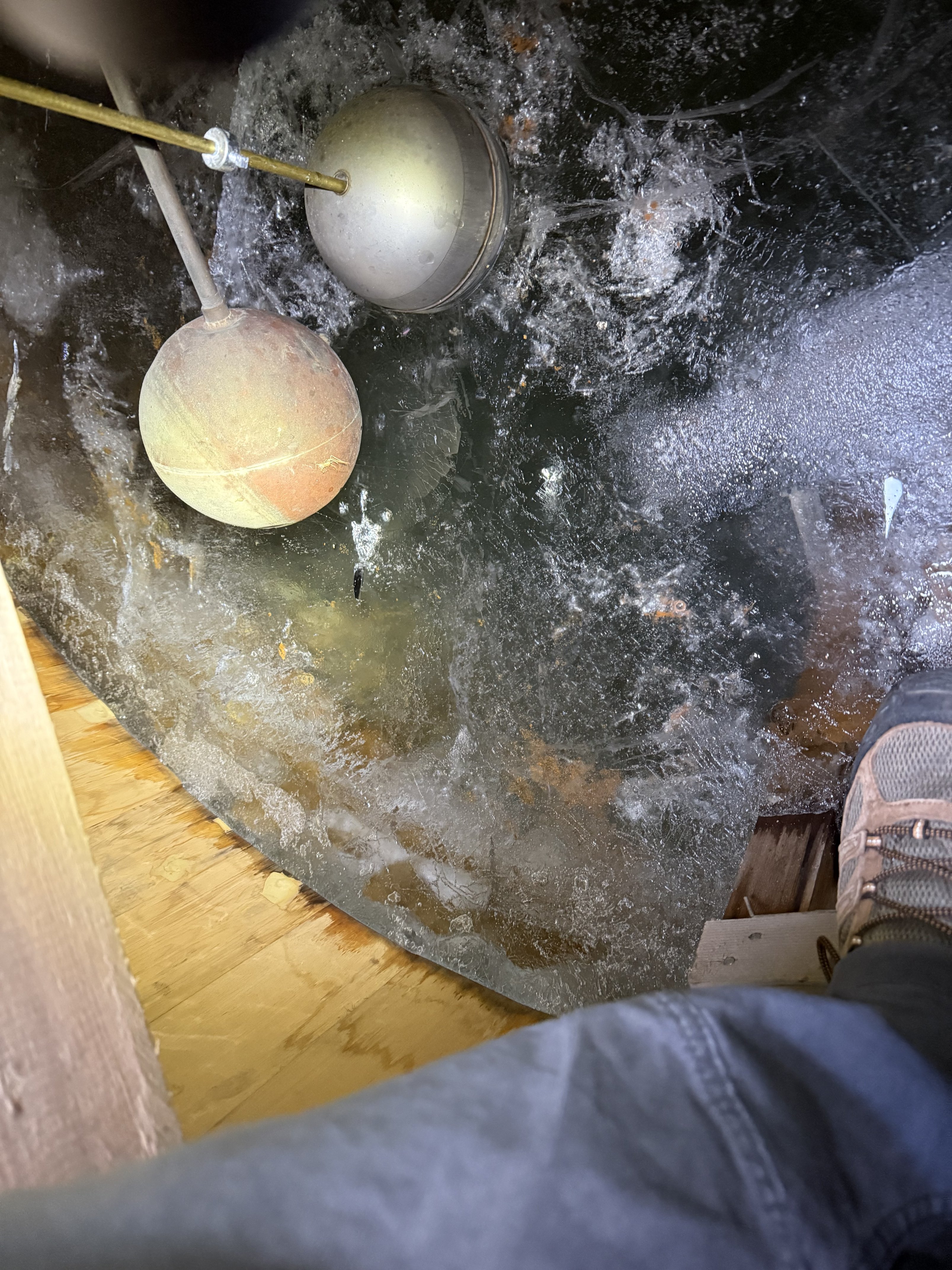
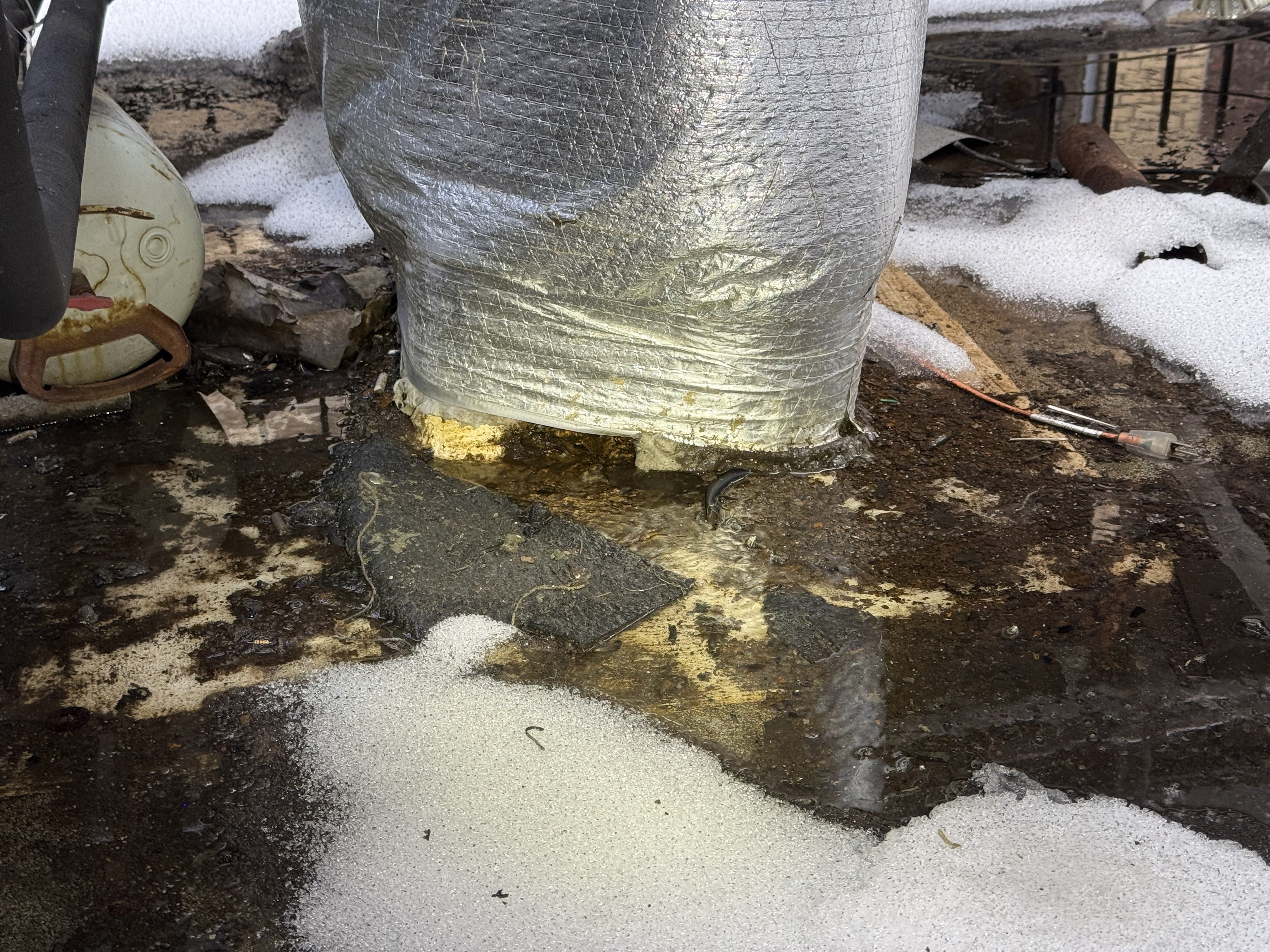
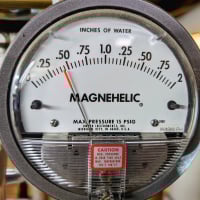
Below is that same fire tank that I shared a photo of before. It froze this past winter when we had that cold spell for couple weeks. Couldn't break it by stomping it as hard as I could. I was there on a warm day when things had started to melt because all the sudden the controls were throwing low level alarm. The piping down to the building had frozen and cracked somewhere under the insulation and it had just thawed enough to start leaking out of the tank. The pumps couldn't push water in either because the inlet was still frozen too. All they could do was let everything thaw first, then fix stuff. I'm sure the building wishes they had kept their heat trace wire plugged in, but as you can see by the naked plug in that second photo… oops!
 3
3 -
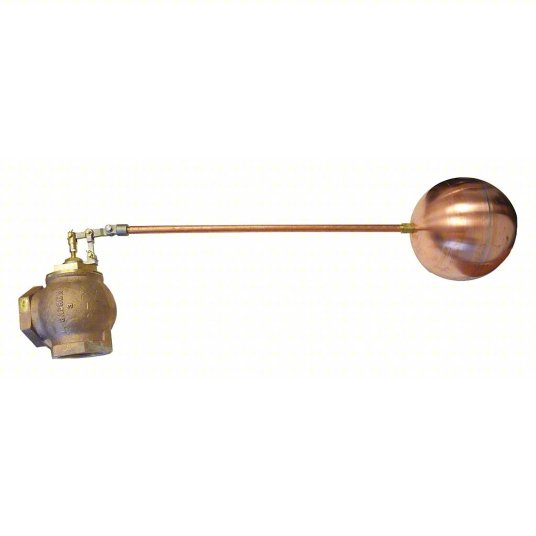
Look at those floats!
What does the valve those connect to look like?
Single pipe 392sqft system with an EG-40 rated for 325sqft and it's silent and balanced at all times.
0 -
I have not seen float balls that big since my father had his 8 bay car wash.
1 -
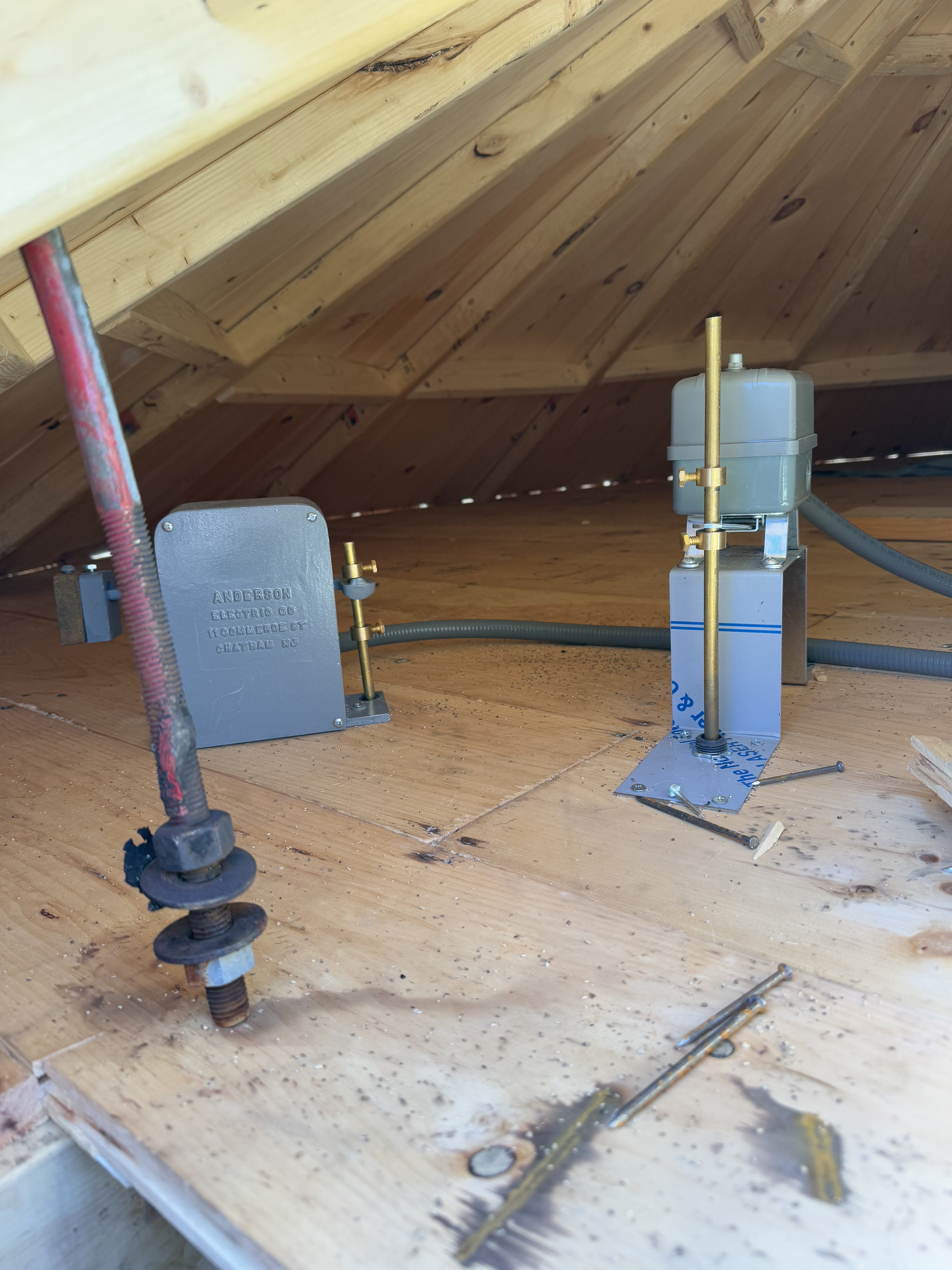
@ChrisJ The float ball with the angled rod is on a fill valve like this. If I recall the riser up to it is 2". The vertical one goes up to a level switch for fill or high/low alarm. Attached a good photo from a different tank of some of those switches.
@leonz any time you see float balls and rods for rooftanks or sewage pits in the city, they're almost always 8"
 2
2 -
I am pretty sure that that was the size of the float balls in the hot water tank and wax tank at his car wash as I had to run over to the plumbing supply house to buy a replacement float ball for him.
0 -
Similar to the valves and floats used on water towers although probably larger.
0 -
Wood actually is a surprisingly good insulator — and so is ice, so in a larger tank unless it's really cold for a long time freezing isn't tha much of a problem…
And yes, New York City water (and, for that matter, most large city systems — Boston, Hartford CT, etc) has very constant water temperatures, right around 50 or so. Small systems or systems with elevated storage, not so much!
And those float valves! I love them. They are so simple and so reliable — and if they fail, they tend to fail open and you will waste water and have an overflow from the tank, but at least you have water.
Br. Jamie, osb
Building superintendent/caretaker, 7200 sq. ft. historic house museum with dependencies in New England0 -
Good afternoon Brother Jamie,
This reminds me of the Aermotor and other windmills that use elevated tanks to water cattle.
The well casing is as tall as the elevated tanks fill hole in the side of the tank and the sucker rod will either have a stuffing box on the elevated well head casing that has a Tee threaded into the stuffing box that seals the sucker rod allows the water to drain into the tank or it has an large overflow pipe that drains back to the well head and back into the well. I will have to find the drawing I have in my files and post them here.
They can be set up with a tee at the top of the tank where the pump jack simply allows the water to be pumped into the elevated tank and the overflow simply falls back into the well with a second pipe and is never lost as long as the well has a second tee to drain back into the well or the drop pipe has a hole in the top joint below the freeze line in the ground to drain the water back into the well and the pump jack just keeps pumping when the wind blows.
0 -
I don't know about surprisingly good, but apparently it's good enough! The staves that make up the tank are apparently 3" cedar for an R value of about 4. If it was surprisingly good, no one would be concerned about thermal bridging of framing studs!
I have never forgotten this great NPR story where they interviewed Mr. Zimmerman of Rosenwach. I heard it when I still lived in Michigan 10 years before I would move out east myselfNJ Steam Homeowner.
See my sight glass boiler videos: https://bit.ly/3sZW1el1 -
If the tanks are to maintain pressure at the higher floors, it must suck to be on the floor right under the tank.
What's that give you, 6 to 10 psi?
For 40 psi you'd need almost 100 foot.
Single pipe 392sqft system with an EG-40 rated for 325sqft and it's silent and balanced at all times.
0 -
Correct BBurd. The Five Boros of New York City are supplied via the Croton (Putnam/Westchester County) Reservoir System and the Delaware System (Catskills, West side of The mighty Hudson River). The original intent was for Fire Fighting, but was soon supplying the exploding building and housing growth.
*Unique NYC Plumbing Vernacular:
We call domestic water piping inside the homes and buildings, "Crotons....are the Crotons complete yet?" Even plumbers on Long Island, NJ 🏝 and Westchester may not know what that term means. Mad Dog
1 -
In olden days Los Angeles had district refrigeration with wooden pipes for ammonia! So I heard. Was wood better in those days?
0 -
old growth wood has tighter grain because it didn't grow as fast being crowded in with other trees.
0 -
Leadville Co had wooden water tanks and mains
in the late 70’s. Because of a parasite that lived in the wood the DEC made us replace the tank, they never addressed the wooden water mains that the same parasite was living in.1 -
Wood was very different in the "old days". Even soft woods — which weren't used for pipes — such as pine or hemlock or fir — grew much more slowly and naturally, rather than in plantations, and as a result have much tighter grain and are considerably stronger (I've seen tensile and shear strengths twice that of modern wood, and elastic modulus 1.5 times as great) for a given size as well as rot resistant (this is yet another factor to worry about when working with old houses — those old beams were a lot stronger than a modern replacement the same size would be). Lots of cities had wooden water pipes, and even very large aqueducts were made of wood — staves for the aqueducts and bored logs for the pipes. Aqueducts were usually a soft wood — hemlock was common as it is very rot resistant — but most bored pipes were from various hardwoods, some of which (such as locust or American elm) are virtually rot proof. Well made, they will last for a century plus (some for two or three!) and just won't leak at all, once they are initially filled (hemlock wasn't used for drinking water, as it leaves a very slight taste).
Br. Jamie, osb
Building superintendent/caretaker, 7200 sq. ft. historic house museum with dependencies in New England 1
1 -
Crotons??………………..I thought those were put in soup or salad!!!
And I thought only the people in Boston talked funny
 3
3 -
i don't think anyone else has their own regional pipe thread
0 -
Even soft woods — which weren't used for pipes — such as pine or hemlock or fir — grew much more slowly and naturally, rather than in plantations,
Paul annoying question of the day: How do they make plantation trees grow faster and "unnaturally" in plantations today?
I'm interested in this because my house from 1915 or so is 100% pine, but it's the densest, hardest, toughest pine I certainly have ever seen. I've heard it's "heart pine" which is either due to where in the tree the lumber came from, and/or a specific kind of southeastern old growth pine from that time frame.
I assumed the reason we don't get new dense pine like this at Home Depot is because they simply don't plant it because it takes too long to grow to harvestable size compared to other faster-growing species used today.
But maybe there is some unnatural way to grow trees that I'm not familiar with, hence the question, thanks!
Is this the "unnatural" part?
And 2nd annoying question since we're talking about the insulative value here…which has the higher R value: old growth dense wood, or looser modern wood? I'd bet on the modern stuff simply because it's less dense so there must be more air pockets in there.
NJ Steam Homeowner.
See my sight glass boiler videos: https://bit.ly/3sZW1el0 -
trees tat grow naturally are more densely packed and intermingled with other species and other vegetation so they get less light and water and other resources to grow and are competing with the other species. farmed trees are spaced out to maximize growth and probably get some fertilizer and cultivation to get rid of intermingled vegetation. the more a tree grows in a year, the more space between rings.
i also think the big box stores get the rejects that the professional lumber yards wont accept. before the owners of the local lumber yard retired, if i bought lumber from them i got lumber that was straight and had almost no wane. when i dug through the pile at home depot looking for a 2x that wasn't twisted I couldn't find one.
 2
2 -
Well, you asked @ethicalpaul , but maybe I can shed some light. Modern plantation grown pine is grown in carefully planted relatively open uniform stands — geometrically vey neat. No underbrush. No competing trees. The pines have all the sun they need to grow as fast as they can — and they do. They can easily put on a quarter inch of diameter a year, or sometimes even more, and are harvestable for timer in a few decades at most (harvestable for biomass pellets and the like in 10 to 15 years).
The pine in question is the same species, although exactly which species is used depends on the location — but mostly one variant of white pine or another.
The only real difference is how fast the trees grew. Your "heart pine" probably took 50 to a hundred years to get to a usable size; some very big timbers may have taken two hundred years or more.
Br. Jamie, osb
Building superintendent/caretaker, 7200 sq. ft. historic house museum with dependencies in New England1 -
50-100 years,
Wouldn't it make more sense to plant sugar maple or oak than to wait for yellow pine at those growth rates?
Single pipe 392sqft system with an EG-40 rated for 325sqft and it's silent and balanced at all times.
0 -
Yes and no. Maple or oak — particularly white oak — is much stronger. BUT… the pines will usually give you 50 to 60 feet of nice straight trunk, and you can saw a lot of lumber out of that. You might get a mature oak — 150 to 200 years — to give you that amount of lumber, but not often! And maple is just as bad…
Not that you can't saw them for lumber, it's just getting long straight pieces is chancy.
On the other hand, oak — white oak particularly — is marvelous when you need odd curved shapes, such as for ship building. Amazing how much one can sell a just right piece of white oak for!
Historical oddity: there are still a few places in seacoast New Hampshire and Maine where one can run across the odd towering pine. If you look closely, you may find a blaze on it in the shape of a broad arrowhead. That means it was reserved by the King (before the Revolution) or the US Navy (afterwards) to make a mast for a ship — and God help you if you cut one down, because nobody else would.
Br. Jamie, osb
Building superintendent/caretaker, 7200 sq. ft. historic house museum with dependencies in New England1 -
old growth took that long. New growth with plenty of sunlight and fertilizer gets harvested in 1/4 - 1/2 that time.
0






Categories
- All Categories
- 87.8K THE MAIN WALL
- 3.3K A-C, Heat Pumps & Refrigeration
- 60 Biomass
- 430 Carbon Monoxide Awareness
- 133 Chimneys & Flues
- 2.2K Domestic Hot Water
- 6K Gas Heating
- 124 Geothermal
- 170 Indoor-Air Quality
- 3.9K Oil Heating
- 79 Pipe Deterioration
- 1.1K Plumbing
- 6.7K Radiant Heating
- 397 Solar
- 16.1K Strictly Steam
- 3.5K Thermostats and Controls
- 56 Water Quality
- 51 Industry Classes
- 51 Job Opportunities
- 18 Recall Announcements