Water Tanks on Roofs?

I have always noticed water tanks on the roofs of buildings in Boston and NYC. What purpose do they serve?
Albert Einstein
Comments
-
the pressure to get the water to the top of the building is more than the main pressure so they pump it to a tank on the roof and feed the building from that.
it can also be done with booster pumps.
0 -
They may also serve fire protection. Either way, you don't have to size your booster pump and service pipes for the peak load — just big enough to pump the average water use per day up there, with some reserve.
Br. Jamie, osb
Building superintendent/caretaker, 7200 sq. ft. historic house museum with dependencies in New England 1
1 -
city water pressure won’t lift that high. Pumps are used to lift it up then gravity delivers to the building.
0 -
I might add that some very tall buildings may have tanks on intermediate floors as well. Others will use pressure reducing valves.
Br. Jamie, osb
Building superintendent/caretaker, 7200 sq. ft. historic house museum with dependencies in New England
 3
3 -
For the last Century and change, they've been assembled on the roof with wood slats like a barrell which are held in place with heavy duty straps. They leaked for a day or two until the wood joints swelled up. They have a large ball Cock much like a toilet tank.
More recently they use Stainless steel. In NYC the two companies that have been doing them forever are Rosenwach and Isseks. Mad Dog


 3
3 -
Average NYC Street water main pressure will usually be good up to 4 stories max, thus roof tanks
 2
2 -
IIRC many of those tanks had steam coils to keep them from freezing. These ran off the steam boiler that heated the building. Makes things tricky when sizing a replacement boiler………
 2
2 -
Its actually quite amazing to see all the water towers in New York. They are everywhere. I stayed at the hilton in times square and i was on the top floor and the amount of towers was crazy.
I live in boston and we don't have rooftop water towers in Boston. I have never seen one here. We use boosters systems to get our water to the high points. Boilers and water tanks will be in the rooftop penthouse or mechanical rooms.
0 -
All the new high-rises have several booster pump zones to serve the higher floors. Mad Dog
0 -
i'd imagine it has to do with the size and condition of the mains too along with the elevation of the street. the mains might be too small for peak demand, they might be too weak for much pressure(or even worse booster pumps might draw the main in to vacuum at peak demand) and the pressure in the main will be a function of the pressure at the source and the elevation in relation to the source.
given that they've been building a new pipeline to the city for 50 years i wonder how much the infrastructure within the city has grown with the city.
0 -
The beauty of the tanks on the roof — or on mechanical floors — is that you can get away with really miserably undersized water mains and still provide enough pressure both for domestic use and, perhaps more important, at least some sprinkler fire flow.
On the domestic, suppose a 50 unit apartment building, 4 person occupancy — that's a daily load of around 16,000 gallons . It probably peaks at at least 250 gpm, maybe higher. That's a heck of a load for even a good size water main. But… if you have a nice tank of that capacity or so, you can chug happily along at about 12 gpm and meet the load very handily. That's a reasonably sized tank — though rather heavy.
Br. Jamie, osb
Building superintendent/caretaker, 7200 sq. ft. historic house museum with dependencies in New England1 -
The one in the building I worked in during high school had steam supply and a vacuum pump in the basement to pull steam thru to prevent freeze ups. I always called them blue collar jacuzzis.
0 -
Forum Moderator

 3
3 -
Many water municipalities obviously have elevated "water towers".
Our 1919 tank is about 100-140' in the air and seldom freezes in northern Nebraska.
I think the pumping of fresh water into it keeps it from freezing. However the 8" riser going up to it is boxed in with some form of insulation inside. Apparently the smaller volume of water in the pipe was a freeze problem.
0 -
My time to shine!
City pressure in most of NYC is around 35psi, although there are some notable exceptions, such as Washington Heights. Add an RPZ to the main coming in and there goes another 8-10psi, so you only get 4-6 floors before pressure is insufficient in the average building.
Many newer buildings will use a constant pressure booster system to pressurize the building. Those basically runs pumps non-stop to keep the building at the needed pressure (although if sized and set up well, will often go to sleep for some amount of the time in low usage times). Old school boosters use pressure regulation valves (Cla-Vals) for pressure regulation, new systems use drives to just control the speed of the pump instead. The one downside with a booster type setup is when the pumps stop, so does the pressure as soon as there is usage. Large buildings can drop 100psi in mere seconds when the pumps turn off.
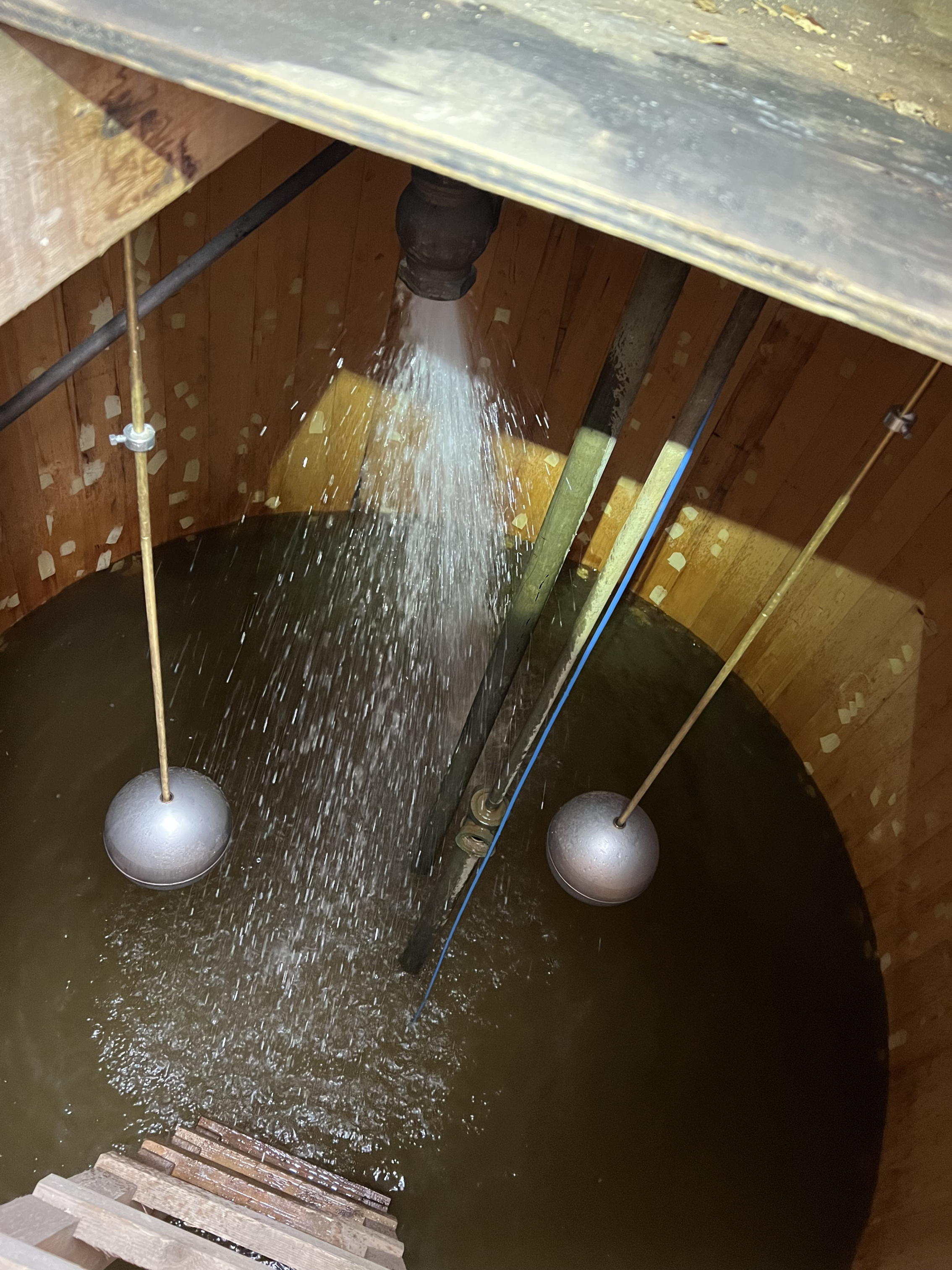
Roof Tanks, while old school, are still relevant also a simple and elegant solution for domestic water. Many domestic tanks also provide fire service water as well, but some are dedicated to just fire service. The tank is filled by tank fill pumps from the city main down in the basement (often referred to as house pumps), and then gravity brings the water down the to units. Conveniently the roof tank acts as a buffer so you can have higher peak usage than what the pump might be able to make up, so pumps can be sized with a fill GPM below potential max usage. The average tank is between 7.5k - 20k gallons. Sometimes buildings with roof tanks don't actually have enough elevation on the tank above the top units and so the top few floors might have insufficient pressure. In this case they will usually add a small booster to add 15-20 extra psi pushing downwards.
Very large buildings will also have what are referred to as Day tanks to act as a buffer between city main and the building. These day tanks are located in the basement mechanical levels and are required if the building has the potential to pull more than a 400 GPM from the city at once to prevent local pressure sag on the city mains.
Very tall buildings will use a combination of Day tanks, Roof tanks, and boosters and will be zoned in into sections of 20-30 floors per section
Here's a photo of what the inside usually looks like and don't worry that this water looks rather green, this specific tank is for fire service only! You can see the fill valve filling dumping water in (ballcock is offscreen to the left) and also the typical float balls for pump run and high/low alarm although those actually aren't in use in this tank. The pump controls here use a submersible transducer for level measurement which is at the bottom of the blue wire that runs down into the water.
 2
2 -
Speaking of booster pumps, we had an excellent webinar last week on VS booster pumps. Thanks to Irfan from Grundfos.
How they size and how to determine when to use multiple pumps for best efficiency, redundancy, etc
Bob "hot rod" Rohr
trainer for Caleffi NA
Living the hydronic dream0 -
Slightly off topic: $$$$ could be saved over long term with separate supplies for potable; irrigation; and fire.
0 -
With all the concern for aerosol germs, I'm surprised the fire service tanks aren't requiring some kind of treatment. Seems like that stuff spraying down on firemen would be objectionable.
It looks nothing like the black gunk that comes out of sprinkler lines around here before the clear water gets to the head.
0 -
Yes, the water sitting in the pipes is Black, skanky and smelly but it does the job! after the 1st 15 - 30 seconds its clearing but I still wouldn't drink it.
By the time the FD shows up it clean.
0 -
i'd be far more concerned about asbestos and other hazardous materials that come apart or get torn apart in a fire.
0 -
FD inside building that required sprinkler activation would most likely be in SCBA air packs already.
0 -
after drenched in water?
the fibers are no longer friable!0 -
even if the cavity you are hacking in to is wet, they will stick to stuff and dry out later.
0 -
The irony is that the folks on the top-floor (often the penthouses) have the worst water pressure. In my rep days, I sized a lot of pressure pumps to go inside a cabinet.
Retired and loving it. 4
4 -
I've always found it rather amusing that those that pay the most in buildings usually have the worst pressure and are right next to the operational noise of any rooftop equipment, fans.
I'll never have to worry about having those problems though 😂
0 -
They never asked about mechanical equipment or water pressure when they are buying the place. It was always a surprise.
Retired and loving it.1 -
Wasn't the top floor the low rent space before practical elevators were invented?
0 -
Yes, due to the chore of climbing all those stairs.
—
Bburd0 -
Another surprise is fluctuating flows with cheapo (light weight) booster stations. Pressurized reserve is necessary.
0 -
We used a small, 3500 rpm, base-mounted pump, a small diaphragm tank, and a flow switch. It did a nice job in a small space.
Retired and loving it.1 -
I've used that kind of setup in applications where I had a well which had inadequate yield — fill a storage tank (pump the low yield well all day) and use a small booster — or in a couple of schools, several! — to get adequate system pressure. I seem to recall there was a self-contained Jacuzzi unit I used. But that was 50 years ago now! I suspect there are new ones now!
Br. Jamie, osb
Building superintendent/caretaker, 7200 sq. ft. historic house museum with dependencies in New England0 -
Deep well pump on a timer feeding a storage tank that had a mercury float switch with a jet pump used to provide pressure to the home system, it works very well.
1 -
For applications like a hotel with many simultaneous luxurious showers; storage is essential, somewhere.
0 -
i don't know what hotels you're staying in but every hotel i've stayed in in about the past 25 years had a shower with a flow restrictor in it that was like trying to shower with a squirt gun

 2
2 -
2 gallons per minute is the maximum flow in new and replacement water appliance fixtures.
0 -
So true and so sad. I used to travel with my own shower head. Later needed a set screw driver. If I still cared I'd need a set screw extractor. I think that leonz is correct that now the fixture itself is limited. US authorities are nuts.
0 -
there is usually a flow restrictor that can be removed from most shower heads. the federal regulation is 2.5 gpm which is adequate. most shower heads are set up for considerably less at usually 80 psig out of the box so if they aren't adjusted for the actual pressure and maximum flow you get a whole lot less than what is permitted. generally people that understand orifice calculations are not installing shower heads in hotels.
0 -
The reduced volume is an irritant for sure, but what I find worse is when they try to make up for it with pressure. There's no experience like being under 20-30 water cutting jets.
0 -
1.8 or 2 gpm shower head flows in California and Colorado.
Bob "hot rod" Rohr
trainer for Caleffi NA
Living the hydronic dream0 -
Hi, Low flow showerheads seem to have a good feel only if they deliver large water droplets. This delivers heat better also. Consumer Reports has looked into this and found low flow heads people actually like. Those old tiny chromed heads that squirt you with mist never were the answer. 😸
Yours, Larry
1







Categories
- All Categories
- 87.8K THE MAIN WALL
- 3.3K A-C, Heat Pumps & Refrigeration
- 60 Biomass
- 430 Carbon Monoxide Awareness
- 133 Chimneys & Flues
- 2.2K Domestic Hot Water
- 6K Gas Heating
- 124 Geothermal
- 170 Indoor-Air Quality
- 3.9K Oil Heating
- 79 Pipe Deterioration
- 1.1K Plumbing
- 6.7K Radiant Heating
- 397 Solar
- 16.1K Strictly Steam
- 3.5K Thermostats and Controls
- 56 Water Quality
- 51 Industry Classes
- 51 Job Opportunities
- 18 Recall Announcements