Best Of
Re: V- Groove
We use the Victaulic groover that mounted on a Ridgid 300. Don't know the model or if it fits a "compact 300"
They make a lot of different models and so dose Ridgid.
What you pick depends on what pipe size you're doing.
If doing 4" or smaller you can get away with less expense and weight to drag around. If your doing a lot of 6" and up be prepared to spend $$$$$ and it will be heavy

Re: Bronx apartment gas explosion
Well, one good thing is no one got hurt whatever the cause.
Re: #2 oil vs Bio- Fuel
On a side note Rudolph Diesel invented his engine initially to run on coal dust but it exploded, he then moved to Hemp oil because he felt that since all farmers grew hemp they could use the hemp oil to run their equipment for free, big oil had other ideas and wanted him to endorse #2 which was already in use for lamps, etc instead of whale oil. History books wrongly state he made it to run on soybean oil, it wasn't a large crop back then.
Diesel was found floating in the English channel. Big oil called #2 diesel oil and the rest is history.
 GBart
GBart
Re: Rinnai i150s Circulator Pump Question
FWIW….
According to Rinanni…a user supplied circulator pump is necessary for the boiler loop, in addition to the radiators loop(s) circulator pump(s) for the Rinanni i150s Non-Combo Boiler.
Thanks Again,
Bill

Re: Rinnai i150s Circulator Pump Question
if there is no built in circ I recommend putting the external circulator on the return pipe flowing into the boiler (blue vertical line under boiler) and yes you will want some drains and valves. webstone makes pump flanges with and without drains that are nice, they also make ball valves with drains built in.
 GGross
Re: Sub floor radiant heat for primary heat source
To get 20 BTU/hr per square foot the floor would need to be 10F above room temperature. Let's say 1.5 inches of wood is R1.5, so you'd need the plate to be 30F above floor temperature to get that 20 BTU/hr. So if the room is 72F the plate needs to be at 112F. The water needs to be slightly warmer, not a lot, so 120F sounds about right. Maybe a couple of degrees more because you need the average to be around 120.

Re: Sub floor radiant heat for primary heat source
There are plenty of hardwood floors heated by radiant. you just have to watch your p's and q's.
Everyone will or should tell you that you need a proper design for your system. Depending on the system you and your contractor decide on, the manufacturer will have engineering data that will tell you if their system will work given your design outdoor temperature and the amount of insulation in your house. The data will also tell you how to program your boiler to deliver the proper temperature water to your floor.
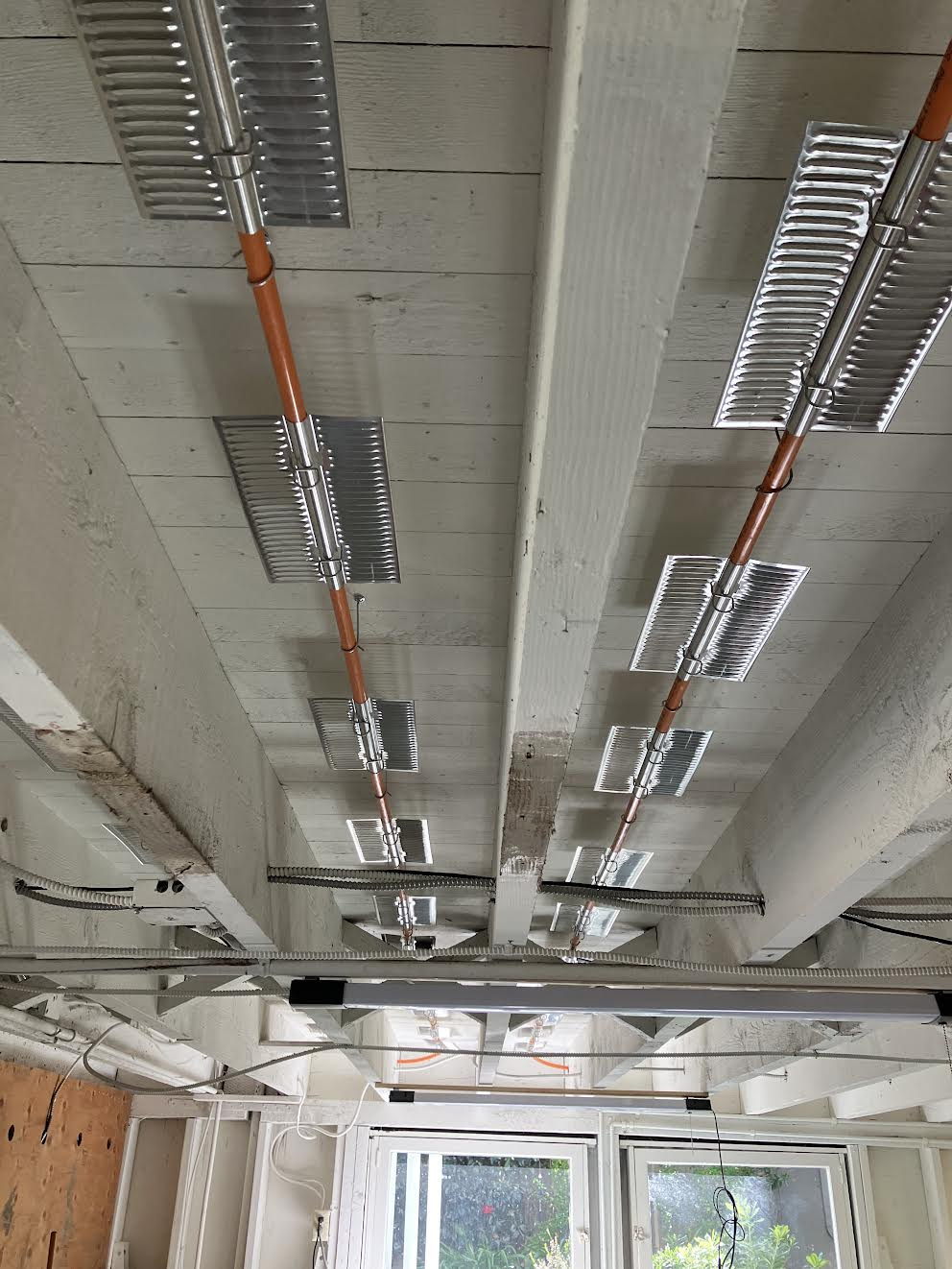
Most staple-up systems should not exceed 120F water temperature as the flooring can react at higher temps. Look also at the Ultra-Fin product as you can exceed 120F since this product does not heat by conduction, rather convection. I like it because you only need one run per bay instead of two.
Yes, floor temps should not exceed 80-85F as it gets uncomfortable for humans. You start sweating at those temps.

Re: Sub floor radiant heat for primary heat source
I have aluminum plates on the underside of the underlayment under both hardwood and even carpet/pad. Not a problem. On a reset control with 120 degree water on design day. Runs most of winter in the 90-110 range, p/s, long cycles.
A thermal imaging camera makes balancing much easier.

Re: Sub floor radiant heat for primary heat source
You need to start with knowing what the insulation will be and doing a heat loss calculation, then you or someone else can use some radiant design software to design tubing to cover that loss.
You will have to insulate under the tubing to push the heat up through the floor.
It is done all the time with hardwood. I don't know what the limits on the surface or the tubing are. Not only will designing for too high a surface temp dry out the wood, it will also be uncomfortable to walk on.
 mattmia2
Re: Sub floor radiant heat for primary heat source
Underfloor heat needs to be designed, there are no useful rules of thumb. It is possible for it to be the sole source of heat, it's also possible for it not to be, it depends upon your heating load and the layout of the house.
I would look at a system like Warmboard (not an endorsement, that's just the brand name of the most popular system).
Will you have air conditioning? It often works much better to deploy the heated floors strategically and supplement with forced air.
Floor thickness won't be an issue with doors, you can raise them. Where it may really be a problem is with stairs. Although if you do both floors you might be able to raise the entire flight by the thickness added.