Best Of
Re: Using a hot-water radiator for one-pipe steam
1" is good for an EDR of 25 so at 20 your not pushing it. Could you use a 1" valve and reduce the riser to go into the valve? A reducer on a riser is less of a problem.
But. if you lay the rad down and put a 2-footer on it with a cheater it will give up. If not Sawzall it out.
The way you have it is probably fine.
Now that I changed my mind 3 times I am out LOL

Re: Water hammer in steam system
Need pictures. Water hammer is usually a pipe pitch problem. The condensate has to be able to drain out somehow,
Re: What type of Vent on pipe near boiler in basement
We need to know the total length and size (diameter) of the steam mains in your basement, not counting the radiator takeoffs or risers to upper floors, to tell you what size main vents you need.
 bburd
bburd

Re: Advice for replacing a Bell & Gossett 2-1/2" with a Grundfos
Farm and Fleet, Auto Zone, NAPA, Menards, Snap On, Mcmaster Carr, check with a NAPA Dealer first if you are in a hurry, Mcmaster Carr can have one on your doorstep in 3 days+-.
You can still buy tools right off the Snap On truck.
 leonz
leonz
Re: Advice for replacing a Bell & Gossett 2-1/2" with a Grundfos
A cushion clamp is what you need for this and perhaps a rubber cushion at the base to absorb more vibration.
Generally, when you have vibration like this the bearings are going bad and all you may need is a new circulator assembly.
You will know if the motor end bearing is bad if the shaft can be pushed/moved too as the outer race will be bad as well.
If you have an engine stethescope you can quickly identify bearing noise and cavitation/air bubbles being generated in the circulator housing too indicating a severely worn volute.
Before you waste your money, invest in an engine stethescope to listen to the noises being made as you will quickly find the cause.
leonz
Re: expansion tank sizing
yes am gona have it swinged away from boiler the picture was just to show new ex-tank beining installed on return side a 12-15" far from the pump ,so it can pump away !!
 nytech28
Re: Boiler pressure rising and expansion tank location
You do not need a check valve. You have zone valves. In the future when you have both zones operating, the zone valves will do the opening and closing of each circuit. A check valve in a pump can only make for problems when a closed zone valve is able to isolate the pump (with IFC) from the expansion tank. NO CHECK NEEDED. The fact that there is no check valve means that your boiler pressure rising issue is not associated with the IFC in the pump because it is not there!!!

Re: Where can I add a scoop and air vent
Where are you going to get 1-1/4" or 1-1/2" zone valves for that old radiator zone
Not all the pipes are visible in this photo:
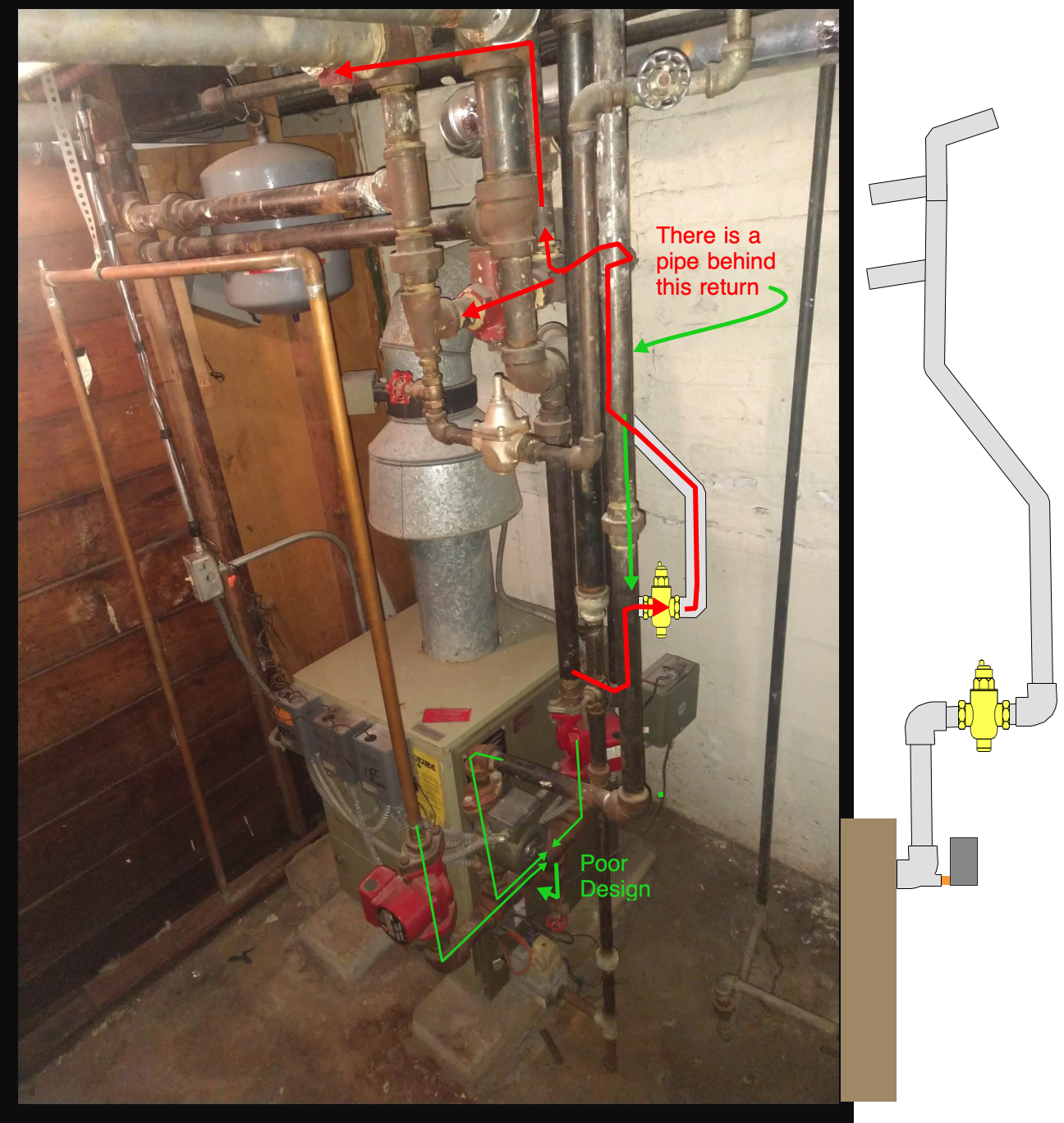
There is a 1-1/2" supply that exits the top of the boiler on the side where the Aquastat relay is mounted. That Aquastat relay is actually mounted on a 1-1/2" x 3/4" x 1-1/2" Tee fitting. The Red arrow indicates the vertical 1-1/2 or 1-1/4 vertical supply riser. The three returns are also designed poorly, but it has worked for years so no need to change it out now. (if it ain't broke don't fix it). Just when the replacement boiler shows up, have someone that understands proper piping practices prepare the piping properly! Say that 10 times fast.
The best spot to place a Discal would be on that riser. indicated in the drawing and the photo. You will need a repipe of that vertical so you can add a short horizontal for the air separator. That will be a bandaid until you do a complete repipe with the new boiler. The proper fix is to start from the boiler and put all the circulators on the supply side after the Discal where you mount the extrol tank under it. Get the book .
Re: Plan Review: Basement Hydronic Convector Wall (DIY)
it a surface area game with a radiant panel. The wall has a lot of sq ft, so it will run at a lower temperature than a panel radiator. And two, in this case the selling feature, it is invisible. No obstruction in the living space to furnish around.
The heat output of any radiant panel is predictable. In this case the formula is near identical to a panel radiator.
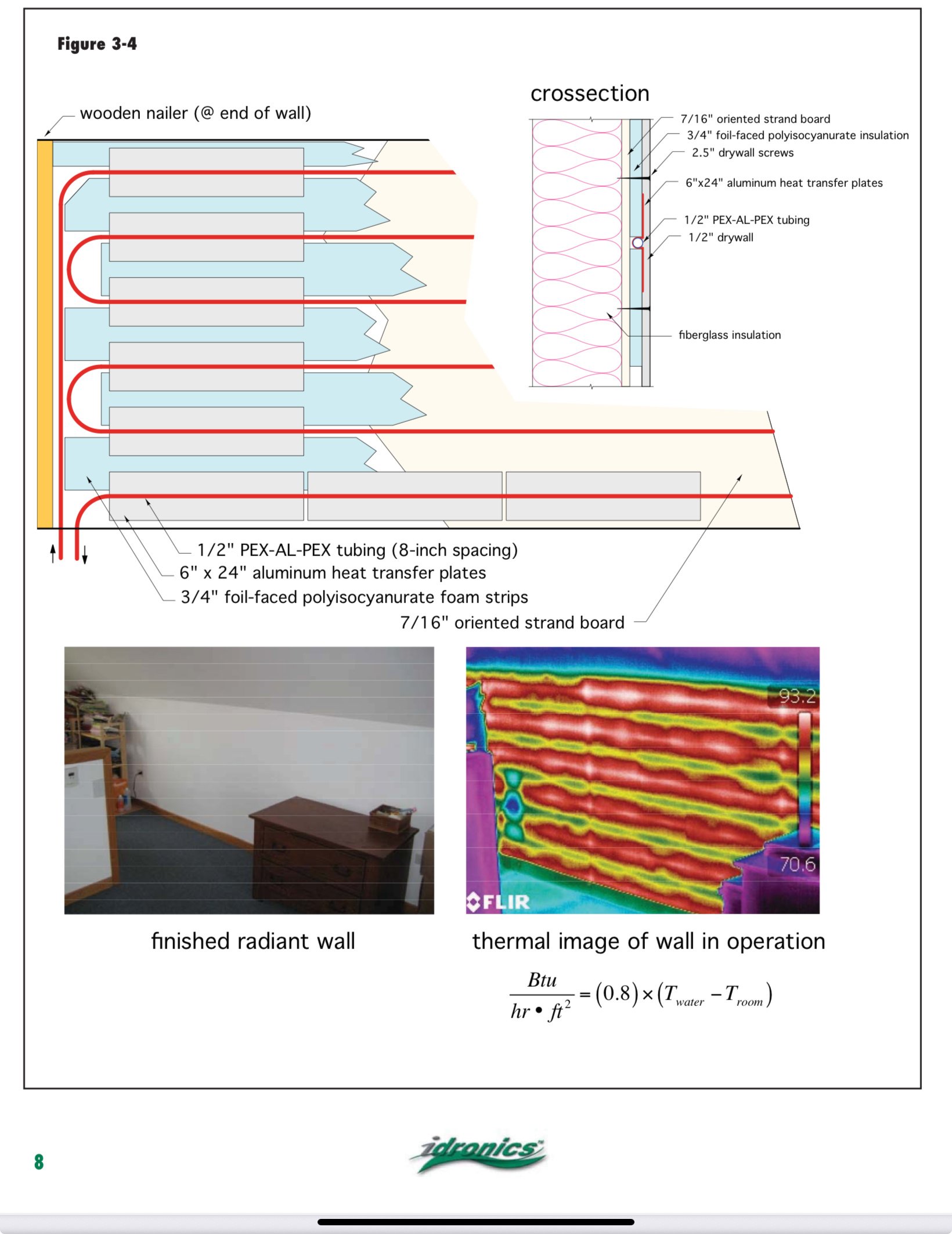
Although some panel radiators have a convection component. Space between the chambers with a finned metal partition. That will factor into the output.
It will also move dust around
The output from a radiant wall, ceiling, or floor are fairly close. The ceiling and walls can run higher surface temperatures= higher output compared to a floor panel.
The walls have a slight edge over a ceiling as you will get some temperature stratification with ceiling radiant, lowering it’s output a bit compared to a wall
Some of the old electric radiant ceilings ran pretty hot. Too warm to keep your hand in for a long period. Being tall, they make my head uncomfortably warm.
 hot_rod