Best Of
Re: HVAC in New Construction in 2024
There have been many discussions on heat pumps and furnaces/boilers, so I thought I would put out some of the points that seem to keep recurring.
Heat Pumps in Cold Climates: Why Hybrid Systems Make More Sense: Heat pumps are a remarkable technology, but in cold climates with high electricity rates, they can be expensive to install, replace, and run. Fortunately, hybrid systems with a boiler or furnace offer a smarter, more flexible solution.
Bosch recommends mini splits with boilers, not just heat pumps alone. In a training session two weeks ago, they also stated that heat pumps in New England are not a good application because the electric rates are so high.
NREL study shows a seasonal COP of 2.1 (210% annual efficiency) - that's almost $6/gal oil equivalent. Since the COP drops further with lower temperatures, electric bills increase rapidly. This May 2023 NREL Field Validation of Air-Source Heat Pumps for Cold Climates study shows the wide disparity between manufacturers ratings and field performance, with an average seasonal efficiency (COP) of 2.1. On a unit of energy basis, $0.30/kWh is the equivalent of $12.18 per gallon of oil and $8.79 per therm of natural gas. New York residential electric rates increased 50% from 2020 to 2024, and 4% in the prior 7 years…Northeast states are leading that trend and forecast to increase further.
Studies show 60% to 80% of people turn off their heat pump below 35°F, often due to high electric bills and the air the blow is colder than furnaces (multiple studies p 18-19). That’s often the right choice economically and environmentally because furnaces and boilers will cost less to operate and they use less source energy compared to electricity generated with natural gas (EPA Clean Air Markets Program Data CAMPD 40% power plant efficiency in New England less 8% transmission and distribution losses); and they have lower carbon intensity (GREET 2022 1.06% natural gas fugitive emissions means natural gas 20 year lifecycle has a 36% higher carbon intensity than fuel oil). Even more so when temperatures drop below freezing.
Imagine a power plant as a hungry pizza eater. You feed it 8 slices of natural gas, but it gobbles up 5 slices just to generate and deliver electricity to your home. That leaves only 3 slices of usable energy. A 210% efficient heat pump can stretch those 3 slices into 6 slices of heat. But if you use a boiler that's 87% efficient, it skips the power plant altogether and turns 7 out of 8 slices directly into heat, more warmth, less waste.
Furnaces and boilers deliver warmer, more comfortable heat (cold climate technical data p A230). For comparison, the air leaving mini split heat pump heat at 91°F can feel like cold air blowing at 73°F just a few feet away. A better air sealed and weatherized house with high efficiency windows and doors can improve winter heat pump comfort.
Electrification will require that the residential grid grow 4X. Cold climate heat pumps consume close to 2X as much electricity as a typical home, and EVs use the equivalent of another home's worth of electricity. In the near term, that means if just 10% of cold climate homes fully "electrify", the residential grid will need to provide almost 30% more electricity (and that does not include overall grid load impacts from AI impacts). And the cost of utility scale battery back up is astronomical, they last about 10 years and cost about $300 to $500 per kWh of storage - that's just $0.30 of electricity.
Heat pumps aren’t just expensive to run, they’re expensive to install and replace. In Rhode Island, representatives indicated that converting low-income homes to heat pumps cost the state $20,000–$25,000 per home this year. Over time, that’s $75,000+, compared to a single boiler that lasts decades.
Hybrid systems make sense, especially in a volatile energy future. It’s not all-or-nothing as hybrid systems let you choose the best tool for the job, season by season. Choosing to heat with a heat pump or a boiler/furnace could be for personal comfort, operating cost, emissions, source energy consumption, and more.
Roger
 Roger
Roger
Re: AO Smith Gas Water Heater Warranty Replacement
Yeah i just can't wrap my head around charging a handling fee to replace a water heater under warranty when you sold the original equipment, it's just not customer friendly at all. seems so clear that 90 was leaking, just fix it and keep the customer happy, clearly an install error.
 GGross
Re: AO Smith Gas Water Heater Warranty Replacement
Thats wild I would immediately lose a customer if I charged them to process a warranty on equipment we are a dealer for. AO smith and their brands are also super easy to process warranty, service tech calls support, support verifies the failure, gives contractor an R number, take a photo of the full rating plate, contractor comes in and gives us the R number, we verify it, they leave with a new unit at no charge. The warranty typically processes before the new unit is pulled from the warehouse. We will occasionally call support for the R number ourselves to help the contractor out and I'm always surprised how quick the calls are for a tech support line.
GGross
Re: AO Smith Gas Water Heater Warranty Replacement
there could be more than one issue but you can look right at it and see it's leaking at that elbow. wild that nobody stocks the regular AO smith 75 gallon tank around and you have to pay shipping in addition to labor? AO smith brands also do a program through distributors that will cover a portion of a contractors labor fees, not going to post a number here as its prob market based and might have changed but at the time it covered maybe half of our more expensive contractors hourly rate. But yeah they don't cover 100% of labor rates, you can try contacting AO smith directly to see if they have a better solution, I know when I had a contractor complain about the labor rates they offered to have one of their partners come do the job and we all agreed we didn't want to have someone do the replacement that worked so cheaply. This may have changed in the past couple of years, it's usually just not a huge deal, water heater changeouts can be pretty quick
GGross
Re: AO Smith Gas Water Heater Warranty Replacement
did you buy the original water heater directly or did you buy it through the installer? I've seen smart contractors charge handling fees when they didn't sell the equipment, because they don't want to be out money if something happens in transport, usually its around the cost of a new unit. I've never heard of an installer charging a handling fee for a warranty unit replacement of a unit they directly sold a customer though. 1 year workmanship warranty is pretty standard, I would be shocked if this wasn't leaking in the first year lol, but yeah kind of less recourse when its been so long, and clearly that leak has been unaddressed for years.
GGross
Re: AO Smith Gas Water Heater Warranty Replacement
Hi, Is the tank itself actually leaking? If not, I'd replace the cold-side plumbing down to the tank, replace the anode rod and keep going. I'd also use a different plumber. The old gate valve should have been replaced, along with having unions at the hot and cold connections. In the West, we almost always use flex connectors, which would have prevented any strain on the copper sweat joints and given unions. 🤠
Yours, Larry

Re: Trying to understand wiring for heating system
" Trying to understand wiring for heating system "
Good that it is now working.
Hopefully now you understand more than you ever really wanted to know about your boiler's wiring.
 109A_5
Re: high velocity ac
I understand all that believe me. The factory is the one who instructed me to have lined inside in this application-I have installed these systems for 30 years

Re: Staged boiler retrofit design questions
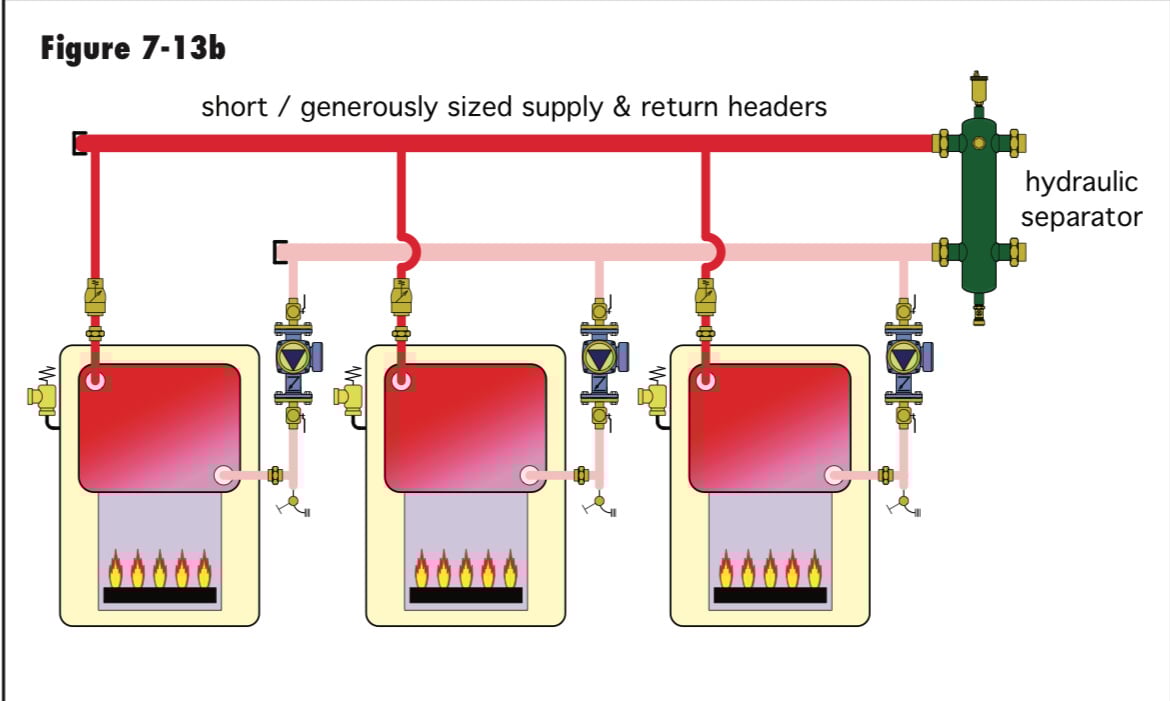
I think a hydronic separator is just the ticket! Great suggestion, thank you @hot_rod !!
 fwmech
Re: Staged boiler retrofit design questions
hydro seps are more common for combining boilers
You get air, dirt, magnetic and hydraulic separation with one component
 hot_rod