Best Of
Re: Ghost or Gravity feed - not fixed with replacement TACO FLOCHEK
Pop the top and clean the weight , shaft and seat with fine steel wool .. . Could also be a strand of teflon tape laying in there . It looks like a 1" flow valve . If it were 3/4" I would recommend up sizing to 1" …. Sometimes ,with long runs and high risers , two flow checks are needed ..
 Big Ed_4


Re: Ghost or Gravity feed - not fixed with replacement TACO FLOCHEK
Its probably the flow check

Re: Ghost or Gravity feed - not fixed with replacement TACO FLOCHEK
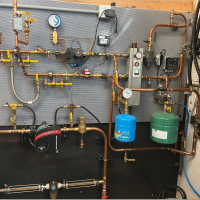
are the return lines above the circulators hot? You could be getting some ghost flow up the return.
If you have isolation valves at the pump turn them off if the returns are hot and see if they cool off?
 hot_rod
Re: Ghost or Gravity feed - not fixed with replacement TACO FLOCHEK
are you sure he took the piece of cardboard out of it before he put it in
 mikedo
Re: New Return Pipe Noise During Renovation
@JodiMe I service the cranford area. The best way to reach is at 2018878856
 EzzyT
EzzyT
Re: New Return Pipe Noise During Renovation
Check if @EzzyT or @Steamhead cover your area.
 Brent H.
Re: System 2000 oil boiler cycling on/off, what is normal?
Overcomplication. The dip switches on the bottom of the manager can be set to increase return temp. shutdown, approx. 155 to 170. Set high limit back to 215, that's how Roger's engineers designed the system. Result will be that first floor will heat a little faster and will be a little less short burner cycling. An original inquiry was "is this normal?" Answer is mostly yes, but I just outlined how to minimize short burner cycling. It is not a big deal, your fuel usage is at a minimum with an EK boiler properly set up. Consult your EK digital manager guide for proper dip switch setting, I don't remember offhand.

Re: Indirect HW off steam- shaking circulator
While not a cheap date, this type of circulator, a B&G PL series, would keep the motor out of any dirty water. This is an air cooled motor as opposed to a wet rotor design., 225°f rated
The B&G series 100 is another option.
 hot_rod
Re: Water heater as buffer tank
This is the control I like to use. It has a lot of adjustability, nice readout. Other versions from HW and Johnson controls. The sensor against the metal tank jammed under the tank foam insulation is accurate enough.
 hot_rod