Best Of
Re: New Return Pipe Noise During Renovation
push that rod thru a couple 2, 3, inches past the boiler jacket,
do both upper and lower valve, you'll want a bucket handy for the lower valve
 neilc
neilc
Re: xx
Ok check valves are not helping. Install the appropriate zone valve and wire it up. The first two responses provide wiring methods, pick the one you like. Each has advantages and disadvantages.
 109A_5
Re: Puzzle: Two Solutions for a Hydronic Systems Flow Problem- Which is Best?
I think a balance valve in each of the supplies would allow you to tune it in. Any idea how many gpm you need to move to the radiators?
Always consult a joist drill chart when drilling structural joists. Seems odd with all the other stuff under the joist that they were drilled? Could have boxed them in along the waste piping if the ceiling is to be finished.
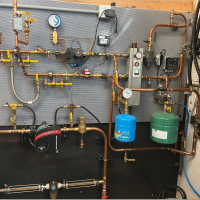 hot_rod
Re: Chart for BTU reduction/increase based on radiator paint?
Here's the US Government's publication on the subject from 1935. Click on the first two words ("This chart…" hyperlink) to see the chart you're looking for.
And remember that the paint only effects radiation heat transfer, with no effect on convective heat transfer. So whatever minimal effect the paint has on radiation is further mitigated by the fact that radiation is only a portion of the radiator's heat transfer mechanism.
 jesmed1
Re: Zone Valves BANG on opening only
@EdTheHeaterMan Diagnosied the issue, the current setup isolates the space heat when zone valves close so when any opens water rushes in. This causes high flow rate and the check valve slam shut once the flow settles.
Remove the check valve.
 Kaos
Kaos
Re: What I think
It's a terrible long term business strategy, but they don't care. With private equity, they're trying to juice the company books quickly, and sell it off at a big profit.
I disagree. Scamming the public in all aspects of life is a good business strategy, especially when done with "facts" where the customer is convinced of the new product. I would hazard a guess that not more than 10% of the public would have a conclusion of being scammed. The people we see on HH are a tiny fraction of what is going on in the world.
Once scam after another without ANY CONSEQUENCES to the scammer.
Note that said companies have no ethics or integrity but if you look at the big picture in the USA today, these two character traits are basically gone in most places. The almighty dollar is all that matters. It begins at the top.
 LRCCBJ
Re: Combined Venting
first of all, the barometric draft control on the boiler appears to be crooked. The face of the draft control must be installed plum, the hinge of the draft must be installed level. Unless your camera is at a really odd angle, it appears that your barometric draft control is not installed properly.
As far as installing a gas vented appliance like a water heater in the same chimney as an oil fired appliance, it is done all the time. It is important, however, to make sure that the 3” or 4” connector pipe from the water heater is at a point in the chimney that is higher than the oil burner Connector pipe. You do not want to connect the water heater under the flue connector of the Oil fired flue connector pipe.

See how this works on that liner connector Tee? Oil boiler at the bottom, gas water heater at the top.
Larry Weingarten brings up a good point about the BTU capacity of each burner. That will come from the boiler rating plate of the water heater and the boiler. A 6” liner can only vent so much exhaust. When you add those two BTU capacities together, it must not exceed the capacity of the 6 inch diameter, flue liner.

Re: Leaking new vents?
Yes your boiler is rated for 391sqft but that is to be compared directly to your standing radiation, not the radiators + piping. The boiler rating already accounts for the piping estimate. So you are almost 50% oversized with all your radiators open. In my opinion you would be better off with slowing some of the radiators down getting a little more length out of a cycle to give the house a chance to heat up before all the radiators are filled and you start cycling on pressure.

Re: National 209 series gas boiler - pilot light went out.
Does the Gas company replace Thermocouples ? As mattmia2 stated, I also would check (replace) that first. They are inexpensive compared to most everything else.
109A_5

