Welcome! Here are the website rules, as well as some tips for using this forum.
Need to contact us? Visit https://heatinghelp.com/contact-us/.
Click here to Find a Contractor in your area.
If our community has helped you, please consider making a contribution to support this website. Thanks!
Best Of
Re: Anyone ever seen this style steam rad?
I think that's a Clogston, and yes, we have charts for radiators like this. Go here:
https://www.heatinghelp.com/systems-help-center/ribbed-and-ringed-radiator-ratings/
and here:
https://www.heatinghelp.com/systems-help-center/clogston-radiator-patent/
https://www.heatinghelp.com/systems-help-center/ribbed-and-ringed-radiator-ratings/
and here:
https://www.heatinghelp.com/systems-help-center/clogston-radiator-patent/


Re: Anyone ever seen this style steam rad?
This is in a church in Baltimore, MD. The church was sold to the Seventh-Day Adventist church back in 1950. It was originally a Hebrew Temple.
 JXH
JXH
1
Re: Uncap 7 inch furnace exhaust pipe in basement
Oh. Well, I won't comment on the crop. However, your humidity is going to be off the charts in that exhaust air. That is going to cause a lot of condensation in that poor chimney. At the very least I would want to add a Continuus stainless steel flue liner or that old chimney will have a short and miserable life.

Does It Pay To Fix Those Steam Traps?
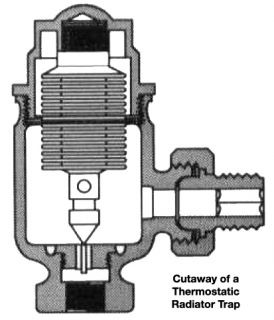
Does It Pay To Fix Those Steam Traps?
Short answer: It sure does, but not in the way you may think.

Re: Looking for a Q90-100
Ed the Heater man,
As a matter of fact I had a 57 2dr post car with a 427 in it. Single 4 barrel on an aluminum intake. That was a fun car. I am currently building a 55 Chevy 2 dr hardtop

As a matter of fact I had a 57 2dr post car with a 427 in it. Single 4 barrel on an aluminum intake. That was a fun car. I am currently building a 55 Chevy 2 dr hardtop
 Chevy57
3
Re: Added Vents, Lost Heat?
Only for this instance because the 16 minutes at the end was on a relatively cold system. It's moot anyway, because I propped it back up, and lifted a couple of radiators and they're now getting hot for the first time ever, woo hoo!GeekGirl913 said:Just timed the front main, without the one end supported, and it took 16 minutes to get my first paltry steam puff. Granted, the system was on the cold side, but still, that's quite a while especially since the cycle guard cuts the burners off after 20 minutes to do its thing.KC_Jones said:Have you timed how long each of the mains takes to heat? Shouldn’t take more than about 5 minutes.
Going to let it cool down, then try it again with the front main propped up a bit to see how long it takes then.
The rear main was/does get hot, but even when I have gotten steam out of it, it's not flowing to those last two radiators out of nowhere.
mattmia2 said:
Oddly, when the guy first redid the near boiler piping, it heated quite nicely, I was shocked. Our kitchen is a converted mud room and is all windows, so it's quite cold in there.Note that the main you showed the end of has a return at the end so that main should slope toward the return. Also not my notes above showing that the way it is piped you can't get that radiator branched essentially off the return to heat well.

Re: This Friday's case, the case of the lost heat call
@The Wire Nut I remember meeting you Thanks for the tour. I dont like being petty on a job and never embarrass anyone in front of another person but in this case i made an exception. Funny thing is I used to be a control tech, spending several years with Johnson Controls. Thanks for watching Alex!

The case of the boiler that failed on low water, this Friday's case
In this case, an attendee at a steam seminar asked me at break about the steam boiler in his home. The cast iron boiler dry fired and cracked. The thing that was different than other cases like this was the homeowner said he blew down the boiler a few times each heating season and it still failed. Each time he blew down the boiler, the burner would shut off like it is supposed to do. It wasn't a one time event like a broken pipe that caused the boiler to fail. I'll let you know Friday at 6am EST what caused the problem.
Re: jet fuel for your oil burner ?
Different Jet Fuels
JET A-1
Jet A-1 is a kerosene grade of fuel suitable for most turbine engined aircraft. It is produced to a stringent internationally agreed standard, has a flash point above 38°C (100°F) and a freeze point maximum of -47°C. It is widely available outside the U.S.A. Jet A-1 meets the requirements of British specification DEF STAN 91-91 (Jet A-1), (formerly DERD 2494 (AVTUR)), ASTM specification D1655 (Jet A-1) and IATA Guidance Material (Kerosine Type), NATO Code F-35.
JET A
Jet A is a similar kerosene type of fuel, produced to an ASTM specification and normally only available in the U.S.A. It has the same flash point as Jet A-1 but a higher freeze point maximum (-40°C). It is supplied against the ASTM D1655 (Jet A) specification.
JET B
Jet B is a distillate covering the naphtha and kerosene fractions. It can be used as an alternative to Jet A-1 but because it is more difficult to handle (higher flammability), there is only significant demand in very cold climates where its better cold weather performance is important. In Canada it is supplied against the Canadian Specification CAN/CGSB 3.23
MILITARY
JP-4
JP-4 is the military equivalent of Jet B with the addition of corrosion inhibitor and anti-icing additives; it meets the requirements of the U.S. Military Specification MIL-DTL-5624U Grade JP-4. (As of Jan 5, 2004, JP-4 and 5 meet the same US Military Specification). JP-4 also meets the requirements of the British Specification DEF STAN 91-88 AVTAG/FSII (formerly DERD 2454),where FSII stands for Fuel Systems Icing Inhibitor. NATO Code F-40.
JP-5
JP-5 is a high flash point kerosene meeting the requirements of the U.S. Military Specification MIL-DTL-5624U Grade JP-5 (as of Jan 5, 2004, JP-4 and 5 meet the same US Military Specification). JP-5 also meets the requirements of the British Specification DEF STAN 91-86 AVCAT/FSII (formerly DERD 2452). NATO Code F-44.
JP-8
JP-8 is the military equivalent of Jet A-1 with the addition of corrosion inhibitor and anti-icing additives; it meets the requirements of the U.S. Military Specification MIL-DTL-83133E. JP-8 also meets the requirements of the British Specification DEF STAN 91-87 AVTUR/FSII (formerly DERD 2453). NATO Code F-34.
AVIATION FUEL ADDITIVES
Aviation fuel additives are compounds added to the fuel in very small quantities, usually measurable only in parts per million, to provide special or improved qualities. The quantity to be added and approval for its use in various grades of fuel is strictly controlled by the appropriate specifications.
A few additives in common use are as follows:
1. Anti-knock additives reduce the tendency of gasoline to detonate. Tetra-ethyl lead (TEL) is the only approved anti-knock additive for aviation use and has been used in motor and aviation gasolines since the early 1930s.
2. Anti-oxidants prevent the formation of gum deposits on fuel system components caused by oxidation of the fuel in storage and also inhibit the formation of peroxide compounds in certain jet fuels.
3. Static dissipater additives reduce the hazardous effects of static electricity generated by movement of fuel through modern high flow-rate fuel transfer systems. Static dissipater additives do not reduce the need for `bonding' to ensure electrical continuity between metal components (e.g. aircraft and fuelling equipment) nor do they influence hazards from lightning strikes.
4. Corrosion inhibitors protect ferrous metals in fuel handling systems, such as pipelines and fuel storage tanks, from corrosion. Some corrosion inhibitors also improve the lubricating properties (lubricity) of certain jet fuels.
5. Fuel System Icing Inhibitors (Anti-icing additives) reduce the freezing point of water precipitated from jet fuels due to cooling at high altitudes and prevent the formation of ice crystals which restrict the flow of fuel to the engine. This type of additive does not affect the freezing point of the fuel itself. Anti-icing additives can also provide some protection against microbiological growth in jet fuel.
6. Metal de-activators suppress the catalytic effect which some metals, particularly copper, have on fuel oxidation.
7. Biocide additives are sometimes used to combat microbiological growths in jet fuel, often by direct addition to aircraft tanks; as indicated above some anti-icing additives appear to possess biocidal properties.
8. Thermal Stability Improver additives are sometimes used in military JP-8 fuel, to produce a grade referred to as JP-8+100, to inhibit deposit formation in the high temperature areas of the aircraft fuel system.
POWER BOOSTING FLUIDS
It used to be commonplace for large piston engines to require special fluids to increase their take-off power. Similar injection systems are also incorporated in some turbo-jet and turbo-prop engines. The power increase is achieved by cooling the air consumed, to raise its density and thereby increase the weight of air available for combustion. This effect can be obtained by using water alone but it is usual to inject a mixture of methanol and water to produce a greater degree of evaporative cooling and also to provide additional fuel energy.
For piston engines, methanol/water mixtures are used and these may have 1 percent of a corrosion inhibiting oil added. The injection system may be used to compensate for the power lost when operating under high temperature and/or high altitude conditions (i.e. with low air densities) or to obtain increased take-off power under normal atmospheric conditions, by permitting higher boost pressure for a short period.
Both water alone and methanol/water mixtures are used in gas turbine engines, principally to restore the take-off power (or thrust) lost when operating under low air density conditions. Use of a corrosion inhibitor in power boost fluids supplied for these engines is not permitted.
The methanol and water used must be of very high quality to avoid formation of engine deposits. The water must be either demineralised or distilled and the only adulterant permitted in the methanol is up to 0.5 per cent of pyridine if required by local regulations as a de-naturant. In the past there were several different grades of water/methanol mixtures, e.g. 45/55/0 for turbine engines, 50/50/0 for piston engines (this was also available with 1% corrosion inhibiting oil and was designated 50/50/1) and 60/40/0, however, with decreasing demand Shell now only supplies 45/55/0. The table shows the principal characteristics of Shell demineralised water and of the commonly used methanol/water blend.
JET A-1
Jet A-1 is a kerosene grade of fuel suitable for most turbine engined aircraft. It is produced to a stringent internationally agreed standard, has a flash point above 38°C (100°F) and a freeze point maximum of -47°C. It is widely available outside the U.S.A. Jet A-1 meets the requirements of British specification DEF STAN 91-91 (Jet A-1), (formerly DERD 2494 (AVTUR)), ASTM specification D1655 (Jet A-1) and IATA Guidance Material (Kerosine Type), NATO Code F-35.
JET A
Jet A is a similar kerosene type of fuel, produced to an ASTM specification and normally only available in the U.S.A. It has the same flash point as Jet A-1 but a higher freeze point maximum (-40°C). It is supplied against the ASTM D1655 (Jet A) specification.
JET B
Jet B is a distillate covering the naphtha and kerosene fractions. It can be used as an alternative to Jet A-1 but because it is more difficult to handle (higher flammability), there is only significant demand in very cold climates where its better cold weather performance is important. In Canada it is supplied against the Canadian Specification CAN/CGSB 3.23
MILITARY
JP-4
JP-4 is the military equivalent of Jet B with the addition of corrosion inhibitor and anti-icing additives; it meets the requirements of the U.S. Military Specification MIL-DTL-5624U Grade JP-4. (As of Jan 5, 2004, JP-4 and 5 meet the same US Military Specification). JP-4 also meets the requirements of the British Specification DEF STAN 91-88 AVTAG/FSII (formerly DERD 2454),where FSII stands for Fuel Systems Icing Inhibitor. NATO Code F-40.
JP-5
JP-5 is a high flash point kerosene meeting the requirements of the U.S. Military Specification MIL-DTL-5624U Grade JP-5 (as of Jan 5, 2004, JP-4 and 5 meet the same US Military Specification). JP-5 also meets the requirements of the British Specification DEF STAN 91-86 AVCAT/FSII (formerly DERD 2452). NATO Code F-44.
JP-8
JP-8 is the military equivalent of Jet A-1 with the addition of corrosion inhibitor and anti-icing additives; it meets the requirements of the U.S. Military Specification MIL-DTL-83133E. JP-8 also meets the requirements of the British Specification DEF STAN 91-87 AVTUR/FSII (formerly DERD 2453). NATO Code F-34.
AVIATION FUEL ADDITIVES
Aviation fuel additives are compounds added to the fuel in very small quantities, usually measurable only in parts per million, to provide special or improved qualities. The quantity to be added and approval for its use in various grades of fuel is strictly controlled by the appropriate specifications.
A few additives in common use are as follows:
1. Anti-knock additives reduce the tendency of gasoline to detonate. Tetra-ethyl lead (TEL) is the only approved anti-knock additive for aviation use and has been used in motor and aviation gasolines since the early 1930s.
2. Anti-oxidants prevent the formation of gum deposits on fuel system components caused by oxidation of the fuel in storage and also inhibit the formation of peroxide compounds in certain jet fuels.
3. Static dissipater additives reduce the hazardous effects of static electricity generated by movement of fuel through modern high flow-rate fuel transfer systems. Static dissipater additives do not reduce the need for `bonding' to ensure electrical continuity between metal components (e.g. aircraft and fuelling equipment) nor do they influence hazards from lightning strikes.
4. Corrosion inhibitors protect ferrous metals in fuel handling systems, such as pipelines and fuel storage tanks, from corrosion. Some corrosion inhibitors also improve the lubricating properties (lubricity) of certain jet fuels.
5. Fuel System Icing Inhibitors (Anti-icing additives) reduce the freezing point of water precipitated from jet fuels due to cooling at high altitudes and prevent the formation of ice crystals which restrict the flow of fuel to the engine. This type of additive does not affect the freezing point of the fuel itself. Anti-icing additives can also provide some protection against microbiological growth in jet fuel.
6. Metal de-activators suppress the catalytic effect which some metals, particularly copper, have on fuel oxidation.
7. Biocide additives are sometimes used to combat microbiological growths in jet fuel, often by direct addition to aircraft tanks; as indicated above some anti-icing additives appear to possess biocidal properties.
8. Thermal Stability Improver additives are sometimes used in military JP-8 fuel, to produce a grade referred to as JP-8+100, to inhibit deposit formation in the high temperature areas of the aircraft fuel system.
POWER BOOSTING FLUIDS
It used to be commonplace for large piston engines to require special fluids to increase their take-off power. Similar injection systems are also incorporated in some turbo-jet and turbo-prop engines. The power increase is achieved by cooling the air consumed, to raise its density and thereby increase the weight of air available for combustion. This effect can be obtained by using water alone but it is usual to inject a mixture of methanol and water to produce a greater degree of evaporative cooling and also to provide additional fuel energy.
For piston engines, methanol/water mixtures are used and these may have 1 percent of a corrosion inhibiting oil added. The injection system may be used to compensate for the power lost when operating under high temperature and/or high altitude conditions (i.e. with low air densities) or to obtain increased take-off power under normal atmospheric conditions, by permitting higher boost pressure for a short period.
Both water alone and methanol/water mixtures are used in gas turbine engines, principally to restore the take-off power (or thrust) lost when operating under low air density conditions. Use of a corrosion inhibitor in power boost fluids supplied for these engines is not permitted.
The methanol and water used must be of very high quality to avoid formation of engine deposits. The water must be either demineralised or distilled and the only adulterant permitted in the methanol is up to 0.5 per cent of pyridine if required by local regulations as a de-naturant. In the past there were several different grades of water/methanol mixtures, e.g. 45/55/0 for turbine engines, 50/50/0 for piston engines (this was also available with 1% corrosion inhibiting oil and was designated 50/50/1) and 60/40/0, however, with decreasing demand Shell now only supplies 45/55/0. The table shows the principal characteristics of Shell demineralised water and of the commonly used methanol/water blend.
