Best Of
Re: Recommendation for highly reliable natural gas water heater?...
I have exclusively installed Bradford White over the last 30 years after the others didn't hold up like they promised..Mad Dog

Re: DIY result, will it hold?

This could have to do with the Hot Work Permit being required to work in that building?
Copper press connections are a safe, reliable method for that type of work.
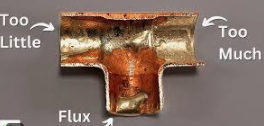
The only way to know the quality of a soldered joint is to cut it open. That is what is required when you take a plumbing license test in some jurisdictions. Same for a poured lead joint test.
The type and brand of solder and flux is more a personal choice, like a tool or truck :)
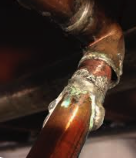
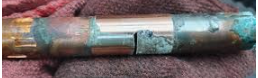
The appearance of the joint can sometimes tell if the solder work was successful. In rare cases the joint can develop a leak after some use if a flux pocket washes out, for example. Many a plumber has had a sweat joint leak appear days later.
With experience you can tell or feel if the joint flowed the appropriate amount of solder into the fitting successfully.
 hot_rod
Re: DIY result, will it hold?
If you cleaned , fluxed and soldered the joints and they don't leak chances are they will not leak regardless of the way the outside looks. After the joint is soldered a wet rag wipe down will remove the excess flux and your fine.

Re: Recommendation for highly reliable natural gas water heater?...
Hi, After turning off the water and relieving pressure, I'd check the condition of the anode rod in the tank. It's your best indicator of actual tank condition. I'd also look around the tank for evidence of new or old leaks. I'd look into the combustion chamber also. If things looked okay and if there was something left of the anode, I'd just replace the anode and then check it periodically… that time period will depend on anode condition and water quality. 😉
Yours, Larry

Re: Now ya see why PVC on mod con flue is not a good idea
This was 3"pvc... .I agree with Bob Harper...we're all just taking a stab at why...only a lab analysis can possibly determine why it pulled apart. Let's just keep an open mind....could the manufacturers have very sound reasons for disallowing pvc in flue exhausts?
Could acidic flue gases cause this is as well? Mad Dog
Re: J.P. Ward
trade jobs and manufacturing have gotten such a bad rap the last 30 years or more, not because they were ever bad jobs but people with degrees had much better communication skills and wooed the kids away from the trades/manufacturing by telling them the degree was their golden ticket to the mountain top and of course we wanted all of our kids to do well, so many of us allowed them to pursue the degree.
Now we are upside down in degrees vs good hand skills. It will take some time but funding trade type schools and classes in regular schools as well as better advertising of the factory/trade work environment would help. The pay is good, the benefits are good, low/no debt upon graduation, typically a job lined up at graduation all good stuff.
Build the plant the hands will come.
 PeteA
PeteA
Re: Single pipe steam system return pipe reroute
This is a cheap installation that can prevent problems though rare where some type of pressurization from the boiler may occur causing water from the boiler to back flow and cause a pressure lock at the trap causing a no flow condition.
This method typically is used where condensate goes below a beam, the jump over equalizes pressures that can occur down stream of the trap.
This is shown on page 50 of my book Steam the Perfect Fluid for Heating and Some of the Problems.
Jake

Re: Now ya see why PVC on mod con flue is not a good idea
high temperature systems with PP and long horizontal run can be a problem if not supported properly.
I have seen the piping sag and leak condensate at the joints.
HTTP failed , standard PVC and CPVC isn’t the best solution, some stainless suffered gaskets or silicone adhesive failures,
Hopefully PP holds up better. It is a harsh environment for the tube and seals
Dirty or plugged HXers can run the flue temperatures up pretty hot. Hot enough to trip temperature safeties.
Mod cons in DHW mode are generally exceeding the PVC, maybe even CPVC temperature limits
Not to mention the lack of listing for flue gas conveyance on typical PVC pipe
Yet manufactures are still sending equipment out with PVC or CPVC “starter pieces” PVC fittings and rubber sewer pipe connectors😲 Some brands sent ABS start pieces, which would often get connected to PVC. Crazy!
hot_rod
Re: Now ya see why PVC on mod con flue is not a good idea
You can armchair quarterback your opinions and guesses as to the failure but without lab analysis you are still just grasping at straws. Was it installed per the mfrs. listed instructions as well as those of the PVC pipe mfr, the primer and the solvent cement? Was the pipe used within the approved applications by the pipe mfr? Was the pipe properly supported? Was it leak tested prior to use? Was the appliance inspected and tested including gas pressures, orifices, firing rate, MUA, intake air obstructions/ sizing/ pressures? Flue gas outlet temperatures? Any signs of overfiring in the unit or historical evidence such as tripped safeties? Was the heat exchanger ever replaced? Lot's of questions in a forensic investigation.
I don't like PVC for a number of reasons: The pipes out there were never listed for this use but specifically forbidden per most pipe mfrs. While the pipe itself might withstand short term temps upwards 170F, the solvent cement routinely fails at 140F or lower. I've never seen an HVAC tech properly cut, chamfer, deburr or join PVC for venting. Never. I see pipe cut with a Sawzall held with one hand and the pipe with the other. The end of the pipe resembles a hole saw with all its jagged edges. The end is never chamfered nor deburred and there is no way to tell externally once the joint is made. Meanwhile, inside, the rough joint plows the cement pushing a dam of it ahead while scraping cement from the outer walls. The result is a very weak, often leaky joint.
The pipe mfrs. expressly FORBID pressure testing with gas, such as done with gas piping. You can do a low pressure water test but how are you going to test the seal on a flush wall termination like a Bayvent? You would have to test with the pipe extended, tested, cut to length and attach AFTER the test. You might be able to rig a test ball in some cases. Also, on long runs through crawlspaces, you may get a few drips that harbinger a future failure yet not manifest during the test duration. You have to rely on one end of the pipe or another just as with gas pipe testing. That brings in the gauge resolution, test duration and allowable leakage. It has to be reasonable yet reflective of the conditions.
The UL 1738 test seems fairly reasonable and reliable. It is also repeatable.
Everything made by man can and will eventually fail. It's just a matter of when and at what cost.

Re: Now ya see why PVC on mod con flue is not a good idea
I am a bit curious on how you came to that conclusion. How can you know if it bottomed out or not by looking at the two photos? You certainly cannot judge this by the length of the primer.
 LRCCBJ