Best Of
Re: Radiators heating even though their zone pump is off.
If it were me, I would correct the 3 way valve piping first.
You could still wire the main floor pump and radiant pump to run off one thermostat for now until you get a relay box to separate the zones. No need to start chopping in check valves until you determine the cause of the cross over.
Then for the other issue, when the porch zone only is running, start turning off various ball valves ( a ball valve is a manual check valve for troubleshooting), to determine which is crossing over or backflowing. You just need to use a process of elimination to narrow down the unwanted flow. This could take hours, days!
It's not easily done over the internet :)
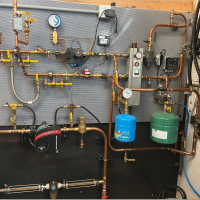
Do you have accurate strap on thermometers to make temperature determinations. You should be able to do the troubleshooting in the mechanical room. Get a pad, pencil, and start recording temperatures and effects any changes make.
 hot_rod
Re: Can you please critique this boiler setup that was installed in my house two wks ago
if you want to go further, the code requires it be installed following the manufacturer's instructions so it is not installed to code.
 mattmia2
Re: Can you please critique this boiler setup that was installed in my house two wks ago
I would demand that they come back and fix this per the manual using either one of the two "correct" configurations @EdTheHeaterMan provided. Here is the manual including for a 63-05. Use it in your argument.

Re: Can you please critique this boiler setup that was installed in my house two wks ago
In your previous post from almost 2 years ago it was clearly outlined that this piping was incorrect, and it's still incorrect. @EdTheHeaterMan took some time in that thread to photoshop your pictures to show how it should be piped, the installer needs to fix it as you paid for a proper install that they didn't give you. For anyone that knows even a little about steam, the piping you have is one of the most egregious errors that can be made. That is one reason Peerless has specific documentation (posted above) to address the problem.
Given the improper piping and their inability to see that, I'd be very curious how they sized the new one, I'd guess they oversized it too.
Was Mr. Gill not available to do the work or are you outside his service area?
 KC_Jones
Re: Weil-McLain EG/H: thermostat and pressuretrol shut the damper, but not the spill switch.
I looked at the Field damper. They just give you external wiring, nothing internal. I guess they don't wan't us to know.

Re: Radiant Heat. Should I raise the temp?
Exactly!
Tube spacing and their depth in the slab will also determine what SWT is required to get the needed floor surface temperature.
hot_rod
Re: Weil-McLain EG/H: thermostat and pressuretrol shut the damper, but not the spill switch.
Seems that both dampers work off the same external wiring. 1 constant hot, 1 common, 1 call for heat and 1 to power ignition so I guess the dampers could be interchangeable. Don't know if the plugs match.
I noticed the LEds in series as well.
Re: Can a new steam system be installed in a new residential house?
George at Harry Cooper Supply in Missouri would do heat cool loads and duct design for residential jobs. He had a drawer full of old cardboard slide rules :) did everything long hand!
But I wonder how many of his designs got purchased and installed as designed. The low bidder, or know it all contractors, tend to value engineer HVAC jobs
hot_rod
Re: Radiant Heat. Should I raise the temp?
I have to disagree with Eds statement here :)

Truth is Higher flow, tighter delta= higher AWT = hotter overall heat emitter = higher BTU output. You cant cheat the laws of thermodynamics
1 Hot goes to cold always
2 The rate of heat exchanges is based on the ∆. Hotter emitters in a room that is of any lower temperature increases the heat output.
Various ways to get there.
Heat exchangers that we maximize transfer from run tight ∆. Solar thermal we look for 3-5°. We want heat in the tank as fast as possible the avoid loss to the ambient.
Plate heat exchangers can design to "close approach" temperature with 3° with high flow rates.
Every single heat output chart you find for any heat emitter shows a selection of flow rates ∆s to see output differences.
Putting a fan behind a finned water coils (forced convection) "speeds up" the air movement, "speeds up" the heat output. It works on both fluids and air.
Google this article.
Floor coverings limit the amount of BTUs you can deliver. Base slabs, tile floors, and hard surface you want to keep around 82° surface. 82-70 X 2 = 24 btu/sq ft as a reasonable heat delivery. Colder ambient increases output 82-65 X 2 =34 btu/ sq ft. That may be fine in a work shop, but 65 ambient is a bit cold for my home :)
Perhaps the first part of a loop is a bit higher surface, above 82° it dissipates as it travels. The AWT tells more of a story.
It is easier and more linear to increase heat output by increasing SWT- AWT, instead of flow increases..
You cannot "fix" a delta T in a system, it goes where nature takes it! Trying to fix or "constrain" a ∆ is basically putting the brakes on the system. Loads are dynamic in a home, building, let your hydronic system also be dynamic, it will find thermal equilibrium if you don't screw it up :)
If you are a just a bit short, a few degrees try upping the SWT 5° first. You have the ability to do that without any component changes.
hot_rod
Re: Burnham boiler question
the book is an easy read, one night,
then read again what didn't stick the first time,
 neilc
neilc