Air in Oil - Can the pump be bad?

Hi All, first time posting here. Hoping to get some insight from burner techs.
Burnham MPO-84IQ installed about ten years ago and absolutely no trouble since, until this year.
275 Roth tank at same level as boiler, about 10' away. Single pipe out the top of the tank and down to the floor to the dreaded TigerLoop at the boiler. Flex lines from the TL to the burner.
This year after cleaning the boiler and installing a new nozzle, it fires right up and runs fine until the ignition turns off.
At this point it 'hiccups', puffs, and doesn't run right for a few minutes, and sometimes the flame would go out. I figured I had air…
Every time I would bleed it, I would get good amount of air/froth out the bleeder. After a bit of bleeding the oil would run clear and the burner starts and runs perfectly until it's shut down and started again some time later. Same scenario when I bleed again and restart.
Strangely, I do NOT see the air in the TL bowl. How can there be air from the bleeder, and not showing in the TL?
Sorry this is getting a bit long… Today I replaced the TL and the flex lines since one way or the other they were due for replacement. This didn't change the behavior. Same thing.
My question is this: Is it possible that the PUMP itself could be sucking air somehow? Do they have seals that can suck air when they go bad? (CleanCut A2EA-6527)
Is that my next logical step, replace the pump?
Thanks for any help!
BTW- can anyone recommend a GOOD burner tech in eastern Monmouth County, New Jersey? I'd happily welcome someone who knows WTH they are doing, not like the previous ones I've hired (and why I try to do as much as possible myself. I consider myself an advanced DIY [which means I know less than I think I do! LOL!] )
Comments
-
Is your next logical step to replace the pump? What's your definition of "logic"?
It worked right up until you walked in the room, so we can assume its due to something you touched. (A little logic + deduction.)
What model Beckett, and what nozzle? The only thing you did on the oil side is replace the nozzle? No filter? No pump strainer? If no, then that would rule out a suction leak. That was before you replaced the TL and braided lines, though. Now who knows?
Did you adjust the electrodes? Are they set correctly? Is the head on the assembly or fixed on the air tube? What's it look like? Shine a flash down the air tube? Coke around the perimeter? Is asking for an ohm reading on the eye too much?
If the only thing you touched was the nozzle, its possible you've got a faulty nozzle. I had one last week. First time since I can't remember when. A .65 80°B Delavan. Not likely, but possible.
There's a "find a contractor" link at the top of the page. Click it. But stop trying to service an oil burner if you don't have the tools. You don't need logic as much as you need the tools at this point. I can't ask what I really want to ask because you don't have the tools to provide the answers.
0 -
Logic: Based on the facts presented, does it make sense?
I understand well your thoughts on the last thing that got touched. It's a lesson I learned many, many decades ago. I thought the same thing, but keep going back to the thoughts of "Where is all this air coming from?" If it was the nozzle bad, how would that allow air into the pump?
It's an AFG burner, the nozzle on the MPO-84IQ is spec'd as a 0.50 45° W. Yes, it's a small nozzle to be sure. I'll take your suggestion and change it anyway, but I'm doubtful that is the cause.
The strainer was replaced last season and was squeaky clean.
I did not change the filters yet, but the vacuum is approximately 1.5". I don't suspect the filters (F100-10 spin on near the TL, a General near the tank.
Electrodes are set correctly. It's an L-2 head and pretty much spotless, no 'mess' inside the air tube. It's not an ignition problem, it starts perfectly. Only when the ignition cuts off and the air in the pump makes it to the nozzle after a few moments does it start misbehaving.
I can get a resistance reading on the cell… I'll do that today.
The question remains though, is it POSSIBLE for the pump to somehow be bad? Sucking air somehow/somewhere? Bad shaft seal ?
I did look at the find a contractor page, there are two that are somewhat close and I'll give them a shout, although neither of their listings indicate that they are oil burner techs. I presume they are…
Tools? For years I had a Fyrite but you know that's discontinued now, and mine is defunct. I would like to purchase an analyzer, but it doesn't make sense to do so for a once a year use.
I have a 'smoke gun' and after the burner is bled and starts and runs smoothly I have ZERO smoke.
The question is "Where is the air coming from?"
0 -
I would look at the tiger loop. Having one is supposed to eliminate the air in the fuel. Where is your filter? Did the tech disconnect the TL and get the lines back on wrong. If the lines are plumbed correctly, try bypassing the TL and see if the problem goes away. Could be some crap in the TL that escaped in the maintenance service. I think you will find that it is a restriction in the fuel supply not the burner pump.
0 -
The problem existed with the OLD TigerLoop and lines. They were both old, and the thought was that there was a suction leak… so at that point, they were replaced and the problem persists, exactly the same.
Also, there are no bubbles or frothing appearing in the TL dome, air is ONLY at the manual bleeder on the pump. That's what keeps leading me back to the pump itself. If I am not seeing air in the TL, where is the air coming from?
0 -
Some other thoughts, check the fuel flow at the in port on the TL. If the tank is full there should be a flow of fuel due to gravity. You have cavitation in the burner pump resulting in vapor bobbles.
0 -
you said the strainer was squeaky clean. Does that mean you took the pump cover off? If so, was it a cork type gasket or a ring?
Either way it’s put it back on especially if it was a ring gasket.
And/or a bad nozzle as mentioned above or you simply just didn’t put everything back together properly.
But no way, I would consider changing the fuel pump until you confirm the other things0 -
When did you change the TL?, Did it run ok after the change. Did you change both?
0 -
If your getting foam, then fuel then foam you have a suction leak somewhere. Pump strainer gasket, tiger loop any flare fitting in the oil line etc.
0 -
Runs fine until ignition drops out? That's the hint! What are combustion readings? What type of primary control?
0 -
Google Roth tank issues.
0 -
Good flow into the TL.
0 -
Exactly same behavior before and after changing the TL and flex lines.
Change both? Both what?
0 -
Yes, fuel / foam / fuel / bubble / fuel / etc …
Keep in mind that if I bleed a bunch of air out, and then start the burner, it will run perfectly until it's shut down and sits for a period of time.
Also note that there are NO bubbles/foam in the TL dome when this is going on. There WERE bubbles after I changed out the filters today, but after running for a bit, those went completely away.
I changed the strainer again… exact same issue persists.
Can a flare fitting that's been in service for … say 10 years go bad? Isn't the fact that there are no bubbles/foam in the TL dome an indication that the piping is tight?
0 -
Yes… but not immediately starts the puffing. It might take 15 seconds, 30 seconds, then it starts acting up. If I shut it down at that point and bleed it again, I get air/foam, and then it will restart and run fine.
0 -
@NJeffro said, “The strainer was replaced last season and was squeaky clean.”
How do you know the strainer is squeaky clean? Did you remove the strainer cover and inspect the strainer? If you did, that is the first place I would look for a vacuum leak that might let air into the oil line system with a Tigerloop.
I carried a full box of pump gaskets for the Clean Cut, A2, and B2 fuel pumps, and I would always change the gasket. I also carried some of the O-rings for the Riello pumps. They could be reused over and over again, but they might eventually fail. You can't get the burner to operate if there is a compromised O-ring on the strainer cover.
The fact that you need to bleed the pump with a Tigerloop tells me you don't understand how they work. You do not need to bleed a fuel pump equipped with a Tigerloop. If you do, then there is an air leak that is greater than the small leaks the Tigerloop will hide, allowing the burner to operate even when there is a small air leak. I think that Tigerloop is the best thing since the bypass plug was introduced.
After you make sure the fuel pump gasket is not the problem, then a vacuum gauge will help you find the source of the air leak. Do you own a 0 - 30 vacuum gauge
Edward Young Retired
After you make that expensive repair and you still have the same problem, What will you check next?
0 -
Are you sure the plug was installed in the burner pump to set it as a two pipe system.
Did you check the flex lines for proper placement?
0 -
the oil is foamy
There IS a vacuum leak!
0 -
If I have this correct, everything was fine. Then @NJeffro "cleaned" the boiler and replaced the nozzle. The oil filter wasn't touched. The pump cover wasn't removed. I believe that's all that was done.
The burner wouldn't start so he replaced the TL and braided lines.
So there's the issue after the cleaning, and a possible issue by touching the oil lines.
Was the boiler opened to be cleaned? Is the door sealed tight How many bolts for the door? Are the air band and air shutter screws tight? Maybe the air setting moved while you were working on the nozzle line?
Beckett made a special note for your boiler (9).
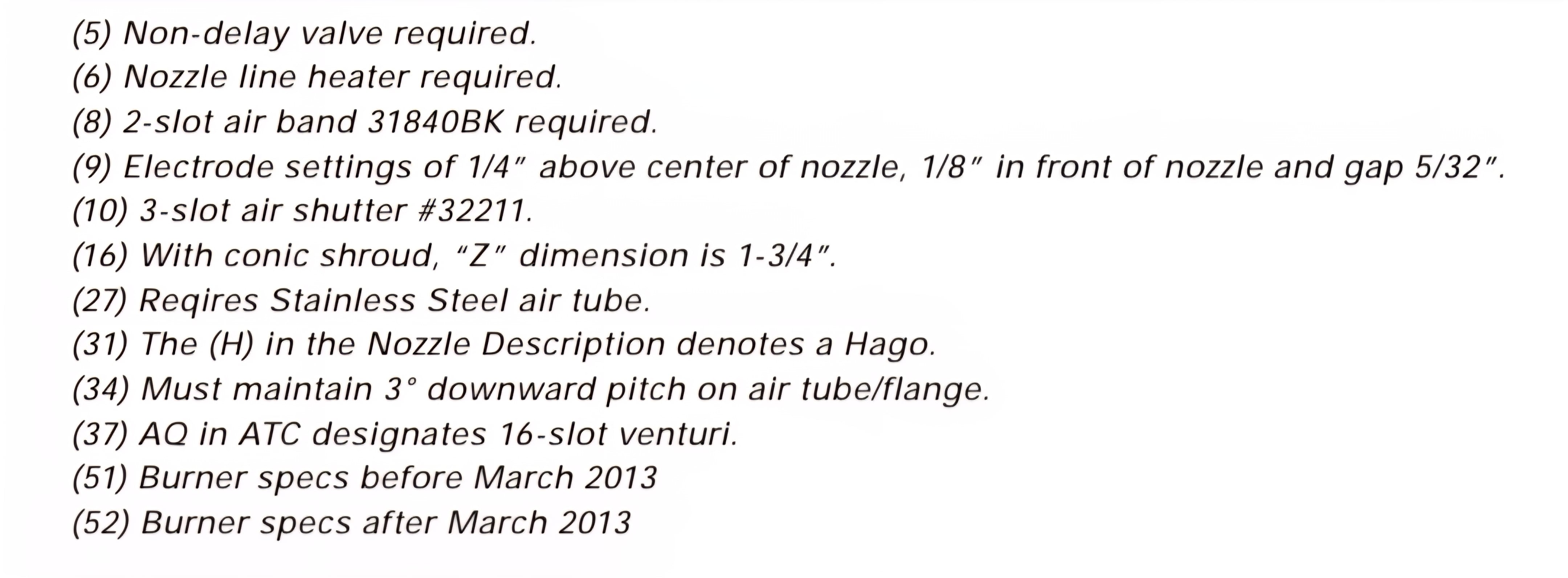
Not sure if thats the measurements on a T-gauge for the L2 head, but I'd start measuring. 51 and 52 is a note for your boiler as well. The only difference between the two is 150 psi pump pressure pre 2013 and 180 psi post 2013. Even the air settings are the same. S-6/B-0.
Oil is easy. Until its not. Thats why @NJeffro is going to spend the weekend researching oil service companies in the greater Monmouth county area. I just did a search and got bombarded.
0 -
I think you're looking at this all wrong.
He is getting FOAM=AIR. Of course, if you are getting air the burner may stay lit when ignition is on and fail when ignition goes off. That is completely normal.
Solve the foam-air problem and the burner will be fixed. Shut the oil off at the tank and disconnect the oil line. Fill a bucket of oil and connect a short line to the burner and run the burner out of the bucket. See what happens.
 1
-
A bad shaft seal in the fuel unit can suck air.
1 -
Maybe a bad TL. Flares don't usually go bad but anything is possible.
That is why I dislike overhead single pipe systems.
In the old day whenever you had lift you would use a 2 pipe system which is what I would use and eliminate the TL.
But I am in the minority on that and will get trashed for even suggesting it. Bring it on.
0 -
Thank you, that answers the question I had.
0 -
If you replace the fuel pump, then anything that is wrong with the pump will be eliminated.
- If it is the pump seal, then the problem is gone
- If there is a bad pressure adjustment piston, then the problem is gone
- If there is a bad pump cutoff, then the problem is gone
- If there is a defective solenoid, then the problem is gone
- If it has a bad $$1.77 gasket on the strainer cover, then the problem is gone.
- If it is missing the $2.40 bypass plug, then the problem won't go away unless you remember to install the bypass plug.
All you need to do is spend about $130.00 wholesale for a new Fuel pump PF20322U and any of the lower cost problems will go away. I just look at this statement "This year after cleaning the boiler and installing a new nozzle, it fires right up and runs fine until the ignition turns off." and ask myself what was included in the "cleaning the boiler". then I look at this statement "The strainer was replaced last season and was squeaky clean." and wonder how @NJeffro knows the strainer is squeaky clean without removing the strainer cover. Then i think It worked fine before you touched it and it does not work now. I believe that is not a coincidence. The heater cleaning included something in the fuel system that has changed.
Then I read my tagline below: “After you make that expensive repair and you still have the same problem, what will you check next?” Substitute the word fuel pump for expensive and see if you can look at the fuel pump gasket before you purchase a fuel pump.
You already did this: “After you make that TigerLoop repair and you still have the same problem, what will you check next?” The next thing I would check is whether or not the $2.40 bypass plug was properly set when the TigerLoop was commissioned.
This sounds like a gravity feed from the tank to the burner that worked fine without the TigerLoop operating properly, since there was no bypass plug for years before this problem. It may not be a fuel pump at all, but rather a loss of the gravity feed as a result of a new air leak at the high point in the fuel line from the tank to the fuel pump. This could happen during a maintenance visit and after you spend several hundred dollars on the expensive parts like a pump and a tiger loop, you then come back and read this comment and look at the less expensive repairs .
If the bypass plug was installed in the fuel pump that the air would show up in the TigetLoop bowl. since there is no foam in the bowl, then the gasket or the bypass plug or both are where an oil-burner man with 45 years experience might look first before swapping parts.
Edward Young Retired
After you make that expensive repair and you still have the same problem, What will you check next?
0 -
Couple of observation: What is the fuel level in the tank? The hydraulic of fuel supply change with the fuel. Can change from gravity feed to a pumped feed.
Did the TL flex lines get connected properly if removed during service.
Could be a failing firematic valve causing fuel restriction.
0 -
I'm pretty much @EBEBRATT-Ed on this one. And I share his dislike of overhead lines. However, let's go back to square one here.
Is this an overhead line? I assume so, since there is a Tiger Loop.
Is the oil level in the tank above the pump inlet to the burner? If it is, the first step is the integrity of the entire line of pipe. Disconnect the oil line at the pump and prime it and, while it is primed (gets messy — got hand soap? Pig mat? cap it tightly. Let it sit for 24 hours. Now uncap it (hopefully ou will need to have it over a bucket…). If you don't get a good solid flow, you have a vacuum leak somewhere along that line.
If the pump inlet is above the oil level in the tank, the principle is the same: remove the line from the pump and prime it (you'll need a vacuum pump). Put a sensitive vacuum gauge on the line and cap it (maintaining the prime) and note the reading. Again, let it sit for 24 hours — if the vacuum reduces (the absolute pressure rises) you have a vacuum leak somewhere.
If you do find you have a leak, finding it is the next problem. And yes, flares can fail. Particularly if they have been undone and that made up again. And remember that a vacuum leak may or may not — often not — show up under a pressure test!
Also remember that with rare exceptions gaskets and o-rings should not be reused. Even if they look just fine, replace them when you reassemble.
Br. Jamie, osb
Building superintendent/caretaker, 7200 sq. ft. historic house museum with dependencies in New England 1
-
I'll re-cap a bit… and repeat a bunch… sorry for the long drawn out.
US Boiler MPO-84IQ installed in 2014 with 275 Roth. The original Tiger Loop was installed at the same time, so it was past due for replacement in any case.
This arrangement has been working flawlessly since then, with yearly cleaning and maintenance.
This problem presented after cleaning the combustion chamber and installing a new nozzle.
NOT using the Roth pickup, Copper line through a bushing to about 6" from the bottom. Tank is currently almost full. It is on the same level as the boiler which is about 10 feet away.
Fuel line runs across the top of the tank and then down to about 1-1/2 feet off the floor to a General 1A-25 filter.
Then, along the wall about ten feet to a spin-on filter (WITH a vacuum gauge which reads between 1 and 2 inches of vacuum when running.) This vacuum holds when the burner is shut down… for a LONG time. (I believe there is a check valve at the inlet of the TigerLoop? Is that correct?)
Then about 3 feet to the inlet of the Tiger Loop, which is a few inches below the level of the spin-on filter.
Flex lines from the TL to the fuel unit.
YES, the bypass plug IS installed, and the lines to/from the TL are in the correct positions.
This year, after cleaning the chamber and replacing the nozzle the burner would start fine, then a few seconds after ignition went off the puffing would start. It would occasionally flame out and lock out.
I bled the pump and got a bunch of air/foam into the catch can.
As soon as I closed the bleeder, the burner would start and run fine. It would continue to run fine until it was shut down and restarted an hour or so later.
Here's what I did next:
Since the TL and flex lines were way past the time to replace them, I did that. It needed done anyway.
Same trouble.
On advice here, I replaced the nozzle.
Same trouble.
Checked Z dimension. Right at 1-3/4" where it should be for L/2 conical head.
I DID replace the fuel unit yesterday. (It's only money, right?) I did install the bypass plug, and did set the pressure to 150 PSI as spec'd, and double checked the lines were correctly installed.
SAME PROBLEM STILL, obviously not the pump.
I changed filters which were replaced at the start of heating season LAST year. The General was quite clean still, and of course I could not see inside the spin-on, but I've no reason to believe it was restricted, and the vacuum gauge never showed above 2".
I see NO AIR/FOAM in the TL dome at any time (except after I changed the filters. That cleared after a few minutes or so.)
Here's the latest… CAD cell resistance: Tested with Fluke meter. Disconnected from primary. 1500 Ohm resistor on primary control after burner lights off. The CAD cell is hovering around 1300-1600 Ohms after burner has run for a few minutes after bleeding. I had a new one on hand, plugged that in, SAME reading.
The resistance is 1600-1800 when the burner first starts.
Pushing the button on the 7184P I get 4 flashes when burner first starts, then after a minute or so it goes to 3 flashes which is consistent with the readings from the ohmeter.
I know this ain't the greatest, but I don't believe it's the ROOT CAUSE, because I continue to get air/foam if I bleed the pump. So this needs resolved first.
So that's where I'm at…
I am going to call around tomorrow and see if I can find tech to come out and take a look see…
😣
0 -
IDK what the problem is because I am not there.
But if your getting foam when you bleed the pump you have an oil supply issue.
This is probably the 3rd or 4th time I have posted that.
If it was me I would pressure test everything
Those GENERAL filter have a few places they can leak. The bolt that comes up from the bottom of the cannister. The rubber gasket where you change the filter and the little screws on top have gaskets as well.
Its probably going to be something simple and stupid when you find it.
My first guess would be filters or Tiger loop. Then flares. make sure if you have any Firomatic valves they are wide open. The stem should be showing above the valve wheel. They are a left hand thread
0 -
Hi Ed, Yes, I've been paying attention… I'm with you on the oil supply issue. I'm just not sure where to go from here.
I've changed the filters, and the gaskets on the General, and the TL is brand new.
I know it's going to be simple and stupid! 😁 Finding it is where I'm failing.
Firomatics are open. I'm aware of the opposite threading, the stems are up. (there are two, one at the General, one at the TL.)
Thank you Ed, and ALL who have replied!
0 -
After you make that expensive repair and you still have the same problem, what will you check next?
This is something I said to the mechanics who worked for me over and over again.
I remember one of my mechanics asking me to purchase a new $500 wholesale blower motor for a high-velocity air handler because he didn't think the existing motor looked like the correct one. Two days later, when the manufacturer sent us the motor, it looked identical to the one already in the air handler.
He then determined that the refrigerant charge was the problem. The system had too much refrigerant. By recovering about 8 ounces of refrigerant, the system worked great, and I was left with a $500 special-order motor that I was never able to sell to anyone. It's only money, right? to quote a very smart repair man (sarcasticly stated).
- Is there a valve at the tank? If not them maybe you should put one there.
- Place a plug or cap at the end of the suction line in the tank. You can do this with a temporary fitting. You can remove the suction line from the bottom of the tank for this test.
- Then attach a vacuum gauge on the line at some location between the tank end of the suction line and the fuel pump.
- Operate the pump in order to get the vacuum up to 10" vacuum.
- The fuel line will hold the vacuum if there are no air leaks.
If there is a leak the vacuum will drop. Find a point mid-way between the fuel pump and the tank end of the capped off fuel line. Re-test and see if the vacuum leak goes away. Continue to test at some different point until you find a test that proves leak free. There are 16 different locations on this diagram that I constructed from your description
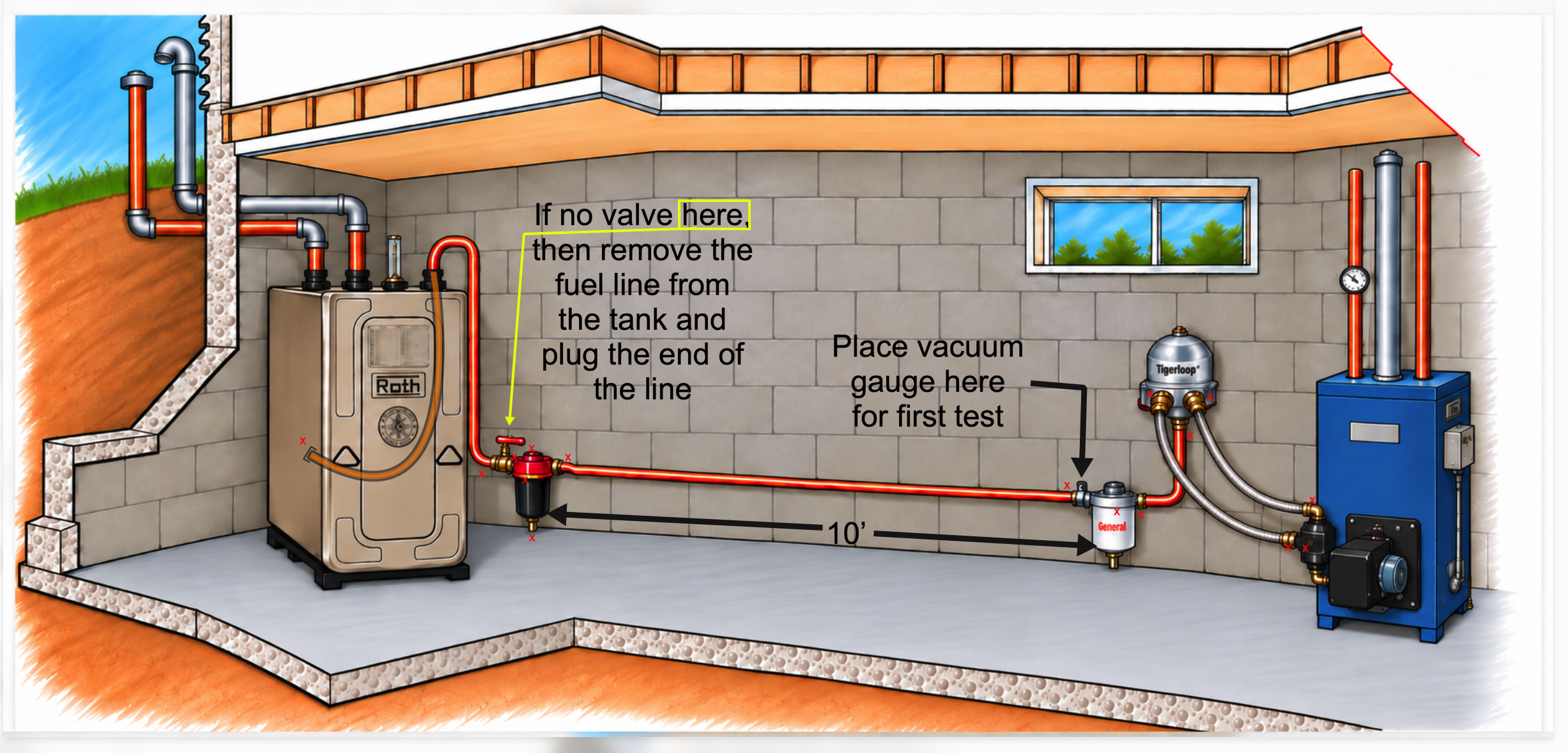
They are indicated by a red X on the diagram. Zoom in on the illustration to see all the red "x"s. Some of those fittings have more than one place where air can leak in under a vacuum.
Start in the middle and move closer to the pump if you find a leak, until you find no leak. If you don't find a leak, move farther from the pump until you do find one. This will help you locate the source of the air leak.
Hope this helps.
Edward Young Retired
After you make that expensive repair and you still have the same problem, What will you check next?
0 -
The TL is below the spin on filter in the system description.
With this configuration, the oil should flow by gravity when the tank is full. The TL bowel should be full or nearly so. If not, then there is a restriction. When the burner starts the available fuel is sent to the burner, the pump goes dry, cavitation, foam, shutdown.
From experience, Firomatic valves fail. The stem separates from the internal parts or washer comes apart. They look like they are fine, stem up but are closed or obstructed.
I would move the vacumn gauge to the TL so you can set the whole fuel supply vacumn.
0 -
I've been following and not commenting since I don't know what's going on, but I do have a question and then a comment. OP mentioned several times that there's no sign of air/bubbles/foam in the TL. I have NEVER seen a TL ever, so I confess that I don't know how they work, but my question is that -
- if there is NO sign of air in the TL dome, does that not eliminate everything that precedes the TL, such as filter housing leaks, flares, and piping from the TL back to the tank? If that's not universally true, then that suggests to me that OP should begin to check from the tank to the TL, whereas he's been concentrating from the TL to the pump. But if the TL is running clear, that means his problem is between the pump and TL, yes?
My comment is his CAD cell resistance. I realize he's running a low volume nozzle, but 1600-1800 ohms seems dangerously close to lock-out. For instance, I'm running a 0.75@100lb W nozzle and I'm getting about 250 ohms on an AFG.
0 -
It's been a while for me but in the day I installed a ton of Roth tanks and tigerloops. I would seem to me that if there were a suction leak befor the TL it would show in the TL. It's not. But also if ther were a leak in the suction between the TL and the pump causing foam at the bleeder that foam would also show in the TL.`After all part of the TL's jub is to de-air not onlyn the fuel line from the tank but also and air the pump is sending down the return port. Are we sure the braided lines are correctly connected to the proper ports?
Miss Hall's School service mechanic, greenhouse teacher, dog walker and designated driver
1 -
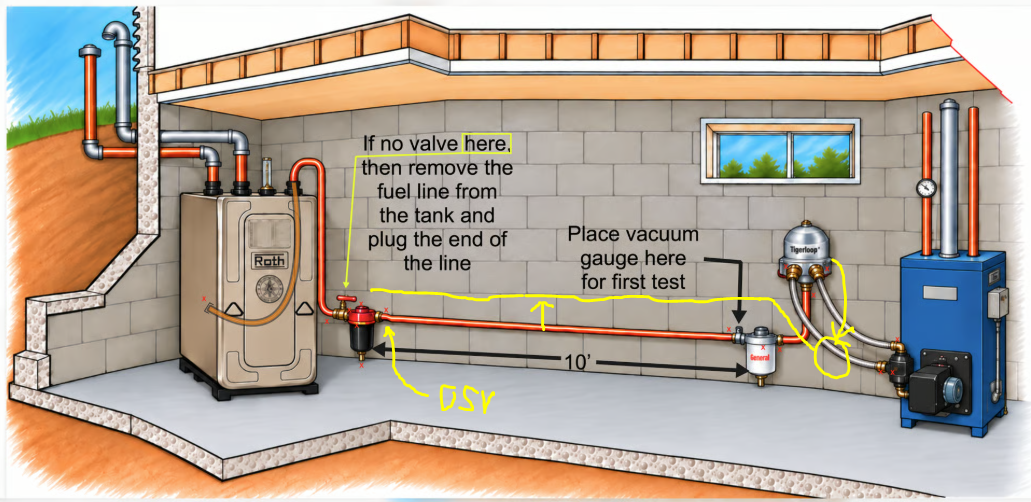
Wow @EdTheHeaterMan that's a impressive drawing! And quite close to what is actually there, with exception that the TL is actually below the level of the filters and the 10' run as @Jon_blaney mentioned, and the filters a little bit higher.
There is already a vacuum gauge at the outlet of the spin-on filter and I've never seen vacuum there over 2" or so. This vacuum holds when the burner is shut down, presumably because of the check valve at the TL inlet.
Also, I totally forgot that there is a Suntec OSV ahead of the General filter at the tank. Sorry about that!
 0
-
Thanks Jon, The TL bowl is consistently about half full. I've never seen it change from that. So if it stays half full, how can the pump go dry?
Would the loop up and out of the Roth tank constitute a 'lift' condition? Even if only a few feet or so?
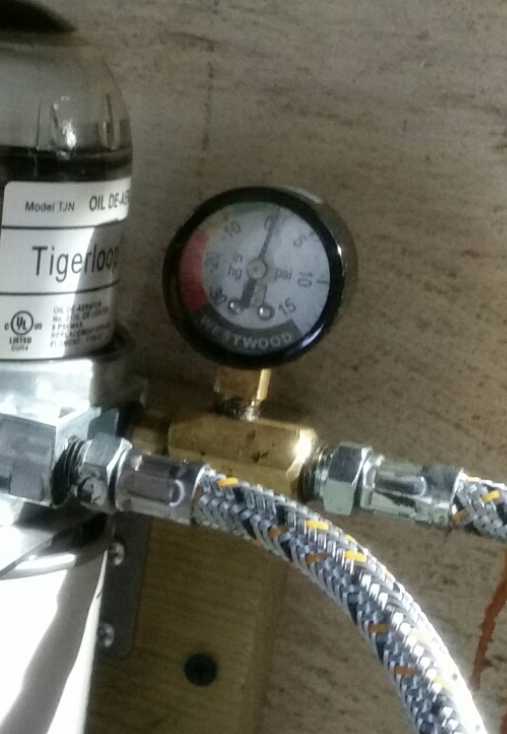
If the vacuum gauge at the outlet of the spin on filter is only about three feet of copper tubing awayfrom the TL, would it make much of a difference?
Or were you thinking about this, as seen in another post here (not my photo)?:
 0
-
In the same thread that I grabbed that vacuum gauge on the TL return line I found this interesting, which is the actual reason I have the TL on my system.
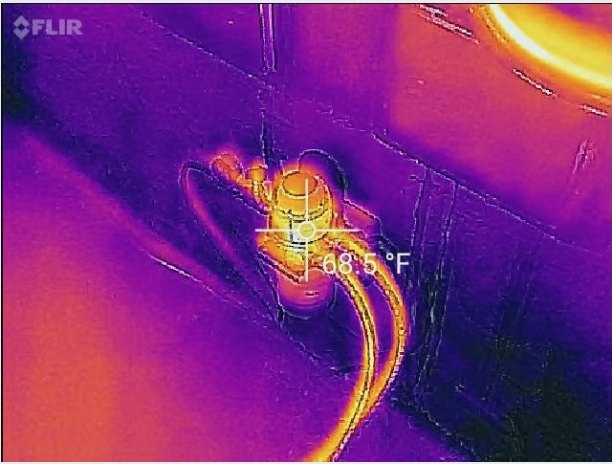
With that itty bitty nozzle, and my system in a minimally heated space, we thought it would be good practice to warm the oil before it hit that nozzle.
I'm waiting on a call from oil service company now, BTW. We'll see what they have to say.
0 -
Thanks Max, your observation of my statement that I see no air in the TL dome is exactly one of my conundrums. I don't understand how I'm getting air/foam at the bleed port, and it's not making it's way back to the TL through the return line.
I'm concerned about the CAD cell resistance myself. The 0.5 nozzle running at 150 PSI is close ( appx 0.6 GPH) to your 0.75 @ 100 PSI. I don't understand why the resistance is so high. This is something I'm going to discuss with the tech when they arrive.
0 -
Take the OSV out and try running the burner without it. The OSV may be defective and pulling air in. Worth a try. The OSV needs a vacuum to open. You can always put it back in if it is not the issue.

 4
-
Good thought, I'll try that at some point. Right now I'm going to pause and wait for the tech to look at it.
I'm still totally puzzled by the one nagging observation that I never see any air/foam in the TL. If there's air at the pump bleeder, why isn't that air making it back to the TL? I don't get it…
0 -
Try bleeding the pump with a clear hose that fits tight to the bleeder, and have the other end immersed into a can with oil in it (which is btw, the way the manufactures want you to bleed it). Only turn it a 1/4 turn.
You could be pulling air in thru the bleeder.2 -
Exactly the way I do it Mike. Thanks!
 1





Categories
- All Categories
- 87.9K THE MAIN WALL
- 3.3K A-C, Heat Pumps & Refrigeration
- 60 Biomass
- 430 Carbon Monoxide Awareness
- 134 Chimneys & Flues
- 2.2K Domestic Hot Water
- 6K Gas Heating
- 124 Geothermal
- 170 Indoor-Air Quality
- 3.9K Oil Heating
- 80 Pipe Deterioration
- 1.1K Plumbing
- 6.7K Radiant Heating
- 397 Solar
- 16.1K Strictly Steam
- 3.5K Thermostats and Controls
- 56 Water Quality
- 51 Industry Classes
- 51 Job Opportunities
- 18 Recall Announcements