Welcome! Here are the website rules, as well as some tips for using this forum.
Click here to Find a Contractor in your area.
If our community has helped you, please consider making a contribution to support this website. Thanks!
Air in Oil - Can the pump be bad?
Comments
-
Yes. There's a label on the side of the burner next to the escutcheon to indicate proper location, and it has been checked a number of times, the label is in the correct position. 1-3/4" is the setting for this head.
0 -
I've done that so many times I could do it in my sleep! And it will hold that vacuum within an inch of vacuum for 12 hours (longest time I've left it.)
0 -
Been thinking about that… I remember you mentioned it once already.
Would it make the most sense to install it up at the top of the loop so I can see if air collects there?
Or would it make more sense to install 'inline' down near the spin-on filter?
Also, did you see my crazy idea of installing a flare tee at the top loop and installing a valve on the bull of the tee so I could use my vacuum brake bleeder to suck air out at that point? Crazy idea? or?
0 -
Where are you located?
0 -
Monmouth County, NJ … too far? 😉
0 -
There are some pretty good oil burner techs in NJ. I still believe you need a high-pressure gauge on the nozzle line that you can leave there permanently.
At McMaster-Carr, you can get a 3850K2 oil-filled gauge with a 2" dial and a 1/8" male bottom port for under $45.00. With a 1491N133 tee fitting and a 4912K1 ball valve, you can install the gauge and leave it there permanently.
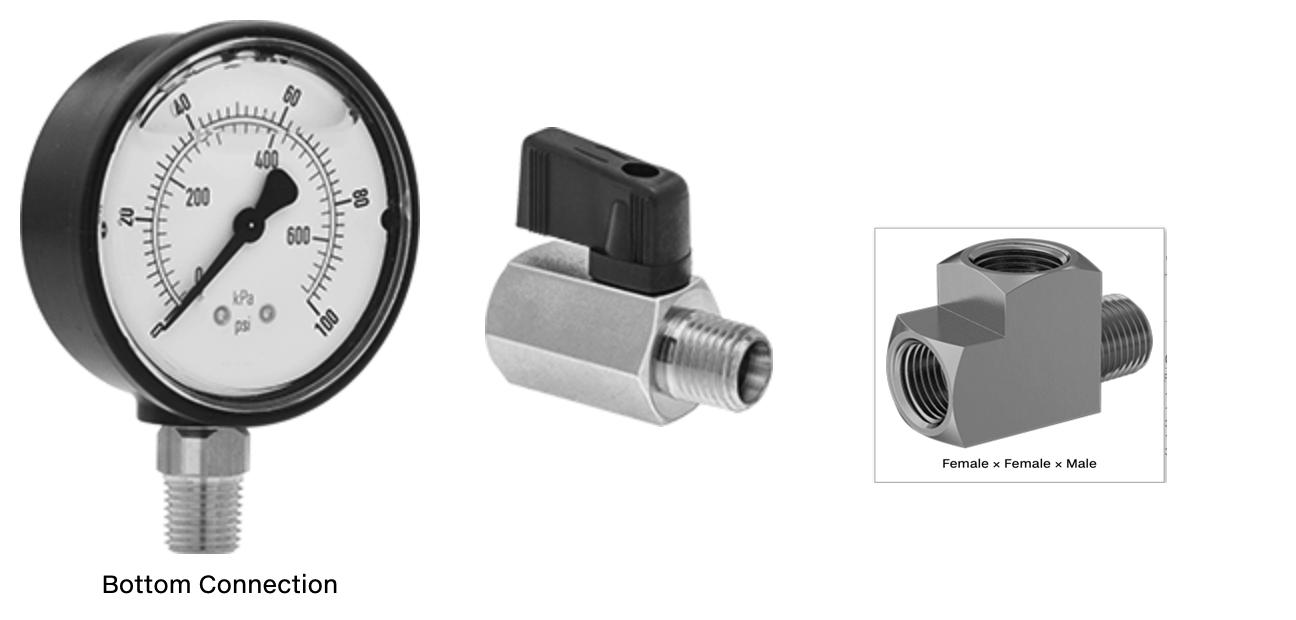
Edward Young Retired
After you make that expensive repair and you still have the same problem, What will you check next?
0 -
@EdTheHeaterMan "There are some pretty good oil burner techs in NJ"
I sure wish I could find them!
Most are in the Northern part of the state and I'm not in their 'service area'.
Can you suggest someone that services Eastern Monmouth County?
0 -
Forgive this thought, but is there any chance there could be something peculiar about the fuel?
 1
-
Ya know … That thought HAS crossed my mind several times.
I know that gasoline definitely can go bad. I have always thought that diesel and #2 were 'relatively' immune to that sort of thing, maybe not immune, but definitely a much longer 'shelf time'.
This tankful was delivered around March of 2026.
0 -
So, when you get a hiccup in the flame, do you know whether it is caused by a lack of fuel due to an air bubble (which a pressure gauge would show), the fuel pump coupling slipping (which would cause a similar pressure change on the gauge), a perfectly pressurized section of something that simply doesn't burn, like water, or something else?
Since you correct the problem by removing air through the bleeder, I would look for an air leak.
Am I correct in saying that you experience some kind of flame interruption? That interruption may or may not cause the primary control to lock out on safety. When you experience the problem, you manually open the bleed port and let out foamy oil, which indicates that there is air in the fuel. Once you get a steady flow of oil, you close the bleed port, and the burner operates normally.
Does that sound like a typical scenario?
If that is in fact the chain of events that you experience, then that does not look like an electrical problem to me. That does not look like a cad cell problem to me. That does not look like a air adjustment to me. That looks like something you need 2 gauges to diagnose. a vacuum gauge on the pump inlet and a 200 PSI gauge on the high pressure line. with those two gauges in place, you can observe the vacuum and pressure when the event occurs and then make a determination as to the direction of the source of the event.
We also know that a new TL, the flex lines from the TL to the Pump and a new Fuel Pump have been eliminated since all of those items have been replaced.
IMPORTANT
One thing has just occurred to me. I remember a new installation where I spent hours troubleshooting an oil line problem, only to discover that the Firomatic valve had been installed backward. There is an arrow on the Firomatic, and I had it facing the wrong direction. It drove me crazy for four hours trying to figure out why the fuel would flow and then stop for no apparent reason.
It must have had something to do with the valve's design. When the flow rate was greater than the nozzle's firing rate, such as when bleeding the fuel line, there was no oil flow problem. But when the burner was operating at the lower nozzle flow rate, the flow through the valve would stop, and eventually the flame would fail.
Make sure all the arrows are pointing in the correct direction. If you have a valve or an oil line arranged so that it is pushing when it should be pulling, you can run into problems.
Edward Young Retired
After you make that expensive repair and you still have the same problem, What will you check next?
0 -
@EdTheHeaterMan "Does that sound like a typical scenario?"
Yes, exactly.
Yes, all Firomatics are pointing in the correct direction.
I'm not going to be able to work on anything for at least the next several days, possibly a week… and may also be out of communication for that time also.
Please don't think I'm ignoring anyone!
0 -
I doubt that I can fit that between the pump and the 'backing plate' that holds the burner cover, there's only a little over an inch clearance there:
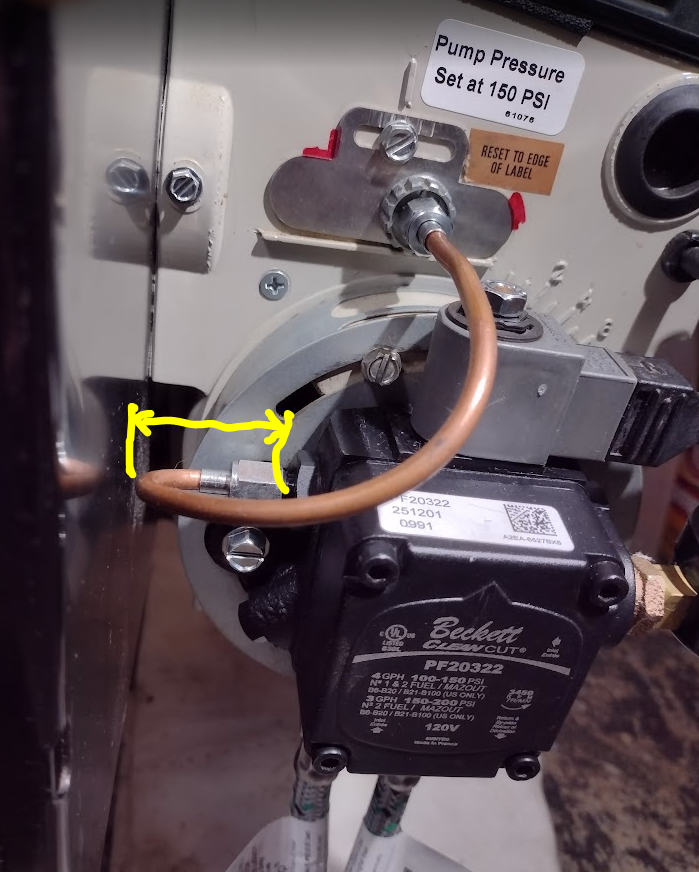
I believe your suggestion is to remove this fitting for the nozzle line and replace with the tee/shutoff/valve?
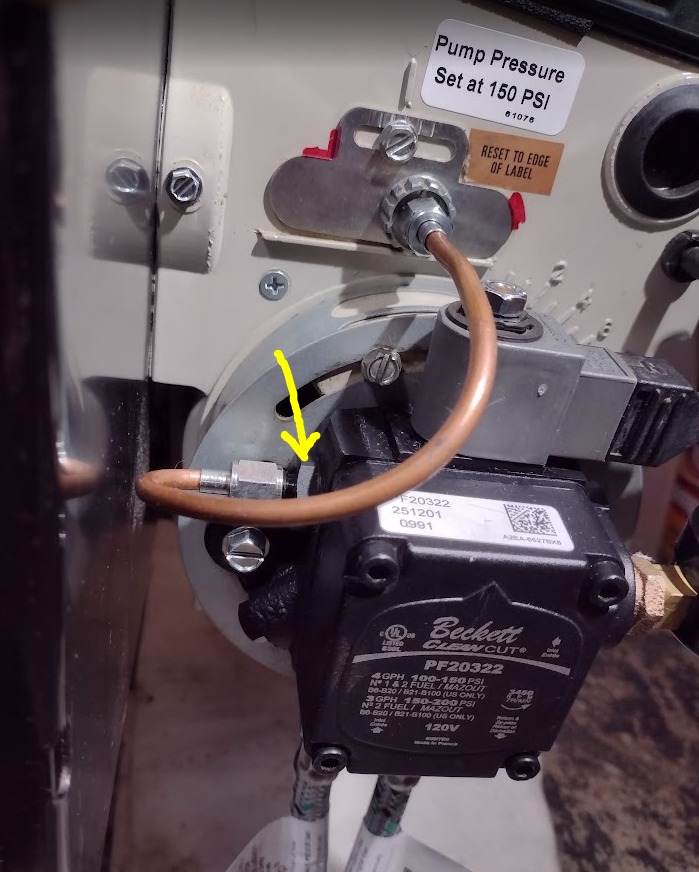
There's also not enough room to spin an elbow in there without removing the pump, which is of course possible.
I was thinking that a 1/4" flare (the nozzle line IS 1/4" SAE flare, correct?) tee fitting using two nozzle lines might be the best bet…
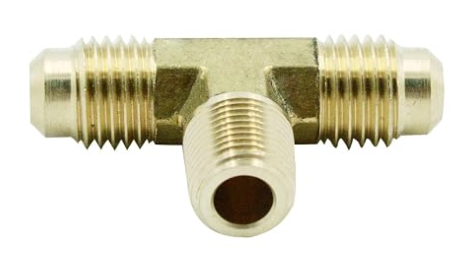
In which case I would use the 4912K31 Fem to Fem valve:
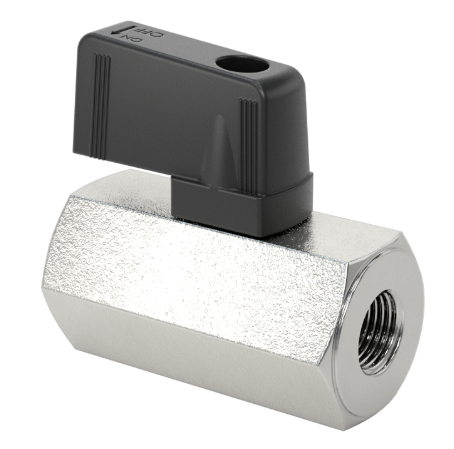
I would imagine that the 1/4" tubing would support the tee/valve/gauge with no issue? Or is that something to be concerned with? (vibration, etc)
0 -
With Riello burners I would always remove the control and jump out the line and the motor terminals. Which would only run the motor and the pump keeping the oil valve closed. I could purge a whole line and filter through the TL. This could be done, I think, by disconnecting the oil valve terminals on a Suntec pump, no?
Miss Hall's School service mechanic, greenhouse teacher, dog walker and designated driver
0 -
Not sure I understand… the primary control on the Beckett has a feature to extend the lockout time to 4 minutes for purposes of bleeding/purging. Hook up the tubing and catch can, and bleed/purge.
0 -
It was just a thought really, and maybe Ed knows but if you didn't open the bleeder would the fuel and air just go back to the TL and the air be vented? I don't know. That's what happens with the Riello pump. I'm now just curious. You've got an issue I've not run into in my many years of service and many many Tigerloops.
Miss Hall's School service mechanic, greenhouse teacher, dog walker and designated driver
0 -
Understood!
Yeah, it's a weird one for sure. I've run this boiler for 12 years with absolutely ZERO problems. WTH happened this year? I still have no clue! 🤔
0 -
Exactly. With the solenoid disabled the oil/air should pass only through the TL. Though I've not tried it with a Suntec pump
Miss Hall's School service mechanic, greenhouse teacher, dog walker and designated driver
0 -
Could also take the TL out and run a return line.
I already know no one would possibly recommend this.
The dreaded "return line leak"
some tubing a couple of fitting and your done. With two pipe it would probably run even if it had a pinhole suction leak.
0 -
This Tee fitting: 41912K31. This Valve: 50635K471 and this Westwood part: 3/16" x 8" flare high pressure line from SupplyHouse.com will get you where you want to be. You place the Tee between the two high pressure lines. Use the valve as a coupling for the two 1/8" threaded ends of the tee and the gauge.
Edward Young Retired
After you make that expensive repair and you still have the same problem, What will you check next?
0 -
I'm with you @Grallert. The air in the fuel line… if and when it gets to the pump WILL end up in the TL center chamber. Enough air and the float will drop to allow the air to exit to the top chamber. That is how it always worked for me. I can't understand where the Hick-up is coming from. That is why I would use the High pressure gauge on the fuel pump. and the vacuum gauge on the extra inlet of the pump. then I can see if there is a problem with the fuel when the flame goes out.
If there is no change in the vacuum but the high pressure drops to zero PSI, that could be a bad primary control that is closing the valve on the fuel pump for a split second. Or perhaps a loose wire connection to the valve on the pump. You could replace the plug that connects the valve solenoid to the primary control. I have has one of those wires go bad on me. as the area around the pump heats up, the wire looses connection for a second or so.
You could also connect the valve to the orange motor wire and eliminate the violet wire from the primary control completely. That might need some primary control reprograming so it does not lock put from sensing a flame before the valve is supposed top open. In the setup you need to select NO VALVE. If that makes the problem go away, then you have a bad Valve Circuit on the Primary Control.
…OR… you can fire up the parts cannon again and just replace the coupling, the nozzle again, the wire that connects the pump solenoid to the primary control, and the primary control. That won't cost too much. While you are at it, swap out the ignitor and motor too. That should cover all the problems.
Could it be the Cadmium Sulfide sensor? Probably not so maybe throw one of those in for good measure.
NOT!
Put your meter on the solenoid wires to see if the current or voltage changes at all when the Hick-up happens. That will be a diagnosis that you already have the tools for.
Edward Young Retired
After you make that expensive repair and you still have the same problem, What will you check next?
 1
-
OK Gentlemen, I'm outta here for several days at the least.
Hopefully I'll be back, Good Lord willin' and the creek don't rise.
Thank you all for everything so far!


 3


Categories
- All Categories
- 87.9K THE MAIN WALL
- 3.3K A-C, Heat Pumps & Refrigeration
- 60 Biomass
- 430 Carbon Monoxide Awareness
- 134 Chimneys & Flues
- 2.2K Domestic Hot Water
- 6K Gas Heating
- 124 Geothermal
- 170 Indoor-Air Quality
- 3.9K Oil Heating
- 80 Pipe Deterioration
- 1.1K Plumbing
- 6.7K Radiant Heating
- 397 Solar
- 16.1K Strictly Steam
- 3.5K Thermostats and Controls
- 56 Water Quality
- 51 Industry Classes
- 52 Job Opportunities
- 18 Recall Announcements