Smart water shut offs - Has anyone installed them? Do they work? Are they worth it? etc.

Comments
-
I have my doubts, though it would be nice. My question is… define "leak". It pretty well has to be something about flows, but what? Considering that one drip a minute — less than a gallon a day — in the wrong place (like behind plaster or drywall) can do an appalling amount of damage given time, is that a leak? Or is it a 1 1/2 inch main at 60 psi making like Niagara Falls? Or…?
I'll be watching this thread!
Br. Jamie, osb
Building superintendent/caretaker, 7200 sq. ft. historic house museum with dependencies in New England0 -
Hi, I have installed Moen and another off-brand because insurance companies in the West are threatening to cancel home insurance if you don't install them. I can only hope they actually do some good. 🤨
Yours, Larry
0 -
I went with a DIY product…..Econet Bulldog Valve Robot Provided you have a ball valve as your main shutoff. This sits on top of the ball value and can articulate the arm to close the valve. It does use sensors that you need to place in strategic locations. But, its a fairly fool proof setup and nothing needs to be learned to work properly.
Cheers, Flo
0 -
It’s another bothersome thing you have to monitor that sends you alerts. It’s insurance: something you get because you’re made aware that a catastrophe might happen.
8.33 lbs./gal. x 60 min./hr. x 20°ΔT = 10,000 BTU's/hour
Two btu per sq ft for degree difference for a slab 1
1 -
i met someone that had a system that used the analysis of sound, possibly ultrasonic to determine what was a leak. i'd imagine it is like GFCI or AFCI products, they will get increasingly better as real world experience increases.
0 -
The issues I have hears is they shutoff prematurely, maybe on a large hose bib draw? I suppose better to error that way then not shut off if there is a burst pipe?
Bob "hot rod" Rohr
trainer for Caleffi NA
Living the hydronic dream0 -
Sounds like a solution to a problem that doesn't exist. I suppose in some buildings it makes sense. Do a walk through and keep your eyes open for problems and you don't need it imho.
Pipes generally don't burst apart and flood. Even water heaters don't usually blow apart.
Just make you wonder if this is a reaction to pex, cpvc, shark bite etc etc etc. Did we need these with copper joints and soldered joints?
i know just and old fart talking.

 2
2 -
i've heard numerous stories of copper joints that got missed when the pipes were sweated that held for years then popped apart one day

 2
2 -
Flologic...yes. no issues we are aware of over the last few years. High Quality product. $$$$..Mad Dog
0 -
@jgg765 I have about 50 of them installed in the field and 20 of them on my phone as some customers have me as the primary contact for alerts. I install FloLogic and Leak Defense. What would you like to know?
They work very well except for those first couple weeks when the valve lets you know you've actually got a toilet that runs all night…sometimes. Or you forget to let the manufacturer know you've got an irrigation system so they can pre-program that in. Or a backwashing filter that cycles once every 10 days.
Most recently, I had an alert that water had been running continuously for 3 hours after some work was done in the home and a fitting went unpressed. The automatic shutoff may have saved thousands of dollars worth of damage. They have their value.
Contact John "JohnNY" Cataneo, NYC Master Plumber, Lic 1784
Consulting & Troubleshooting
Heating in NYC or NJ.
Classes


 6
6 -
Well, lots of opinions and experience here. Here's mine.
I've been chasing leaks for over 50 years. The only thing I've found that they have in common is that they waste water, and in SOME cases, can cause damage.
We had a 1/4" shark byte style of fitting going to a humidifier in a heated attic on a 2 story plus basement cut loose when the home was unoccupied, causing around million dollars worth of damage. I WISH we'd have had one on that job.
I had a good friend who installed warm board on a framed floor in a basement that got "hit" by the hardwood floor contractor. The hit(s) self healed until the fasteners rusted off. Around 3/4's of a million dollars in damage.
He too wished he'd have had some sort of monitoring device on this system. SO badly that he actuallyy invented a system, and patented the logic used to monitor the system and determine the difference between "normal" usage for compensation for air elimination, versus a continuous leak.
So is it warranted? Absolutely. If insurance companies get involved, they can (and in fact HAVE) stopped insuring peoples homes because they had a hydronic radiant heating system. And THAT is not good for this industry. IMHO, a make up reservoir, with limited fluid volume makes excellent sense for closed loop heating systems. You can visually monitor fluid consumption, and tie it into the alarm system to notify you when there IS a leak. No leak is a good leak. Period.
If you have a leak, you need to find it an kill it before it destroys something. But as others have noted, in a larger home, it will shut off continuously until all leaking toilets, faucets etc have been found and eliminated, and the people who have money don't like being put into this sort of position due to inconvenience, hence the system was bypassed, or completely eliminated.
Again, my mantra is "No leak is a good leak". Find it and fix it.
Insurance companies carry a lot more power of persuasion than you know. If they decide to start a campaign, they will get involved with the code authorities, and then it becomes mandatory. And it is a known fact that the largest annual insurance claim/loss cost are caused by water damage. That covers a LARGE area, but bottom line, water does cause damage.
Speaking of unpressed fittings, did you hear about the hot water line at Denver International Airport that caused $50 million of dollars of damage? Yeah, it happens. And we all pay for it in premiums.
Proceed with caution, and educate the consumer to expect problems initially that need to be concerned. Leaks happen, undetected. Find them and fix them. There's a drought out west. Every drop is precious.
ME

 5
5 -
I have been watching these valve for a couple of years. I was called out to a house that the owners were away on vacation for two weeks, the 2nd floor toilet supply hose burst. The water company came by and got a crazy reading and contacted the owners. I got there to find 3-4 inches of water in the basement. I think these have value. I do not think I would use one that actuates an existing ball valve because I have found some non cycled valves very hard to move.
Seth
1 -
I can easily see the benefit of a system which would sense and close on a catastrophic leak. I too have seen a house — not in the range that @Mark Eatherton mentioned! — totally destroyed by a leak; in that case a power outage led to freezing of a hot water heating system. That situation did have a leak alarm in the basement, which sounded off quite vigorously and, once the power came back on did notify the owner. Unhappily, in that situation, the individual who was supposed to be monitoring the house didn't.
Where I still have a question, though, is not on the catastrophic leak — that should be easy enough to implement — but is for the persistent small leak, which can also cause a lot of damage even in an occupied building.
So long as the "smart" water shutoff has two characteristics I'm for it. The two characteristics are a full shutoff on excess flow, with "excess flow" determined by the situation, and second it must be fully mechanical — not dependent on having electrical power.
I might add that such contraptions are VERY commonly used in hydraulics — I've seen them used on machines ranging from skid steers through big drills through trasnport aircraft. And they work. They're called hydraulic fuses.
I have yet to see a widget which would reliably shut off on a small leak.
Br. Jamie, osb
Building superintendent/caretaker, 7200 sq. ft. historic house museum with dependencies in New England1 -
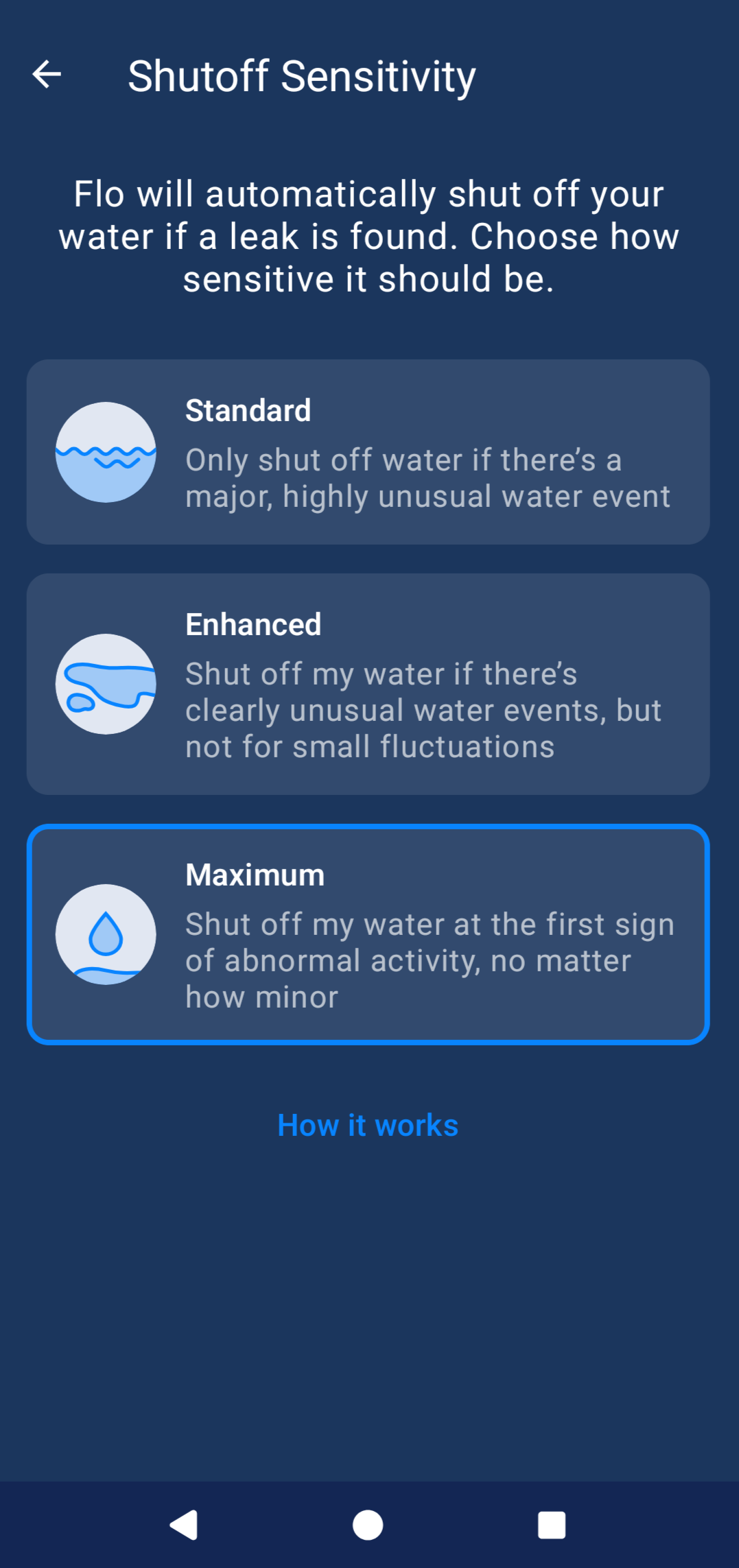
The moen flo is capable of detecting "micro leaks". How much volume/time is that? I couldn't tell you. Moen states as slow as 1 drop per minute. I'm not sure I believe that. It does this test (daily, say 4 a.m. or a time range set by user) by shutting off their automatic valve and monitoring any pressure drop. If a micro leak is detected , a notification will be sent but the water will not be shut off.
I have a 1.25" moen flo valve on the main supply in basement. The water has been shut off a number of times for long showers, toilet flapper not closed, etc. The app/software will learn what is the homes expected usage patterns. It's well worth it in my opinion.

 2
2 -
I can see the apps driving proliferation of zone valves, how else will you be able to zero in on a micro leak?
My house had one shutoff for water before we renovated probably have 12 now between hot and cold lines. And We exercise annually.
Moen charges a monthly monitoring fee. Believe the two @JohnNY do not have monthly fees?
Smart valve + Fee may seem cheap if insurance company refused to renew without it
0 -
Companies manufacture these valves and don't leave it as an intelligent option, but run to the code committees and get them to mandate it in the code. Big money in mandating it. However, all these improvement are nice, but drive up the cost of a house. I don't personally think a nation wide mandate is justified.
Getting insurance companies onboard is a big step. Non compliance = no insurance. No insurance = no mortgage. Insurance companies think, your cost, our protection.
Competition is a solution to all your problems any and everywhere.
1 -
Unfortunately these devices require a robust home wifi network with a reliable internet connection as well as power.
Imagine you are away during an ice storm, and power to your house is cut. The furnace wont run and the network/wifi wont run. Disaster waiting to happen and these devices can’t help you because they have no power and no network connection.
Just be sure you understand the limitations of what they can and cant do before you purchase. Connecting the device to a small battery UPS might be a good idea!
0 -
i'm pretty sure the better ones have a battery and local control.
0 -
nothing is 100% foolproof.
0 -
The Moen Flo instructions state the following. This post was about the Moen Flo. There is no mention of installing a battery in the installation instructions.
… require continuous power within 10’ of the installation
… If the device is plugged in and not connected to internet, it will go into Local Mode and experience frequent water shutoffs. The only way to get the device out of Local Mode is to connect it to the internet.
 0
0 -
i wouldn't count the moen in the group of better quality
0 -
I have a Phyn. It doesn't have a monthly fee. They have two models, only consider the one that will turn off the water. I have a ice maker that is a nugget ice maker that slowly fills with water and is very hard for it because the flow is so slow almost constant. It takes about a month for it to learn the house and water usage patterns. IE it used to text my phone and say it found unsual water flow, it was the master bath and my wife would have to text me to turn the water back on because it turned it off. But after that if i left the outside hose on it would text and say if you don't respond it will turn off water as a pre caution. After one has a big water loss it is nice to turn the water off from an app when going away, so doesn't mater it power goes out the water is all ready off. I would highly recommend the Phyn.
1 -
Thanks for asking, I have been wondering the same. With the craziness of home insurance these days, we are required to hold it (if you have a mortgage) but God forbid you actually need to use it, now you must jump through hoops. I try to prevent the need to file insurance claims as much as possible. As someone who saved $1000s of dollars preventing an undetected leak from the use of smart leak detectors, I am a firm believer in utilizing leak detector technologies. I have one placed around every area there is water leak potential. Two years back I got alerted of a leak at my attic expansion tank valve. (Yes my house is that old and still a gravity system). So every heating cycle, when the water expanded would have been a fast leak. I knew within seconds the first time it happened and was up there fixing it.
So I like the added security of actually being able to shut off the main water if something catastrophic occurs. So I have definitely been looking at the various options. *Also, I’m aware that technically my gravity heating system would not be covered as it’s a closed-loop system not attached to the main plumbing system. But I would want this for the main plumbing system anyways as that’s the whole sell for these systems anyways.
Lifelong Michigander
-Willie
0 -
There are smart water valves and actuators that will integrate with home automation systems. That should allow you to manage things internally, without dependency on the cloud. You might lose the polish of the current app (depending on how much effort you are able to put in), but I dislike depending on a server farm in North Elbonia for infrastructure, critical or otherwise.
0 -
The insurance angle was mentioned. That could be a headache! We are insured for liability, but not property damage or loss (we did enquire, for laughs — the premium quoted was in the high FIVE figures per year). But to go back on topic — the various gadgets mentioned, and their usage, is very much geared to the more "normal" suburban or even urban type situation where usage is predictable and it is possible to easily determine the necessary parameters. And in that application, I can see it. Otherwise, only a device which would positively shut off on truly excess flow would be useful — and even that might not protect against a frozen pipe (particularly a heating system pipe) as the margin between a genuine leak and a large normal use (say two hose bibbs at once) just isn't big enough.
Br. Jamie, osb
Building superintendent/caretaker, 7200 sq. ft. historic house museum with dependencies in New England0 -
I’ve had the opportunity to work with and evaluate a lot of different water management products on the market over the years.
One system that really stands out on the premium end is Sentinel Hydro Solutions, now part of Watts. The company was acquired by Watts a few years ago out of the San Diego area, and while the system is certainly one of the more expensive options on the market, it also offers an impressive level of features, flexibility, and control.
What I like most about the Sentinel system is its ability to scale. It can be applied to everything from smaller applications to large commercial buildings, hotels, and other complex facilities. The system can be fine-tuned around the specific requirements of the building and adjusted based on how occupants are actually using water.
It’s truly a smart water-management system rather than just another piece of equipment.
If you work in commercial plumbing, water management, hospitality, or facility operations, it’s definitely worth taking a look at what Sentinel Hydro Solutions has to offer.
0 -
Interesting thread. I agree with Mark Eatherton's point that no leak is a good leak — finding and fixing it quickly is the real goal, and these devices are really just an early-warning layer. One thing worth considering is the insurance angle mentioned above; if insurers start requiring them, that could tip the value question for a lot of homeowners. Has anyone had their insurance actually offer a discount for having one installed?
0








Categories
- All Categories
- 87.8K THE MAIN WALL
- 3.3K A-C, Heat Pumps & Refrigeration
- 59 Biomass
- 430 Carbon Monoxide Awareness
- 133 Chimneys & Flues
- 2.2K Domestic Hot Water
- 6K Gas Heating
- 124 Geothermal
- 170 Indoor-Air Quality
- 3.8K Oil Heating
- 79 Pipe Deterioration
- 1.1K Plumbing
- 6.7K Radiant Heating
- 396 Solar
- 16.1K Strictly Steam
- 3.5K Thermostats and Controls
- 56 Water Quality
- 51 Industry Classes
- 51 Job Opportunities
- 18 Recall Announcements