Baptismal pool boiler set up..
Comments
-
Ah yes, variable speed salvation. I'm guessing though, that it happens all at once. But what do I know? I'm only a plumber.
 1
1 -
Blasphemy!
Now say 10 Hail Mary's and a good Act of Contrition then go and sin no more ✝️
Edward Young Retired
After you make that expensive repair and you still have the same problem, What will you check next?
0 -
I'm not religious. I just like the stories. Besides, I only know "Hail Mary, full of grace", then I'm lost. Can I do 20 of the Lord's prayer instead?
1 -
At the First Baptist Church in the Back Bay section of Boston, built in the 1870s, the baptismal font had a cast iron one pipe steam radiator in it. The air vent was piped up above the flood rim. Simple and effective.
—
Bburd1 -
For Cripe's Sake! @HVACNUT
That would be Jesus Cripe, Son of Gosh, along with Great Cesars Ghost, of the Roman Church of Holy Moley. For those that are not of this faith
Edward Young Retired
After you make that expensive repair and you still have the same problem, What will you check next?


 3
3 -
I think normal swimming pools run at 81-82
1 -
@EdTheHeaterMan thanks ed .
The customer is fixed on a boiler set up. For your proposed set up which I like, is that with the boiler loop with a automatic bypass valve or primary secondary? Can you make a piping arrangement diagram? And I was thinking a tekmar 150 for controlling the pool temp. Thanks again
-1 -
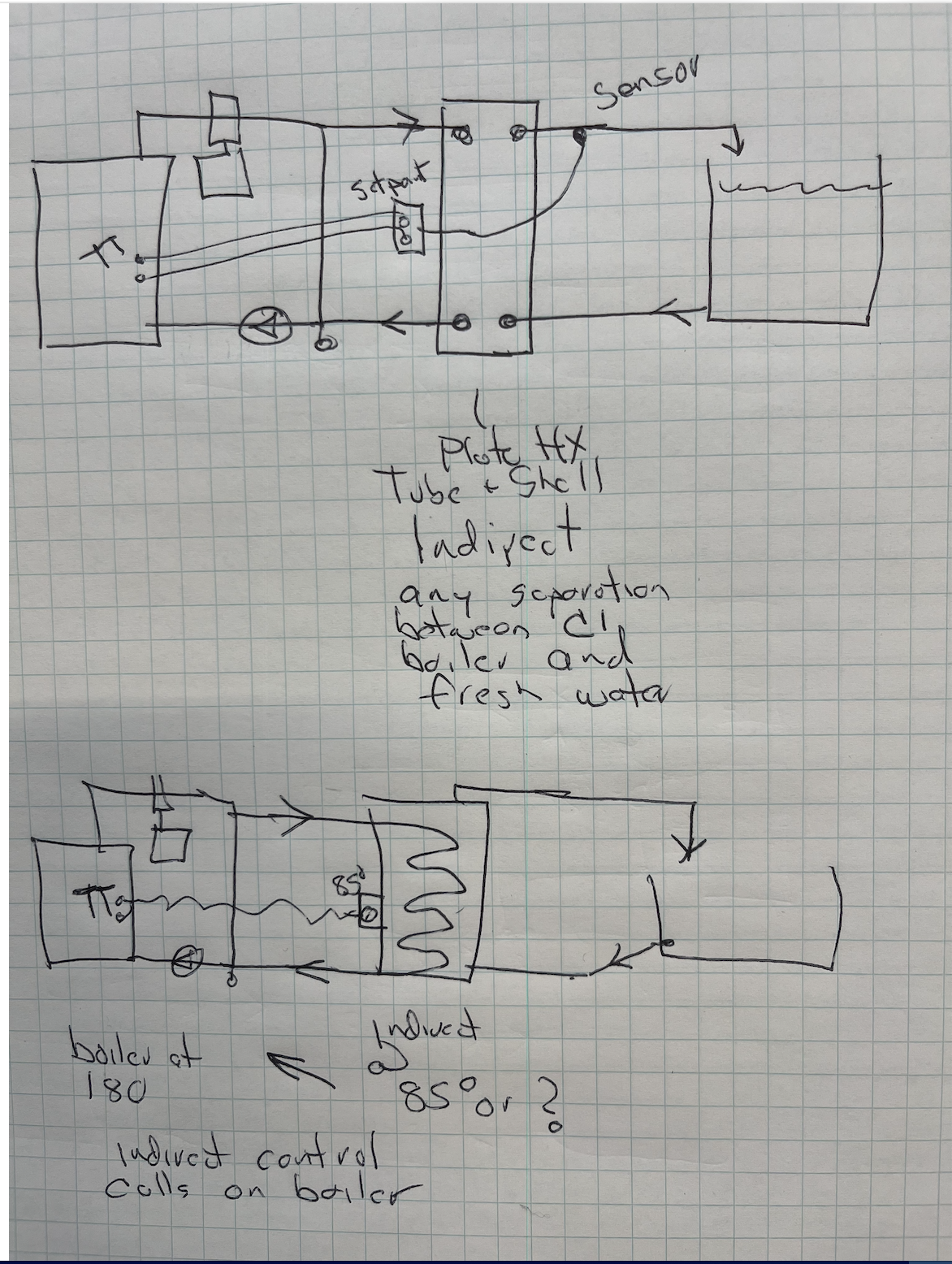
With a CI boiler you need some sort of return temperature protection if the tub is heated to say 85- 100°?
A 3 way protection valve is ideal, or cobble together 3 ball valves and manually adjust flow.
So you can use whatever device between the boiler and tank.
With an indirect it may have the temperature control built in. Set it to the desired temperature wire it to TT on the boiler.
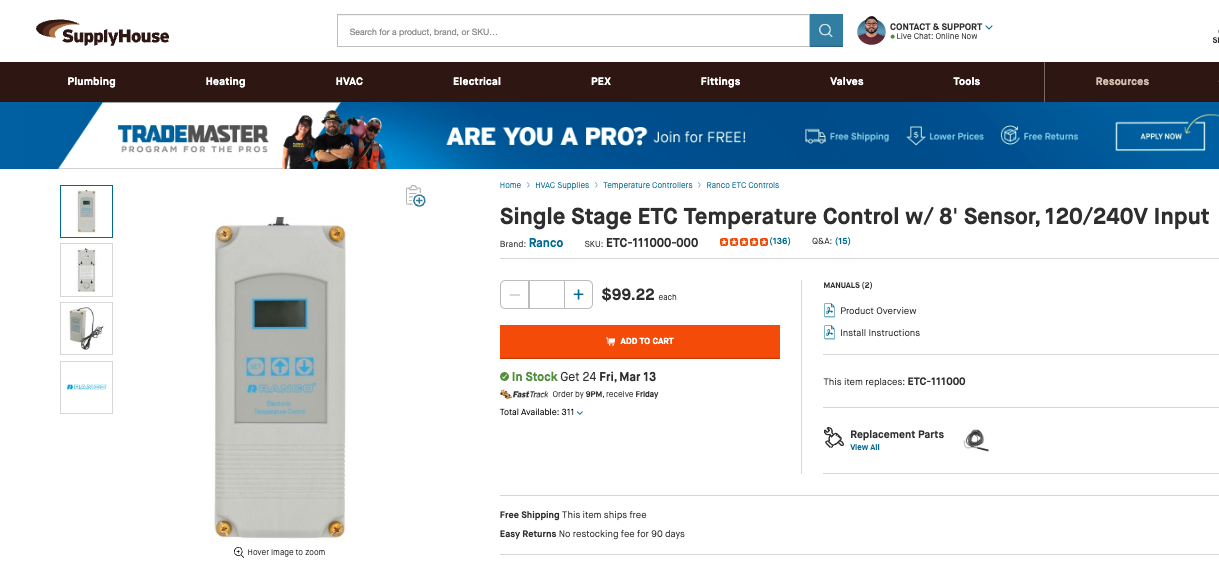
A setpoint control like a Ranco, Johnson control, etc would allow tighter more accurate temperature control, and digital readout. Probably less $$ than a tekmar 150 and more features.
 Bob "hot rod" Rohr
trainer for Caleffi NA
Living the hydronic dream 2
2 -
This is what I come up with for your boiler system

However, if you feel the need for overkill, install the bypass and use manual valves to get the return water temperature where you need it. The boiler protection valve will make the adjusting automatic if you believe you need it.
The parts list is above and the boiler protection valve can be found here: Caleffi 280966A-1, but I really believe it is overkill. But if it is in the church's budget, then go for it. I try to keep the cost as low as possible when it comes to church.
Edward Young Retired
After you make that expensive repair and you still have the same problem, What will you check next?
0 -
i really think a glass lined steel tank type gas or electric water heater will last forever in this application. if you're only putting 600 gallons of water in it a month that is nothing, in normal residential use it sees that in a couple days.
i assume your boiler failed because you're running the tub water directly through it, a cast iron boiler isn't designed for an open system with potable water, a water heater is.
 1
1 -
Agree, but @Mail4tommo said above, "The customer is fixed on a boiler set up." I'd at least try to push an indirect coil.
I also don't see the point of using a circulator pump instead of just filling it with water that goes through a water heater. Use a tempering valve to get it the right temperature.
 1
1 -
The original boiler was probably an AO Smith copper-coil water heater, similar to a AO Smith Burkay Water Heater. There was once a much smaller model available, but it is no longer manufactured.
A copper-coil water heater with a bronze or stainless-steel circulator pump could last for decades in this type of application. However, in this case the unit has failed, and there is no inexpensive replacement that offers a 60,000 to 80,000 BTU burner, which would be ideal for this application.
A large-burner, small-tank water heater would be perfect here. Unfortunately, there does not appear to be a large market for this type of water heater, so manufacturers rarely produce them.
I suppose baptism is not a large market for water heater manufacturers.
Edward Young Retired
After you make that expensive repair and you still have the same problem, What will you check next?
0 -
This is being made way more complicated than it needs to be.
The makers of baptisteries also offer electric in line heaters (usually made by Little Giant) specifically for this purpose. They’re usually 4-5kw and can easily heat the average sized baptistery over night.
I’m a Baptist and I’ve installed or repaired several over the years.
Bob Boan
You can choose to do what you want, but you cannot choose the consequences.
 3
3 -
I made that suggestion earlier and the customer only want s a boiler accorcing to @Mail4tommo
And you know the customer is always right! (Harry Gordon 1909)
Edward Young Retired
After you make that expensive repair and you still have the same problem, What will you check next?
0 -
Ed, the customer is definitely wrong in this case, probably from the misconception that they need a boiler to do the job.
Baptist churches are democratic in their decision making (sometimes too much so) and usually a committee makes these kind of decisions. The problem is that the committee is quite often a pool of ignorance putting forth erroneous opinions.
It has well been said that a camel is a horse that was put together by a Baptist committee.
Did I mention that I’m a Baptist?
Bob Boan
You can choose to do what you want, but you cannot choose the consequences.2 -
@EdTheHeaterMan you are 100% correct it's exactly the setup they used to have.
0 -
I hear ya' @Ironman Cape Island Baptist Church In Cape May, NJ was my customer for many years. I was the oil company's service man (by recommendation) and when they needed a new boiler for the church, I wanted the job. I also knew that there was a committee of
ignorance putting forth erroneous opinionsvery intelligent people, and I didn't have time to answer 20 questions, over the phone, after each member read the proposal, so I didn't mail the proposal. I requested that I be invited to a committee meeting as a guest speaker to give them the proposal in person with all decision makers present.I then prepared three options with a power point presentation explaining the features and benefits of each choice. After the presentation, I answered questions for the group and then left the meeting with the thanks of the committee and my sincere thanks for them to make time for me at their meeting. The next day I got the call that I was awarded the job and selected the middle cost proposal.
And I remember seeing that baptismal water heater in the boiler room standing about 3 ft tall. All copper coils with a 60,000 BTU burner under them. I thought to myself when I looked at it, "I would hate to have to vacuum clean soot out of that mess of copper"
That's why I thought the electric spa heaters were the way to go.
Edward Young Retired
After you make that expensive repair and you still have the same problem, What will you check next?
 2
2 -
Cheer up, @Ironman . You should try my game — dealing with a vestry (Episcopal). There are times I sit there and contemplate career choices… oh one other thing. Never, ever argue with the Altar Guild…
Br. Jamie, osb
Building superintendent/caretaker, 7200 sq. ft. historic house museum with dependencies in New England3 -
I got a PM from @Mail4tommo about another project. He stated:
I have to go to a customer's here shortly and measure up the windows and btus of all the appliances, I convinced the customer that it would be a good idea to put motorized louvers and Boiler room for the fact of potential pipe freezing and the tenant that is directly above the windows and constantly has a freezing cold floor. I said it would definitely help with that (not necessarily get rid of the cold completely), and also it would help keep the elements out... So I get to figure out how to wire that in the safety circuit.
Also the same boiler I get to figure out how to wire in a vent damper for an LG B7. I told them it's constantly sucking the heat right off the boiler right out the chimney every time it's in standby I told them it would help their efficiency dramatically. So I get to figure out the wiring for that too.
I was wondering if the same motor with the built in safety circuit cant be used on both the combustion air louver and the vent damper. this is the auto vent damper needed Field Control 12" Vent Damper. and the combustion air louver could be this one: . the actuator motors need to be different though. Here is the sequence of operation:
- Call for heat
- Louver actuator opens combustion air
- End switch proves open
- Boiler circuit enables
- Vent damper opens (its own motor)
- Vent damper end switch proves open
- Boiler fires
Edward Young Retired
After you make that expensive repair and you still have the same problem, What will you check next?
1 -
or replace it with a fan in a can
0 -
Doesn't NFPA 54 allow for indoor combustion air use as long as the boiler room volume is at least 50 cubic feet per 1,000 BTU/hr? Is the boiler room in question too small for that?
Fortunately our old condo building basement is big enough and leaky enough that we don't need outside combustion air.
0 -
IIWM, I'd open both the dampers at the same time, just put the end switches in series so they both have to prove open before the boiler is allowed to fire.
Unless, of course, you want a little extra delay, to limit short cycling or something. But that's getting into "clever"; not always a good idea.
1 -
LGB 7 is a comercial boiler.
Do they make a commercial version of the Fan-in-a-Can for a one million BTU boiler?
Edward Young Retired
After you make that expensive repair and you still have the same problem, What will you check next?
0 -
So you would rewire the damper and the louver from Factory specs to something else. Why re-invent the wheel?
Edward Young Retired
After you make that expensive repair and you still have the same problem, What will you check next?
0 -
When was the last time you saw a commercial boiler room that was 2,000 sq ft with a 10-foot ceiling? I believe this boiler is just under one million BTU and is in a room no larger than 10' × 15' with a 11-foot ceiling. That is about 1,650 cubic feet. That is considered a confined space by NFPA 54.
Edward Young Retired
After you make that expensive repair and you still have the same problem, What will you check next?
 1
1 -
looks like this one claims 900,000 btu/hr but i'm sure there is more to the engineering than that
0 -
The Field Control is it's own thing, wire it up per the IOM; but the Greenheck you linked to is just a plain old damper with an actuator (if you order it with one, otherwise it's field-provided). They don't come with any kind of wiring diagram more complicated than "power these wires to open, and here's your end switch". Order the right actuator and it can be connected in parallel with 2 & 4 of the Field Control to open the damper, and the end switch can break 3 going to the TH terminal on the gas valve. They'll both start to open at the same time, and the gas valve will stay off until both are open (or, at least, the end switches make). You'll save some time vs opening them one at a time.
I suppose it's possible that there could be some strange interaction with the internals of the Field Control that would make my plan not work, but I can't see anything wrong with it, judging by the wiring diagram in the IOM.
0 -
The Fan in a drum CAS-6 is a nice unit. Relatively quiet, 70db @ 36”
0 -
Couldn't I just replace one of the modules with lets say a SM8610U to simplify the vent damper situation? Just a thought.
So for the louver, I would use a relay for when there's a call for heat it would open, then for the end switch on the louver once its fully opened it would be powered from W back to terminal 1 on the terminal block?
1 -
Also for the vent damper, if i cannot use the other module. I would have to wire in a separate transformer for the hot and common for the vent damper correct? So this way when the 120v breaks and the 24v circuit de-energizes it doesn't keep the vent damper open. Since its power open and power close
0 -
Thanks for boosting this.
So for the louver motor, should I go the 24v route?
if for 120v i was thinking call for heat , w goes to relay and closes the relay with w going back to common, sending 120 to the louver then the end switch closes. with R going to one side of the end switch and then back to terminal 1 on the terminal block
0 -
you'd just put the end switches on both dampers in series with the burner control
1 -
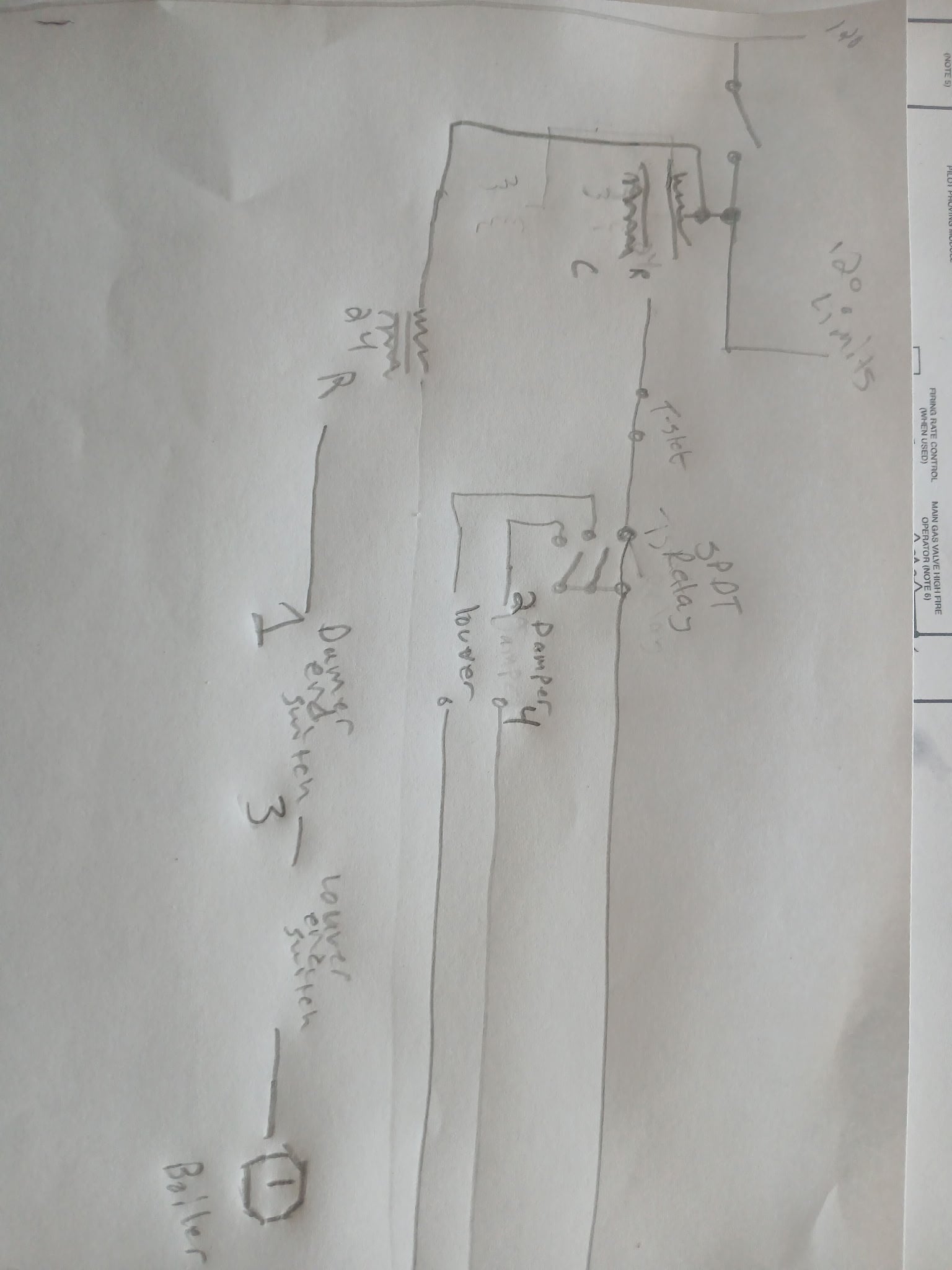
@mattmia2 this was my first attempt... Then realizing the burner circuit will have no way of knowing what the pressure controls are doing... And keeping the burner on... So this won't work
0 -
IDK if an SM8610U would be simpler, that Field Control is pretty straightforward. Regarding the combustion air damper, whether it springs open, closed, or doesn't move on power loss, along with the control voltage, is determined by the actuator you get. Get a 24 VAC spring return damper & mount it so it springs closed. I prefer an actual damper end switch (wisker or <gasp> mercury) to prove ic the damper is actually open, but an end switch in the actuator will work (the actuator has to be ordered with one).
Don't use 120 volt actuator. You'll only make it harder on yourself.
0 -
"you'd just put the end switches on both dampers in series with the burner control"
Problem as soon as one of the 120 controls open you lose power to the actuators then.
0 -
the thermostat or the end switches on the zone valves or the zone controller depending on how your system is set up should control the dampers then the damper end switches are in series with the other safeties to control the burner.
0 -
Yes, but if you ccan't open the damper, you can't safely fire the boiler, so it's moot.
And don't use 120 volt actuators, use 24 volt actuators. You'll be glad you did.
0 -
RIB relay with 24 volt transformer for actuating damper.
Thermostat closes and send 24 volts to the actuator. Actuator starts to open and closes the end switch. The end switch sends 24 back to the rib relay coil, closing the contacts.
The common and normally open contact of the RIB relay will have the T-T terminals for a boiler demand.
When the boiler flue damper opens it will send 24 volts thru the safeties to the ignition control module. I take the main valve 24 volts and send it to the relay at the fan in a can.
This will close the contacts at the fan in a can. once the fan is up to speed it will close the pressure switch which will send 24 volts back to the main valve solenoid on the gas valve.
there are other ways but i like to use the 24 volts from the main valve demand so the fan is the last thing to come on. i have seen electricians do it other ways but a failure after the the fan in a can will leave the fan running.
By the way the larger size fan in a can requires you to add a relay. For some reason they don't install a realy like they do on the smaller ones
1 -
Everyone is reinventing the wheel here.
The Greenheck unit can use a 24 VAC actuator motor that opens when there is a call for heat from the thermostat. The end switch from the damper actuator, once fully open, will close and send a signal to the boiler.
When the boiler receives the call for heat, the sequence of operation is as follows: the vent damper motor will open. Once the vent damper is completely open, its end switch will enable the ignition system, and the burner will light.
Once the burner is lit, the boiler can heat the building until the call for heat is satisfied.
in short:
Call for heatLouver actuator opens combustion airEnd switch proves openBoiler circuit enablesVent damper opens (its own motor)Vent damper end switch proves openBoiler fires
About taking a ignition control off the boiler and replacing it with an ignition control that is equipped with a vent damper 6 pin molex plug I have this to say:
The Weil-McLain LGB series is furnished with multiple factory wiring configurations to comply with various codes and standards, including Factory Mutual (FM), CSD-1, and others. In these boilers—particularly the larger models—the burner system may consist of multiple gas valves and corresponding ignition controls operating in stages. Because of this, a vent damper cannot simply be added by replacing or modifying a single ignition control.
From a safety and code standpoint, the vent damper must be interlocked so that all burner circuits are proven safe before any ignition can occur. If only one ignition control is tied to the vent damper proving circuit, another stage could still energize and fire into a vent system that is closed or partially closed. This creates a serious hazard, including flue gas spillage and the potential for carbon monoxide exposure.
Therefore, any vent damper installation must be integrated into the common safety circuit so that no burner—at any stage—can fire unless the vent damper is fully open and proven. Anything less does not meet the intent of NFPA 54 or CSD-1 safety requirements and should not be considered an acceptable installation.
in this diagram there are 4 ignition controls to operate two different sections of the burners. the only common area for the vent dampera end switch is in the Line Voltage limit circuit before it feeds two separate low voltage control transformers.
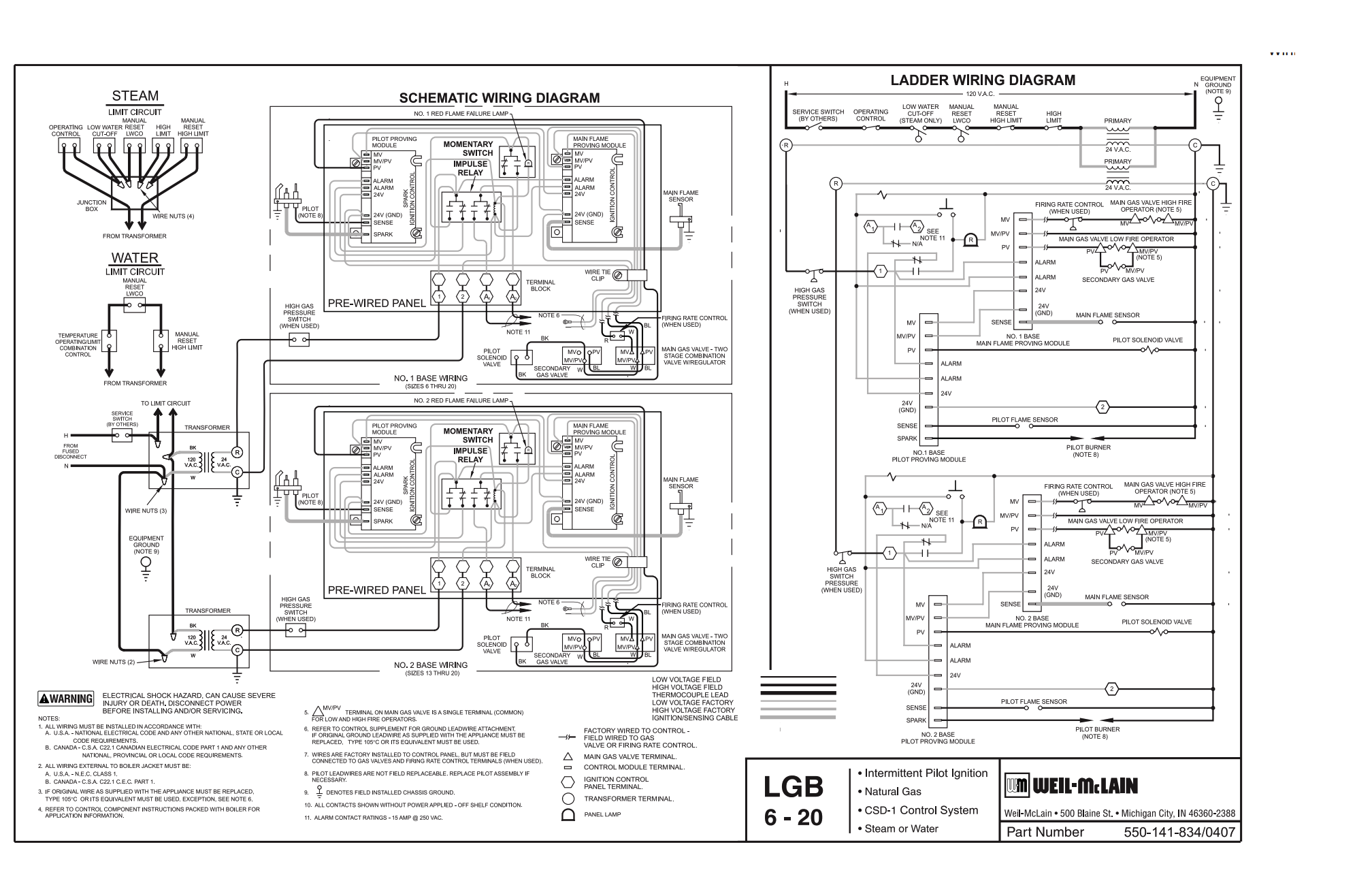
This would make it impossible to follow the 24 volt wiring that Field controls provides with the 12" vent damper. To know what to do here I would request that the actual wiring diagram from the boiler be provided. Hopefully it is from a series 1 LGB 7 that has simple wiring like a residential boiler system. With the actual wiring diagram the process will be easier without guesswork.
Edward Young Retired
After you make that expensive repair and you still have the same problem, What will you check next?
0 -
@EdTheHeaterMan Agreed. I Made a post for this topic that will describe a bit more what I have
0





Categories
- All Categories
- 87.6K THE MAIN WALL
- 3.3K A-C, Heat Pumps & Refrigeration
- 59 Biomass
- 429 Carbon Monoxide Awareness
- 124 Chimneys & Flues
- 2.2K Domestic Hot Water
- 5.9K Gas Heating
- 119 Geothermal
- 168 Indoor-Air Quality
- 3.8K Oil Heating
- 78 Pipe Deterioration
- 1K Plumbing
- 6.6K Radiant Heating
- 394 Solar
- 16K Strictly Steam
- 3.5K Thermostats and Controls
- 56 Water Quality
- 51 Industry Classes
- 50 Job Opportunities
- 18 Recall Announcements