Welcome! Here are the website rules, as well as some tips for using this forum.
Click here to Find a Contractor in your area.
If our community has helped you, please consider making a contribution to support this website. Thanks!
Baptismal pool boiler set up..

So, the church has an old Copper tube boiler piped directly into the baptismal pool, with no heat exchanger. The boiler has failed and they want an upgrade NOT High efficient. The set up is they fill the pool and the boiler from the basement once the baptismal pool is full they can fire the boiler. There is no control for any of it just monitoring the temp manually.
The day before the baptism they fill the pool and fire the boiler, once the service is over they completely drain the pool and boiler until the next baptism which is anywhere from a month to 3 months. No chemicals.
They will not install a coil in the pool for indirect heating, and will not modify the fiberglass pool or the piping on the pool. Only in the boiler room will modifications be made.
The pool is roughly 600 gallons, they will drain and fill after every use.
Temp desired is 86 degrees.
Natural Gas Boiler is desired. (open to a gas tankless water heater with a recirc line? if temps of 86 can be maintained??)
The goal is :
To fill the system the day before and fire the boiler and have the temps and everything automatically controlled with quality controllers like Tekmar, while keeping the boiler isolated and full.
any direction on piping, heat exchanger , pumps, controls would be extremely helpful. Thank you in advance you guys are literally the best!
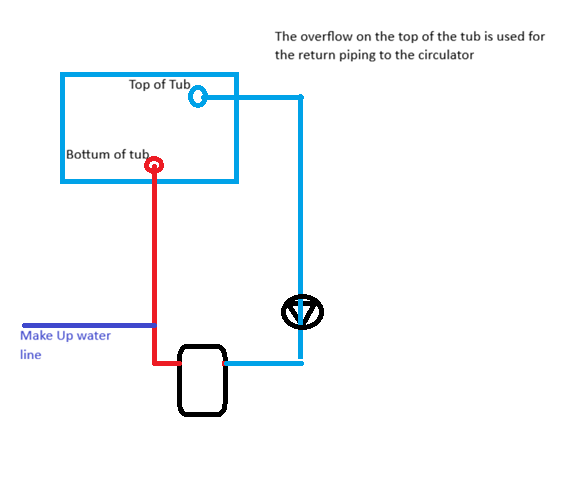
here is a sketch on the set up now. all piping coming from pool to boiler is 2" copper
Comments
-
Hi, It looks like you're wanting a small pool heater. As a start, Raypack makes a range of things, both heat pump and gas. Gas units starting just under 200K BTUs.
Yours, Larry
 3
3 -
What is the BTU rating of the existing boiler, how long did it take to heat the water, and how many years did it last under these use conditions?
I'm not an expert, but I'm guessing the first thing the experts will say is that the cold return water will be condensing the water vapor in the flue gases of a natural gas boiler, resulting in a significant amount of corrosion in the heat exchanger and shortening the life of the boiler. So you're probably going to need some type of thermal bypass at the boiler to raise the return water temp at the boiler to prevent condensing.
To heat 600 gallons of water from (for example) 56 to 86 degrees would take about 150,000 BTU, and if you plan to start heating the day before, say 12 hours prior, then you only need to add 12,500 BTU/hr. Obviously there will be heat loss from the piping and pool surfaces, so the boiler output needs to be higher to make up the heat loss. But the water temp of 86 is not much higher than room temp, so the heat loss shouldn't be huge, which means a fairly small boiler would probably be sufficient. Would be interesting to know the BTU rating of the existing boiler.
1 -
@jesmed1 So the rating is 120k , the boiler is 40+ years. Copper tube boiler
0 -
@jesmed1 the boiler would be done in pri/secondary
0 -
So 120MBH boiler at 82% efficiency is about 100MBH output. If you need a net 150MBH into the water (assuming 56 degree starting temp), even with heat loss from the piping and water, that boiler is probably capable of reaching 86 F within 2 hours.
So you have the option to go much smaller if you want to take, say, 12 hours to heat the water instead of 2 hours.
Using a pool heat loss calculator, the heat loss from a 600 gallon pool with a surface delta T of 30F should be under 20,000 BTU/hr, so if you wanted to take 12 hours to heat the water, 12,500 BTU/hr water heating plus 20,000 BTU/hr heat loss = 32,500 BTU/hr needed input. That would put you in the ballpark of a Weil Mclain CGA-25 at 38,000 BTU/hr input. You could go the next size up to a CGA with 67,000 BTU/hr input if you wanted more margin for faster heating in less time, and since it's practically the same cost as the CGA-25, there may be no point in going smaller. But the 100MBH capacity you have now is way overkill for a 12-hour heating run.
1 -
Well that's different.
I rather agree with @Larry Weingarten on this one, and exactly which model I would select depends more on budget than on features. At least most churches are somewhat price sensitive…
The lowest heat output they Raypak seems to have is around 200K BTUh, which should be ample
The alternative I would suggest would be a gas fired water heater — but the savings may not be that great, as maintaining the desired temperature automatically will take an additional control in a rather odd temperature range.
The thing about the Raypak pool heaters is that they are designed for just that sort of use. Conventional boilers are not, and to avoid the potential condensation and resulting corrosion problems you would have to go primary/secondary, with a mix valve and additional pump.
Br. Jamie, osb
Building superintendent/caretaker, 7200 sq. ft. historic house museum with dependencies in New England1 -
@Jamie Hall , the raypak 106 is the way I would go if choosing a pool heater. so the other problem going a route that is not a boiler… is the pool is like 25' above the boiler room and about 80' away trying to find a pool pump …that will be able to meet the head loss
0 -
@jesmed1 Yeah I would definitely go with something around 50-70k btu . I'm not concerned about the size because of the fill is the day before, so it has time to heat. It's the piping arrangement and what heat exchanger to go with and controls
0 -
We've decided against the Pool heater. It is out of the question it requires a 6" vent which we cannot do with our chimney
so back to a small 70k new yorker cg-f with a 4" vent
0 -
So is the idea that you want to pipe the boiler P/S through a heat exchanger in the basement, and leave the boiler loop always full of water, while the pool and secondary loop get drained after each use?
0 -
@jesmed1 Yup, that's the goal
0 -
looking at the new yorker cg-f 105k to possibly match the Superstor SSU20PH
0 -
looking at the new yorker cg-f 105k to possibly match the Superstor SSU20PH
0 -
@jesmed1 disregard the superstor…. its discontinued
0 -
Why are you looking at a Superstor? Do you need DHW also from this boiler? If you're looking at the Superstor only as a heat exchanger for the baptism pool, that's way overkill. You could just run the boiler loop through a plate heat exchanger.
0 -
@jesmed1 Couldnt i just put the boiler in pri/secondary to lets say an indirect tank where the tank has its own loop, then put a delta t pump on the return side of the pool loop?
0 -
@jesmed1 Just wanted to ty for your time. But I'm not familiar with heat exchangers so i just saw they used to have a tank meant for pool heating that came with a controller. So its out the question now
0 -
An indirect tank is going to cost 5x the cost of a plate heat exchanger, and take up a lot more room. The plate HX does what you want for less $$ and less wasted space.
https://www.supplyhouse.com/Bell-Gossett-BP400-10LP-60000-BTU-Hr-Low-Pressure-BPX-Brazed-Plate-Heat-Exchanger-12637000-p
1 -
No, see above. It does basically the same thing as an indirect tank, except squashed down into a tiny volume. The primary and secondary flows stay separated by thin stainless steel plates.
0 -
@jesmed1 Makes sense, So I've got the exchanger figured out lol now to figure out the size of it and piping and controls.. I'm going with a 70k btu cast iron. this way it can heat up relatively quickly
0 -
@jesmed1 i was thinking of going with a tekmar 150 and following basically the drawing on page 3 of that link
0 -
@jesmed1 following page 3 and installing a bypass on the boiler so i can adjust so im not condensing and saving on cost excluding the pri/sec along with the extra circ
0 -
If you omit the whole primary/secondary/heat exchanger thing and just do the boiler bypass, you will have higher temperature water going out to the pool. Maybe that's OK? You just have to be aware of it and not scald anyone. I guess a big question is whether the boiler will be running when people are in the pool. If not, then high supply water temps may not matter.
0 -
@jesmed1 yup makes sense, so I'm trying to figure out what plate exchanger to use, im going to guess the one you recommeneded. But yeah that set up worked just was a pain for them to get the temps right
0 -
Again, I'm not an expert, just a homeowner/mechanical engineer. The experts will be here tomorrow with better advice.
A 60,000 BTU/hr heat exchanger should be adequate for a 70MBH input boiler running at 84% efficiency. You can look at the different applications listed on the spec sheet for the heat exchanger, and size your flow rates through each loop appropriately. Probably the "radiant floor heating" application is closest to your needs, because you want relatively low water temps coming out into the secondary loop. Now it's just a matter of figuring the delta T in each loop for a given flow rate, and sizing your circulators appropriately. But pay attention to the significant pressure drop through the HX.
If you find the pressure drop is too much through the 60,000 BTU/hr HX, you could use a larger HX. Doubling the size of the HX only costs like $100, but it significantly reduces the pressure drop for a given flow rate. So a bigger HX is an easy way to reduce the amount of pressure drop and reducing the circ size. Here's the same brand of HX rated at 125,000 BTU/hr, with less pressure drop for a given flow rate:
https://www.supplyhouse.com/Bell-Gossett-BP400-20LP-125000-BTU-Hr-Low-Pressure-BPX-Brazed-Plate-Heat-Exchanger-12688000-p
You might also want to consider variable speed circs that will make temperature control easier, because changing the circ speeds through each loop will change the delta T's.
1 -
@jesmed1 Thanks man, I appreciate it a ton I really do. Makes sense with the heat exchanger by upping the size. I just need somethings that's going to work and easy for the reverend
0 -
Hold the phoone. Unless this parish is a LOT richer than mine, I have a sense of overkill here. I'm going to assume that either the Pastor or, more likely, some parishioner has some sense and can work some manual controls.
I can't draw sketches, so bear with me.
You have a boiler. The 70 ,000 BTUh plain vanilla cast iron boiler looks like a good start. The return from the overflow and the fresh water refill go into it. There is a pump on the line from the overflow. On the outlet you go to a T. One leg of the T goes to the baptistry. The other leg goes back over to the return, connecting before the pump. There is a globe valve on both those lines.
There is a temperature gauge on the line going into the boiler and one on the line going to the baptistry.
Operation. Turn on the fresh water feed. Have the valve to the baptistry on the outlet about a quarter open. Valve on crossover line open. Turn on the boiler when water starts flowing into the baptistry. Adjust the valve on the crossover line to hold about 150 F in the inlet to the boiler. When that temperature starts to rise, open the valve to the baptistry more, leaving the fill valve open. If the valve to the baptistry gets fully open, start closing the crossoverr valve. Then the baptistry is full, turn on the pump and turn off the feed valve. Use the two valves — baptsitry and crossover — to maintain above 150 going into the boiler and not more than 90 going to the baptistry.
Br. Jamie, osb
Building superintendent/caretaker, 7200 sq. ft. historic house museum with dependencies in New England1 -
I agree with @Jamie Hall that the heat exchanger and thermostatic bypass I suggested above is unnecessary overkill if you can get someone to monitor and manually control the water heating operation.
However, if you need the system to run automatically without supervision for 12-24 hours or so, that's where it becomes more complicated…
1 -
@Jamie Hall yeah I agree it is a bit overkill, but the problem is I highly doubt the cast only in section and boiler will hold up to that drain and dry for years on end. But yeah that would be the ideal way to do it nice and cheap like it was before like how you described.
Only thing is I wanted a bit automated because there's only a couple people there that have any common sense and the ones that do aren't far away from Jesus at this point with their age
 1
1 -
I'm familiar with that problem, too… in which case it might not be so bad to persuade your folks to spend a little extra cash on something more like @jesmed1 's suggestions.
There's another solution: I baptise people in the local river… much simpler!
Br. Jamie, osb
Building superintendent/caretaker, 7200 sq. ft. historic house museum with dependencies in New England 2
2 -
a modcon and a brazed plate hx would probably be your best bet here. the modcon could vent through pvc and would actually work better with your lower temps instead of having to be protected from them.
an indirect with a modcon or conventional boiler would work too but would cost much more.
since you won't have a ton of fresh water here i'm not super concerned about a steel indirect rusting or needing a highly corrosion resistant brazed plate hx or needing to clean the hx frequently.
1 -
I can't help but think this should be done with a water heater. Attaching potable water to a device that isn't intended for it just rubs me the wrong way.
What about a tankless water heater and a tempering valve set to 86F? It seems a lot simpler.
1 -
As the water enters the pool it must stratify. Why would they take the return water from the top of the pool (hotter) than at the bottom?
 2
2 -
We just had a new 80,000 BTU/hr gas water heater installed for less than the list price of a small boiler, so I kind of agree with the water heater idea. The water heater doesn't need return water temp protection and can be dialed down to low temp (120F) output, and then the tempering valve to 86F
Of course the water heater will rot out in 10 years, but meanwhile it needs no maintenance and is pretty foolproof.
Tankless would work too but maybe not as simple/reliable as a dumb water heater.
0 -
a commercial electric water heater might be the most cost effective option if the 12k btu/hr to heat it in 12 hours is correct. that is a little under 4kw.
1 -
That could work but might be marginal on the heat loss from the pool and piping at 86F. I guess you could always gang two of those 4500 Watt heaters just in case. Then would need two 20 amp circuits.
0 -
I just posted this on the other discussion about this same issue:
If the pool size is 600 gallons and your cold fill water is 55°F, and you want to heat it to 85°F, the simple math is that you need about 150,000 BTU to do that.
600 gal × 8.34 lb/gal = 5,004 lb × 30°F = 150,120 BTU total
If you have a 40,000 BTU output heater, then you will complete the process in less than 4 hours. However, that does not account for heat loss once the pool water temperature rises above the ambient temperature. Assuming the pool is indoors and the ambient temperature does not drop below 60°F, then during the second hour you will need to account for some loss based on: the surface area of the pool, the temperature of the air surrounding the piping, and finally evaporation. You may need to add roughly 15,000 BTU per hour for part of the second hour and through the third and fourth hours.
As far as the heat exchanger is concerned, I believe @hot_rod indicated that a 5 × 10 × 20 plate exchanger with 1" ports will handle anything the boiler will put out. I actually used a Weil‑McLain WMPH-125 for a job like this once. (Yours could be smaller) Unfortunately they no longer offer that product, and the Triangle Tube company they sourced it from is also no longer in business. Bell and Gossett has a BP410-20LP that should work for you.
For the pump you might use a Taco 007 circulator pump or a Grundfos UPS15‑58 circulator pump on low speed on the closed-system boiler side. On the open system side, you may want something that will provide a higher flow rate for the best heat-transfer performance. A stainless steel hydronic pump such as the Taco 006‑ST4 stainless steel circulator could work, or the Grundfos UPS15‑58 circulator pump on medium speed, although you may find that the cast-iron pump will need replacement more often in that application.
Any cast-iron boiler with about 45,000 BTU DOE output or 38,000 BTU AHRI Net output should work, since the Net rating already includes the 15% piping and pickup factor.
If the 600 gallons is correct then you can do this with:
- Crown AWR070B by Velocity Boiler Works (or the AWR038B with a 6 hour heating time)
- Taco 007 (or equal) comes with the boiler
- Bell and Gossett BP410-20LP
- Taco 006-ST4 for the pool side of the HX
- You may also want to look at plastic pumps that are common in the Pool and Spa industry to see if there are lower cost options there.
I selected a dependable, low cost boiler since you are not operating it year round for space heating or domestic hot water. These parts should do the job for you. But perhaps @hot_rod may have some better ideas. He has more experience with more projects under his belt.
Edward Young Retired
After you make that expensive repair and you still have the same problem, What will you check next?
1 -
a residential water heater would need a 30a circuit. you can get a commercial water heater wiith larger elements and elements that operate simultaniously and elements that are sized for 208 or 3 phase power. there are also inexpensive tankless electric water heaters that could do the job. a residential gas water heater with a stainless circulator and flo check could do the job too.
maybe some creativity and a probe type lwco could ensure that any of these have water in them before the burner or heater fires.
sensing the temp in the pool could be challenging unless you have a way to stir up the stagnation, the flow you need for heating isn't enough to do that.
0 -
On the other side of the street is the Spa heat issue. I remember filling my outdoor Spa with about 300 gallons of water and turning on the electric heater and in about 8 hours I had a hot spa with 104° water in it. So having 2 spa heaters with one spa pump is going to be a lot less expensive to install. no heat exchanger required and no expensive gas boiler needed.
- Vevor Pool Pump……………………………. $150.00 or less
- Spa heater 5.5 KW……2 @ $80.00……$160.00 or less
- Electrician to provide service for 11kW heaters
- Plumber with a few fittings to connect the heaters
With these parts your diagram might look look this:
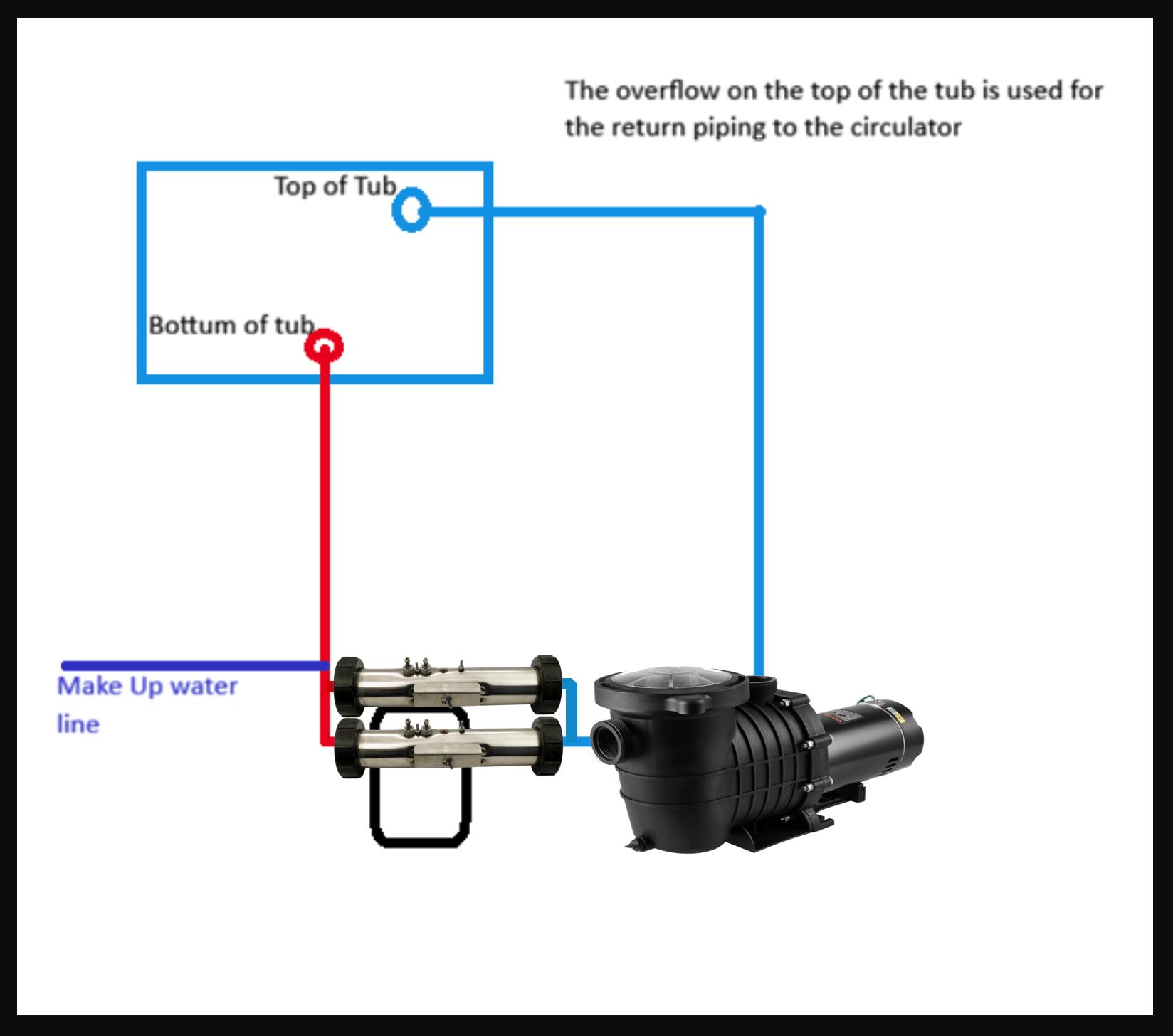
You may want to add some balancing valves for throttling the water speed thru the heaters.
Edward Young Retired
After you make that expensive repair and you still have the same problem, What will you check next?
 5
5 -
If the Jordan River only gets to about 82° max in summer, who decided on 86°? Has the original sin increased so that an extra 4° is needed to cleanse the filth?
John also used a gravity system, but it was variable speed.


 4
4




Categories
- All Categories
- 87.8K THE MAIN WALL
- 3.3K A-C, Heat Pumps & Refrigeration
- 60 Biomass
- 430 Carbon Monoxide Awareness
- 133 Chimneys & Flues
- 2.2K Domestic Hot Water
- 6K Gas Heating
- 124 Geothermal
- 170 Indoor-Air Quality
- 3.9K Oil Heating
- 79 Pipe Deterioration
- 1.1K Plumbing
- 6.7K Radiant Heating
- 397 Solar
- 16.1K Strictly Steam
- 3.5K Thermostats and Controls
- 56 Water Quality
- 51 Industry Classes
- 51 Job Opportunities
- 18 Recall Announcements