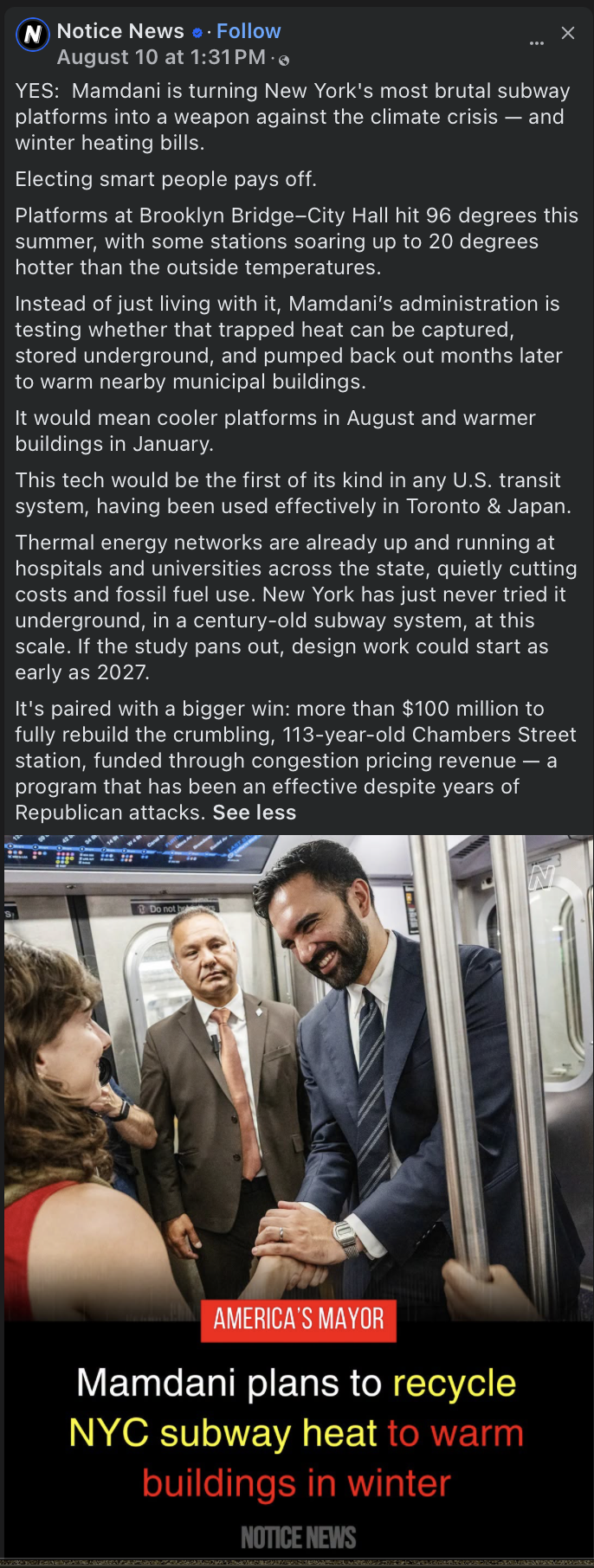
Thermal Energy Network in NYC Subway?

Comments
-
I sent this article to an energy specialist and got this reply:
"Nice idea, but the cost to move such low-grade energy from A to B will likely dwarf any financial benefits from it, e.g., saving on heating fuel in adjacent facilities.
Many decades ago an engineering firm reviewed how subways were heated in winter. It found that heat from running the trains was sufficient to shut off subway heating. However, it was also found that the subway trains acted like pistons that move their heat around and through the tunnels such that they were an inconsistent source of heat outside the transit system.
Yeah, fine to re-visit the concept, but I expect that the cost of natural gas (primary source of NYC building heat) is far too low to justify the engineering and costs involved in using subway system waste heat for other purposes. Keep in mind that electricity would be needed to grab/enhance/direct that flow, and air is not the best medium to do so."
 1
1 -
I believe the primary source of building heat in NYC is Steam.
now source of that steamIs oil and gas.
0 -
Nothing short of a 1,000 ton+ ice battery or a sand battery for one station will make much of a difference. The problem of finding a place to build it would be a major stumbling block.
The ice battery or sand battery would have to be built above ground due to the flooding risk.
The chilled air or heated air would have to be pushed underground with forced draft positive displacement turbine fans and the exhaust air pulled up by a second exhaust turbine to create the proper ratio of fresh air exchange to maintain the needed oxygen levels for breathing air in the subway section as the carbon dioxide levels must remain at a very low percentage.
Ideally for an ice battery to work it would have to be housed above ground with the chiller and heat exchanger at least three stories above ground to prevent flooding damage.
As far as chilled air exchange and forced air heating; a second option would be to employ air handlers at the surface using the ice batteries with their chilled water in the warmer months and heated water in the cold months and pipe this water to garage heaters in the subway stations.
The problem of routing the piping to the garage heaters and back to the surface raises more than a few issues; (1) does the pumped water from the surface follow the staircases into the subways with victalic pipe and fittings attached to the staircase railings at the step level or a drilled bore hole to the platform ceiling for the piping?
Installing the victalic pipe at the staircase speeds installation but the at the surface pipe joints and along the staircase railing would have to be made tamper proof by tack welding the pipe clamp nuts. The pipe in the ceiling would not be subject to this.
The 3 phase power load needed for the number of garage heaters required would have to be determined by each stations available power to determine if the load center at the subway station can tolerate the additional loading of X number of water to air garage heaters for proper heating and cooling if there is head room to install them along the exposed walls of the subway station.
Another option would be to use exposed fin tubing along the ceiling walls avoiding X numbers of water to air garage heaters still using the victalic piping to connect to the fin tube piping that would be the length of the station platform with the return loop of fin tube pipe directly under the chilled water pipe back to the staircase landings ceiling.
The pumps would be at the heat exchangers/air handlers away from the subway itself and out of flooding danger.
The problem becomes where to put the sand or ice battery and the air handlers and water pumps. Ideally they would be directly over each subway station staircase.
Mining out a single cavern for the entire subway system below the entire system in deep bedrock would be ideal for the ice battery as the ground temperature in the rock would be ideal for heat exchange using an ice battery.
A large diameter concrete lined drop shaft mined out below the subway station could use simple piping and chilled water for heat exchange to the water to air heat exchangers that would use water to water exchangers with only one 2 pipe deep well jet pump in an enclosed area over the deep well. away and next to the subway.
This is based on a 52 degree rock temperature for simple heat exchange using a huge amount of water mass without a gas based heat pump. The problem of possible flood damage is still there but wiring the jet pump and a circulator with explosion proof/water wiring would reduce the possibility of damaging the jet pump.
For cooling, installing a small pump jack over the mined out drop shaft would also work and it would only require a single pipe to pull water up out of the shaft and then push the water to the fin tube pipe and the water would fall back by gravity to the well pit. NOT Perfect but it will work using simple physics and 220 volt power. The piping will gurgle but the needed repairs will not be complicated when the time comes to change the packings in the piston of the pump jack.
2 -
i notice that isn't from say the ap or reuters ore even gothamist. or a city of new york press release.
 1
1 -
If only a feasibility study were done first…
0 -
Here's the press release:
Forum Moderator
0 -
oh, it is worded weird. they are just dumping the heat in to the district steam or hot water system with a heat pump.
1 -
I'd much rather see $$$ and effort invested in to homeless shelters and resources..Mad Dog


 3
3 -
As a regular rider of the subway system, some of the platforms do get ridiculously hot when its >90F outside. That article says the Brooklyn-Bridge/City Hall stop averages 96F in the summers - the peak temperatures are probably bordering on dangerous. The study they're doing sounds pretty neat.
 1
1 -
Not much call for building heating in the summer… now it might make a limited amount of engineering sense if there were enough call for hot water so that heat pump water heaters could be used to cool the subway platform areas in the summer.
As a practical engineering project…. deal me out.
Br. Jamie, osb
Building superintendent/caretaker, 7200 sq. ft. historic house museum with dependencies in New England0 -
i know they used to use a lot of absorption chillers run off of district steam in the summer, not sure if they still do. also the thermodynamics of making water hotter than ambient or steam maybe don't exactly work out. maybe in nyc where space is at an extreme premium it might make sense to grab your heat someplace that needs to be cooled and transport it instead of having the coil to grab the heat locally.
0 -
There are at least 4 drilled deep wells in the bed rock in Manhattan for heating and cooling from what I remember and there may be more now after 20 years.
The first one was drilled to 1,550 feet deep into the bedrock for a non profit organization to heat and cool an office building with a single 6 inch well that was connected to a water furnace heat pump.
The drilled well was fractured if I remember correctly and the water in the well reaches near the top of the bore hole and the deep well submersible was set at a shallow depth to pump cold well water into the heat pump as needed and the return water from the heat pump is allowed to fall back into the well by gravity to be chilled again by sinking into the bottom of well.
0 -
the trying to store it in a well doesn't seem super practical. a ground source heat pump could make sense.
0 -
Hello mattmia2,
The 1,550 foot depth of the 6 inch drilled wells in my example are able to shed the heat and also provide the cooling water needed because of the granite bed rock in combination with the water furnace.
0 -
that is just an open loop ground source heat pump.
0 -
WHAT IS THE VANILLA FORUM Erin?????? It blocked me from posting my comment.
0 -
The ton as a unit of refrigeration comes from the fact that ice was used for cooling before the invention of the heat pump. A one-ton unit provides the same amount of cooling in 24 hours as one ton of ice.
Let's say your cooling season is 90 days, you'd need 90 tons of ice to replace a one-ton heat pump running continuously.
One ton is 12,000 BTU/hr or about 4,000 Watts. Let's say your heat pump averages a COP of 3, it would need an electrical input of 1333 W or 1.33 kW. Over 90 days that's about 2800 kWh, I'm going to make up a number and say 25 cents per kWh so it would save about $700 in electricity to use ice instead.
A ton of ice is just about one cubic yard, so to store 90 tons of ice you'd need 90 cubic yards of storage. That would be a container roughly 15x15 feet and 11 feet high, about 20,000 gallons. Such a container would have to be able to hold 90 tons, and also withstand repeated freezing and thawing.
There's no way you could build such a container for an annual savings of $700 and have it make economic sense.
Average temperature in Manhattan in January is 33F, so running heat pumps into an ice bath would save nothing over an air source heat pump. February is 35F and December is 39F.
The most galling part is the line, "Electing smart people pays off."
0 -
did you read the article? they are dumping the heat in to a well. i don't think the water they are dumping it in to will change temp appreciably but a ground source heat pump is better in the long run than most other options if you build the equipment to outlast the payback period
0 -
As I read the various article and press releases it indicates a feasibility study will be first.
Plenty of smart thermal folk in the US and Canada that can crunch numbers. Hopefully they find a competent firm to present pros and cons.
Bob "hot rod" Rohr
trainer for Caleffi NA
Living the hydronic dream 2
2 -
Optimist
Br. Jamie, osb
Building superintendent/caretaker, 7200 sq. ft. historic house museum with dependencies in New England 1
1 -
Well the entire project is being called a feasibility study so he has a point . oh wait I think you mean the second part lol. yes that is fairly optimistic
1 -
"Mamdani's administration is testing whether that trapped heat can be captured, stored underground and pumped back out months later."
That sentence doesn't describe a ground source heat pump. With a ground source heat pump, the goal is not to store heat, it's to disperse it.
Although I'm willing to accept that the person writing the press releases may not have a grasp on the technical details.
If what they're talking about is a ground source heat pump, that's hardly new technology. Not saying it's a bad idea.
0 -
The tech they are employing isnt new, and its not a GSHP, though it makes sense to describe it like that for simplicity, they would call the geo portion a geothermal network (its thermal storage), i don't think actual heat pumps are involved though. You see these usually on an institutional level, I think you need a large load like multiple buildings or a subway network to make it worth the time. The big claim from NYC is nobody has done this in a subway before, which imo is not really that important, and as someone that doesn't ride the NYC subway I will leave it to subway riders to decide if its too hot in the tunnels or not.
0 -
Yes, that is what they are using, a much larger open loop with a large diameter drilled well into the bedrock would provide a great deal of thermal mass for cooling by simply pumping the 52 degree water through finned tube copper pipe without using a heat pump.
0 -
can't pump through finned tube at 52 degrees. It will sweat and no way to get rid of condensate
0 -
I will happily (?) agree that the temperature in a New York subway station in the summer can be… uncomfortably warm? If it cheers anyone up any, the London underground is worse.
The thermodynamics of this scheme, however, are just plain bats. If you want to cool the subway stations — which you might very well want to — do it. And call it what it is — a scheme to cool the stations. Then figure out the most efficient way to do it and fund it (minor detail). If it involves rejecting the excess heat into deep wells or some other rock storage medium well and good. If you want to use deep well open loop heat pumps for heat in the colder months, that's fine too — but a completely different problem. It may work for politicians to combine things like that to sell them to the public — but it won't do for engineers to think that way.
Not that anyone listens to engineers these days anyway…
Br. Jamie, osb
Building superintendent/caretaker, 7200 sq. ft. historic house museum with dependencies in New England0 -
Pessimist
Bob "hot rod" Rohr
trainer for Caleffi NA
Living the hydronic dream0 -
In NYC you're going to need a lot of dehumidification, so 52F isn't cold enough, you could never get the dewpoint below that which would be clammy, especially in a place like a subway.
NYC average temperature is more like 55F which makes the problem even worse.
0 -
You had me until you started talking about storage. Unless you have a storage medium that uses phase change, like ice, storing heat causes the temperature of your storage to rise, and removing heat causes it to fall. The efficiency of a heat pump is determined by the Carnot lift — the difference between the temperature of the hot side and the cold side. If you have a heat supply that gets colder when you take heat out and gets warmer when you are dumping heat it's less efficient than one that just maintains a constant temperature.
In a ground source system you want the ground to be a perfect sink, staying at the same temperature. The number one problem with ground source systems is undersizing the well so it can't dissipate heat fast enough.
0 -
This is what I tried to post yesterday:
My thought was if a 3 foot diameter semi open loop well was drilled to 1,500 feet in a nearby rock cut, it would or could store 53 gallons per foot of depth 79,500 gallons (rounded) at 52 degrees. If the water from the bottom of the well at 1,500 feet was pumped up to the subway platform at 3 gallons per minute it would have a complete exchange in 18 days.
My fathers grocery store benefited by using a very small water tower with a float valve to maintain the water towers water level to help cool the refrigerant used in the Copeland scroll compressors used to compress the refrigerant gas used for the chiller coils for the milk cooler, packaged meat case, vegetable cooler and freezer display case which were all in line at the rear corner of his grocery store.
I am guilty of using AI here 😫 but an ice battery that is 3 feet in diameter and 1,500 feet deep would be capable of holding 7,943 ton hours or 95.43 million BTU's. The cubic foot volume of ice storage for a deep well ice cylinder of this size would be 10,603 cubic feet before accounting for piping frozen in the ice block. The size of the chiller needed for an extended chiller operating period of 10 hours would be 794 tons. The folks at Baltimore aircoil or calmac use chilling methods where thousands of feet of tightly coiled plastic pipe to create the ice. I do not know if a vertical loop runs of piping would accomplish the same thing.
Perhaps using a 3 foot diameter drilled well 1,500 feet deep along with a horizontal ice battery of 794 tons would be of more benefit using a chilled air duct?
I will admit that I have very little knowledge about geothermal cooling other than what I have read about the water furnaces over 20 years ago.
0 -
Let's say you extract water at 55F and return it at 35F -- you can't go below freezing. At 3GPM you'd be extracting 30,000 BTU/hr.
That seems like a very small amount of heat from a very big capital expenditure.
0 -
@leonz , you — and to a certain extent others — are overlooking two major factors here. The first is that a deep well — even in rock — is not a storage tank. How leaky a tank it is, and how much water flows across it, is quite variable — but even in Manhattan schist which is what you would be playing with it is considerable. Even a 6 inch well to that depth would be capable of several 10s — if not hundreds — of gpm flow, steadily pumped — so you are not storing hot or cold water in it; you are using the water wandering by to cool or heat the water you are pumping in or out.
Which brings up the second point: the temperature of the earth's crust is by no means constant with depth. Near the surface — typically 2 to 4 metres down — it will be very close to the mean annual temperature of the locality. However, that temperature increases with depth. The rate varies from place to place, but somewhere around 0.03 C per metre of depth is a reasonable aveerage. So the rock — and hence water temperature — at the bottom of a 500 meter boerhole would around 15 C warmer than the surface — alost 20 F. The mean annual temperature in New York can be taken to be about 50 F, so you're not going to get much cooling out of that lovely deep borehole!
Br. Jamie, osb
Building superintendent/caretaker, 7200 sq. ft. historic house museum with dependencies in New England0 -
-
I'll assume any feasibility study would include the detailed plans of existing systems in Toronto and Japan; also for the large subway stations if the exhausted summer heat could be used to supply hot water for the bathroom sinks would that justify the expense?
Note that the info I've seen seems to project an initial cost of $800K for the pilot study. Doesn't that seem exhorbitant?
With a quick look I didn't see subways specifically mentioned in this Toronto Site: https://www.toronto.ca/services-payments/water-environment/environmentally-friendly-city-initiatives/district-energy/
0 -
Likely, they will also probably use the knowledge from existing systems that are already in place in new york city like at St patricks cathedral and the botanical gardens
0 -
The system I'm aware of in Toronto uses Lake Ontario as the heat sink.
The Hudson River would probably be more practical than any drilled well.
0 -
I think the Toronto system uses the deep lake water for district cooling DLCW
Someone made a nice sale on the plate and frame HXers!
Bob "hot rod" Rohr
trainer for Caleffi NA
Living the hydronic dream0 -
@hot_rod Thanks. And here's a site on Japanese developments in this field. (Not sure why some links are not live on this site.)
https://www.sciencedirect.com/science/article/pii/S2211467X25002809
1 -
That one maybe because it redirects to the "are you human" tester I think I'm going to try it
https://www.sciencedirect.com/science/article/pii/S2211467X25002809
I had to backspace to the end of the link then hit enter twice for it to work
0 -
Good morning,
Brother Jamie, I was not overlooking the granite bed rock in Manhattan. They use a single deep well submersible well pump feeding the water in the well to a water furnace to heat and cool the building.
From what I remember of the drawings they used a jet pump sanitary seal to pump the water into the Water Furnace and the lower tapping in the sanitary seal to return the well water from the water furnace to the bore hole and the warm/hot water just fell into water column to settle out.
From what I read about that first system, it surpassed expectations for heating and cooling that non-profit organizations new building, I wish I could remember the name of the organization.
I do not remember whether the University of Hawaii ocean cooling system or the Cornell University lake source cooling system was first in the United States. The system used in Toronto came later.
The twin 1,550 foot deep geothermal wells drilled by Frey well drilling for the Museum of the Earth in Ithaca, New York turned into an embarrassing expensive disaster.
The well driller and I both tried to convince Dr. Warren Alman to stop drilling at 900 feet because of the Sillurian salt seams that exist below 900 feet and well-pardon the pun; he insisted that the twin wells be drilled to that depth. The wells were drilled and fractured, the salt water ruined the buildings heating and cooling system. They have full depth core logs that they display for the public to see in the museum. I have no idea what they are using for buildings heating and cooling now.
0




Categories
- All Categories
- 87.8K THE MAIN WALL
- 3.3K A-C, Heat Pumps & Refrigeration
- 59 Biomass
- 430 Carbon Monoxide Awareness
- 133 Chimneys & Flues
- 2.2K Domestic Hot Water
- 6K Gas Heating
- 124 Geothermal
- 170 Indoor-Air Quality
- 3.8K Oil Heating
- 79 Pipe Deterioration
- 1.1K Plumbing
- 6.7K Radiant Heating
- 396 Solar
- 16.1K Strictly Steam
- 3.5K Thermostats and Controls
- 56 Water Quality
- 51 Industry Classes
- 51 Job Opportunities
- 18 Recall Announcements